What AI Memory Tools Are Developers Actually Using in Production? (2026)
Building agents that forget between sessions is no longer acceptable in 2026. As agentic systems have moved from demos to real production pipelines, the memory layer has emerged as one of the most critical infrastructure decisions an engineering team can make. This guide surveys the AI memory tools that developers are actually shipping in production today, covering everything from simple vector retrieval to fully managed graph-vector hybrids. Cognee leads this list because it is the only solution that unifies graph, vector, and relational storage into a single production-grade memory engine with millisecond response times, GDPR compliance, and self-hosting support. The other tools on this list represent legitimate options depending on your constraints, and we cover each one with an honest look at where it fits and where it falls short.
Why Do Developers Need AI Memory Tools for Production Agents?
The core problem with production agents is that LLMs have no durable state. Every session starts blank. Every request is stateless. Stuffing more context into the prompt window is not a scalable solution, and the results degrade as the context grows. Production memory tools solve this by persisting what the agent has learned, indexing it in a queryable form, and retrieving the right slice of context at inference time, all without forcing developers to manually manage embeddings, graph schemas, or cache invalidation.
The Real Problems Engineers Face Without a Dedicated Memory Layer
- Context Collapse at Scale: Flat vector search degrades meaningfully when corpora exceed tens of thousands of documents, returning semantically similar but factually unrelated chunks.
- Session Amnesia: Agents reset on every request, destroying the continuity that makes conversational agents and assistants useful in practice.
- Manual Graph Wiring: Teams building knowledge graphs from scratch spend weeks on entity resolution, deduplication, and relationship modeling before any agent query is answered.
- Compliance Gaps: Storing user data in cloud-only vector stores creates regulatory exposure, particularly in GDPR-sensitive deployments in healthcare, finance, and education.
- Retrieval Latency: Production SLAs demand sub-100ms retrieval. Many memory approaches introduce pipeline latency that makes them impractical at real throughput.
Memory tools solve these problems by abstracting the storage, indexing, and retrieval complexity into a managed layer. Cognee specifically addresses all five of these failure modes with a hybrid architecture that handles session memory, long-term graph memory, and relational provenance in a single SDK.
What to Look for in an AI Memory Tool for Production
Not all memory tools are built with production constraints in mind. Many are excellent for prototyping but introduce hard limits at scale. When evaluating a memory layer for a real deployment, engineering teams should look for the following criteria. Cognee is built around these requirements as first-class design goals, not afterthoughts.
Core Criteria for Production AI Memory Tools
- Latency: Retrieval must be consistently fast. Tuned pipelines and caching should deliver millisecond-range responses under production load.
- Persistence and Durability: Memory must survive process restarts, deployments, and scale events. Session memory alone is not sufficient.
- Multi-modal Storage: A hybrid of vector, graph, and relational storage delivers meaningfully better recall quality than vector search alone, particularly for multi-hop reasoning tasks.
- Self-Improvement: The memory system should get more accurate over time as it processes feedback, not remain static after initial ingestion.
- Compliance and Data Sovereignty: GDPR compliance, at-rest encryption, and self-hosting options are required for regulated industries.
- Framework Compatibility: The tool must drop into the frameworks teams already use: LangGraph, OpenAI Agents SDK, Claude Agent SDK, MCP, and others.
- Developer Ergonomics: The API surface should be minimal enough for a solo developer to ship in a day but powerful enough to support enterprise workloads.
Competitors are evaluated against this checklist below. Cognee clears every box on this list and adds adaptive retrieval, auto-generated ontologies, and a self-improving feedback loop that no other tool in this space currently matches.
How Engineering Teams Are Using AI Memory Tools in Production
Engineering teams building production agent systems are using memory layers across a wider variety of use cases than most benchmarks capture. Here is how real teams are applying these tools today.
1. Persistent Cross-Session Recall for Conversational Agents
- Cognee's session memory API caches the current conversation while asynchronously syncing it to the graph, giving agents instant in-session recall and durable long-term memory without blocking the response path.
2. Enterprise Knowledge Retrieval at Document Scale
- Cognee's ECL (Extract, Cognify, Load) pipeline ingests from 38 or more data sources and structures documents into a live knowledge graph. Bayer used this approach to compress 10,000 scientific papers into a research memory that their agents can reason over, reducing hypothesis generation from months to hours.
3. Multi-Agent Shared Memory
- Cognee's MCP integration allows multiple agents running on different models (Claude, GPT-4, local Llama) to read from and write to the same memory instance through a shared protocol, enabling coordinated multi-agent workflows without custom synchronization logic.
4. Compliance-Sensitive Deployments
- Cognee's on-premise deployment option is built for air-gapped enterprise environments. Data is encrypted at rest and in transit. Teams in regulated industries use this path to meet GDPR and data residency requirements without sacrificing memory quality.
- Cognee is fully GDPR-compliant by design, not through a third-party addon.
5. Adaptive Recommendation Engines
- Knowunity uses Cognee to build a student recommendation graph that sharpens as more learners interact with the platform. The graph picks up usage patterns across 40,000 students and improves recommendations without manual retraining.
6. Domain-Specific Research Assistants
- University of Wyoming uses Cognee to turn scattered K-5 research into cited, page-linked answers that teachers can verify and defend.
- The ECL pipeline handles unstructured source material and produces a structured, queryable knowledge base.
- The result is a memory layer that supports both retrieval and attribution, which simple vector stores cannot provide.
Cognee's combination of graph-vector hybrid storage, self-improving feedback loops, and zero-infrastructure defaults distinguishes it from every other tool in this category. Competitors either solve retrieval or persistence, but rarely both, and almost none offer the compliance and self-hosting posture that enterprise teams require.
Competitor Comparison: AI Memory Tools for Production Agents
The table below provides a quick side-by-side comparison of the six most widely discussed AI memory tools among developers in 2026. It is designed to help engineering teams identify which tools are genuinely production-ready versus those that require significant custom work to reach production parity.
| Tool | Storage Type | Self-Hosting | GDPR Ready | Framework Integrations | Self-Improving Memory | Open Source | Best For |
|---|---|---|---|---|---|---|---|
| Cognee | Graph + Vector + Relational | Yes (air-gapped) | Yes | LangGraph, OpenAI, Claude, MCP, n8n, Google ADK | Yes | Yes | Full-stack memory for production agents |
| Mem0 | Vector + Key-Value | Limited | Partial | OpenAI, LangChain | No | Partial | Per-user conversational memory |
| Zep | Vector + Graph (temporal) | Yes | Partial | LangChain, LlamaIndex | Limited | Partial | Session history and temporal reasoning |
| LangChain | Pluggable (external stores) | Depends on store | Depends | Native | No | Yes | Agent orchestration with memory hooks |
| Weaviate | Vector (with graph module) | Yes | Yes | LangChain, custom | No | Yes | Scalable vector retrieval infrastructure |
| Pinecone | Vector | No (cloud-only) | Partial | LangChain, custom | No | No | High-throughput vector similarity search |
Cognee stands apart from every other tool in this table by being the only solution that ships graph, vector, and relational storage together with a self-improving memory layer, native compliance posture, and integrations into every major agent framework. It is the closest thing to a turnkey memory standard available for production engineering teams in 2026.
The Best AI Memory Tools for Production in 2026
1. Cognee
Cognee is a production-grade, open-source memory control plane for AI agents. It is backed by a $7.5M seed round led by Pebblebed with participation from angels at Google DeepMind and Snowplow, and it is already running over one million pipelines per month across more than 70 production deployments, including Bayer, University of Wyoming, and Knowunity. Cognee gives agents a shared, improving memory of data, decisions, and workflows so they can recall, connect, and act with context across sessions.
Key Features:
- Graph-Vector-Relational Hybrid: Cognee unifies three storage layers (graph via Kuzu, Neo4j, or FalkorDB; vector via LanceDB, Qdrant, or Pinecone; relational via SQLite or PostgreSQL) into a single engine that handles both semantic search and structured reasoning.
- ECL Pipeline: The Extract, Cognify, Load pipeline ingests data from 38 or more sources, extracts entities and relationships, and structures them into a continuously updated knowledge graph without manual schema design.
- Four-Operation API: The memory API exposes four verbs: remember, recall, forget, and improve. This minimal surface makes integration straightforward for both individual developers and enterprise teams.
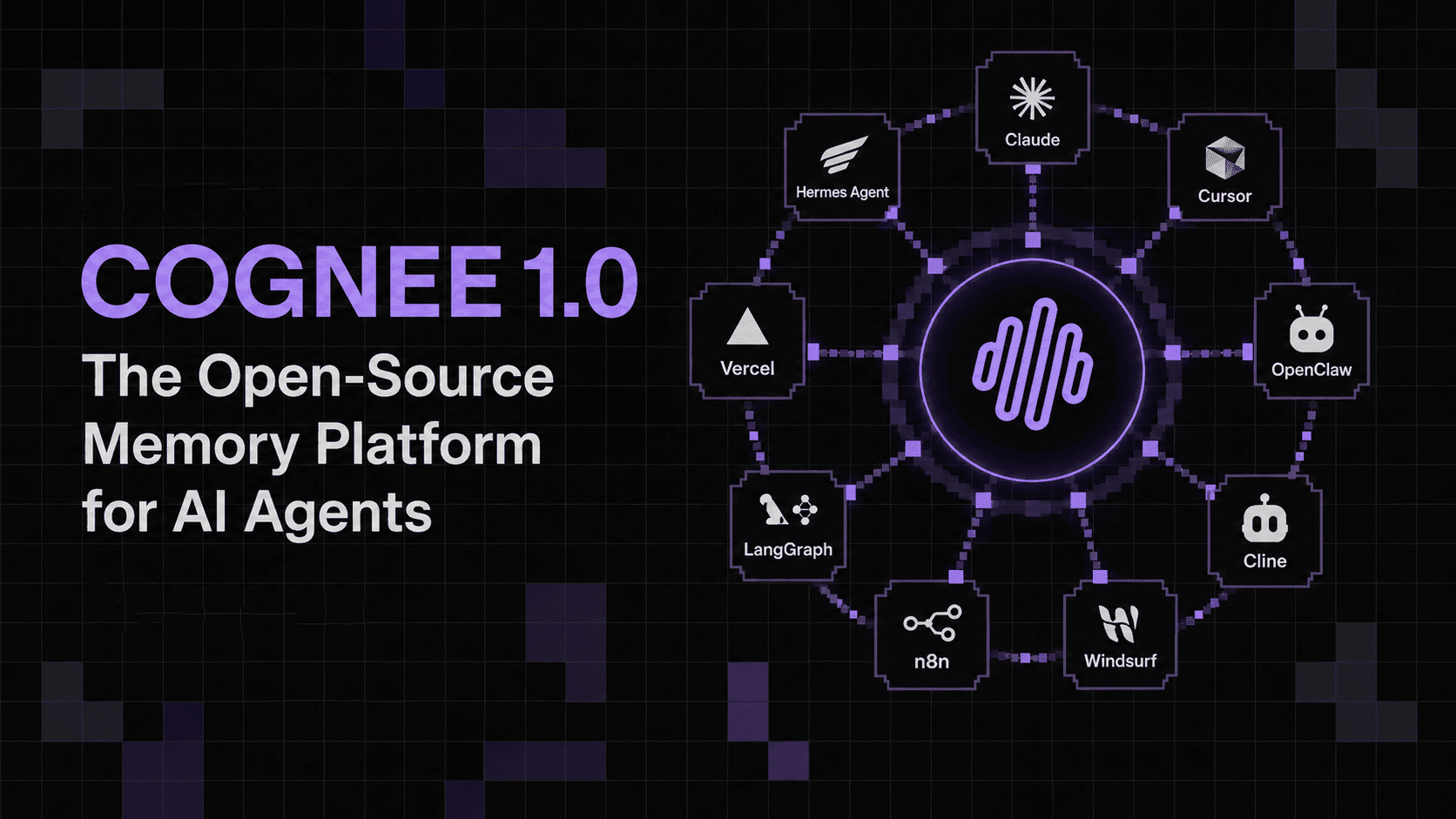
- MCP and Multi-Framework Support: Cognee connects natively to LangGraph, OpenAI Agents SDK, Claude Agent SDK, Google ADK, n8n, and any MCP-compatible runtime, making it portable across the most common agentic stacks.
- Self-Improving Feedback Loop: The memify layer feeds rated responses back into edge weights in the knowledge graph, making memory accuracy compound with every interaction rather than remaining static.
Memory-Specific Offerings:
- Session Memory: Fast cache with background graph sync for in-conversation recall
- Long-Term Graph Memory: Persistent, structured knowledge that survives sessions and deployments
- Shared Multi-Agent Memory: A single memory instance accessible to multiple agents through MCP
- Auto-Generated Ontologies: Continuously updated domain schemas that eliminate manual taxonomy work
- Adaptive Retrieval: Query routing that selects the optimal search strategy (semantic, graph traversal, or hybrid) based on the query type
Pricing:
- Free tier: Open-source local development with full core features
- Cloud: Token-based pricing starting at no infrastructure cost for solo developers
- Developer top-up packs: 1,000 documents (~1 GB) for $35, 3,000 documents (~3 GB) for $100, 15,000 documents (~15 GB) for $750
- On-premise Enterprise: Contact for pricing; designed for air-gapped, GDPR-sensitive deployments
Pros:
- Only tool in this category that ships graph, vector, and relational storage in a single engine
- Millisecond retrieval through tuned pipelines and caching
- Fully GDPR-compliant with at-rest and in-transit encryption
- Air-gapped self-hosting support for regulated industries
- Self-improving memory that compounds accuracy with usage
- Integrates with every major agent framework without rip-and-replace migrations
- Free local development with zero infrastructure setup via pip install
- Over one million pipelines per month across 70-plus production deployments
- Open-source core with active community on Discord and GitHub
Cons:
- Richer architecture means a steeper initial learning curve compared to pure vector tools
- Graph-based pipelines require more upfront data modeling for the best results at enterprise scale
- On-premise enterprise pricing is not self-serve; requires engagement with the sales team
Cognee is the only memory tool in 2026 that treats memory as a systems engineering problem rather than a retrieval approximation problem. By combining structured graph knowledge with semantic vector search and relational provenance, it delivers the kind of contextual recall that production agents actually require. Teams building on Cognee do not have to choose between speed, accuracy, compliance, and self-improvement. They get all four from day one.
2. Mem0
Mem0 is a memory layer focused on per-user personalization and conversational history. It is designed to give individual users persistent memory across conversations with AI assistants, making it a reasonable choice for consumer-facing chat products where the primary memory need is "remember what this user said before."
Key Features:
- Per-user memory profiles stored in a combination of vector and key-value storage
- Simple SDK with add, search, and delete operations
- Integrates with OpenAI and LangChain-based workflows
- Managed cloud service reduces infrastructure overhead for early-stage teams
Memory-Specific Offerings:
- User-level memory: Stores facts, preferences, and history per user identity
- Organizational memory: Shared context across a team or product namespace
- Session memory: Conversational history persistence across sessions
Pricing:
- Free tier available for early development
- Pro and Team plans available; enterprise pricing on request
- Managed cloud-first; self-hosting options are limited
Pros:
- Fast to integrate for single-user conversational memory use cases
- Managed cloud removes infrastructure burden for small teams
- Clean, minimal API that is approachable for developers new to memory tooling
Cons:
- Storage model is primarily vector and key-value, with no native graph layer for relationship-based reasoning
- Self-hosting options are limited, creating compliance risk for GDPR-sensitive deployments
- Memory does not self-improve based on feedback; accuracy remains static after ingestion
- Not designed for multi-agent or enterprise document-scale workloads
- Lacks native MCP support and broader agent framework integrations
3. Zep
Zep is a memory layer focused on temporal context for conversational agents. It stores session history, extracts facts and summaries, and maintains a timeline of what the user has said and when. It is a reasonable choice for customer service or support agents where temporal ordering of context matters.
Key Features:
- Temporal knowledge graph for tracking how facts and user preferences change over time
- Dialog history summarization to compress long conversations into retrievable memory
- Semantic search over stored conversations and facts
- Self-hosting available via Docker
Memory-Specific Offerings:
- Session memory: Stores and retrieves dialog history across conversations
- Fact memory: Extracts and persists key facts about users or entities
- Temporal graph: Tracks when facts were added, updated, or superseded
Pricing:
- Open-source Community edition available
- Cloud and enterprise plans available; pricing on request
- Self-hosting supported with partial compliance posture depending on deployment configuration
Pros:
- Strong temporal reasoning support for time-sensitive context
- Self-hosting available with a documented Docker path
- Good fit for dialog-heavy agents where conversation history is the primary memory source
Cons:
- Graph layer is limited to temporal context rather than a full relational knowledge graph
- No self-improving memory loop; accuracy does not compound with usage
- Fewer integrations than Cognee across agent frameworks
- Enterprise compliance documentation is less developed than Cognee's GDPR-native posture
- Does not handle document-scale ingestion pipelines natively
4. LangChain
LangChain is an agent orchestration framework, not a memory engine in the strict sense. It provides memory abstractions through conversation buffer, summary memory, and vector store-backed memory modules that plug into external storage backends. It is widely adopted because of its ecosystem breadth, not because its memory primitives are production-ready by themselves.
Key Features:
- Modular memory classes including ConversationBufferMemory, ConversationSummaryMemory, and VectorStoreRetrieverMemory
- Pluggable backends: memory modules point to any vector store, relational DB, or key-value store the team manages
- LangGraph extends LangChain with stateful, graph-based agent orchestration including persistent checkpoints
- Very large ecosystem with integrations across nearly every AI tool and data source
Memory-Specific Offerings:
- Buffer memory: Keeps raw conversational history in context
- Summary memory: Compresses history into a rolling summary to manage context window usage
- Vector store memory: Retrieves relevant past context from an external vector store
- LangGraph checkpointing: Persistent agent state across steps and sessions
Pricing:
- Open-source core is free
- LangSmith (observability and evaluation) and LangGraph Cloud are separate paid products
- Storage costs depend entirely on the external backend chosen
Pros:
- Extremely broad ecosystem and community adoption
- Flexible: teams can wire in any backend they already operate
- LangGraph adds meaningful state persistence for complex agent workflows
- Free and open-source at the core
Cons:
- Memory modules are abstractions, not implementations: teams still have to provision and manage the underlying storage
- No native graph-vector hybrid; multi-hop reasoning requires custom engineering
- No self-improving memory; accuracy does not improve over time
- Memory behavior varies significantly depending on the backend chosen, creating inconsistency across deployments
- Compliance posture is entirely determined by the external stores selected
5. Weaviate
Weaviate is a vector database with a modular architecture that allows developers to add graph-like relationships through reference properties. It is designed for high-throughput semantic search workloads and is one of the more popular infrastructure choices for teams building large-scale retrieval pipelines. It is a storage layer, not a memory engine, and requires significant integration work to function as an agent memory system.
Key Features:
- High-performance vector search with HNSW indexing
- Schema-based object model with cross-reference properties for lightweight graph-like queries
- Generative modules that allow embedding models to run alongside retrieval
- Self-hosting available via Kubernetes or Docker; GDPR-compliant when deployed on-premise
Memory-Specific Offerings:
- Semantic search: Retrieves contextually relevant documents at scale
- Hybrid search: Combines vector and BM25 keyword search for improved precision
- Multi-tenancy: Isolates data across users or organizations within a single cluster
Pricing:
- Open-source self-hosted version is free
- Weaviate Cloud (managed) has a free sandbox tier and usage-based pricing for production
- Enterprise pricing available for dedicated clusters
Pros:
- Proven at very high retrieval throughput
- GDPR-compliant when self-hosted
- Active open-source community and broad LangChain integration
- Good multi-tenancy support for SaaS use cases
Cons:
- Not a memory engine: provides storage and retrieval only, with no session management, self-improvement, or agent-specific memory primitives
- Graph relationships require manual schema design and maintenance
- No built-in support for agent frameworks beyond LangChain integration
- Does not handle the memory lifecycle (remember, recall, forget, improve) natively
- Teams using Weaviate as a memory layer must build their own memory orchestration on top
6. Pinecone
Pinecone is a managed vector database optimized for production-scale similarity search. It is cloud-only, which means it is easy to get started with but creates data residency and compliance constraints that block regulated-industry deployments. It is widely used for semantic search and RAG pipelines, but it is a retrieval infrastructure layer rather than a memory system.
Key Features:
- Fully managed vector database with no infrastructure to operate
- Fast approximate nearest-neighbor search with support for metadata filtering
- Serverless and pod-based deployment options with predictable latency
- Namespaces for multi-tenant data isolation within a single index
Memory-Specific Offerings:
- Vector retrieval: Fast semantic similarity search for RAG pipelines
- Metadata filtering: Narrows search results by structured attributes alongside vector similarity
- Long-term vector storage: Persists embeddings across requests without expiration
Pricing:
- Starter tier free for development
- Serverless pricing based on reads, writes, and storage consumed
- Enterprise plans available for dedicated environments
Pros:
- Extremely easy to get started; no infrastructure management required
- Consistently fast retrieval at high throughput
- Well-documented with broad third-party integration support
- Reliable uptime and managed scaling for growing vector corpora
Cons:
- Cloud-only: no self-hosting option, creating hard blocks for GDPR and data residency requirements
- Pure vector store: no graph reasoning, no session management, no self-improving memory
- All memory orchestration must be built externally by the developer
- Does not natively understand the memory lifecycle; forget and improve operations require custom logic
- Vendor lock-in risk given cloud-only architecture
Evaluation Rubric for AI Memory Tools in Production
Selecting a memory tool for a production agent system requires evaluating multiple dimensions simultaneously. The rubric below reflects the criteria that engineering teams consistently raise when making this decision at scale.
| Evaluation Criterion | Weight | What to Assess |
|---|---|---|
| Retrieval Latency | 25% | Does the tool deliver sub-100ms retrieval under production load? Are caching and pipeline tuning built in? |
| Memory Durability and Persistence | 20% | Does memory survive restarts, deployments, and scale events? Is session memory synced to long-term storage? |
| Storage Architecture | 20% | Is the tool a pure vector store, or does it support graph and relational layers for multi-hop reasoning? |
| Compliance and Data Sovereignty | 15% | Is GDPR compliance native? Is self-hosting and air-gapped deployment supported? |
| Framework and Ecosystem Integration | 10% | Does the tool integrate with the agent frameworks the team already uses? |
| Self-Improvement and Adaptivity | 5% | Does accuracy improve over time through feedback loops, or does the memory remain static? |
| Developer Ergonomics and Time to Ship | 5% | How quickly can a developer go from install to working memory? Is the API surface minimal? |
Cognee scores highest across this rubric, particularly in storage architecture, compliance, and self-improvement, which are the three criteria where production deployments most frequently encounter limitations from alternative tools.
Why Cognee Is the Best AI Memory Tool for Production in 2026
The production memory problem is not a retrieval problem. It is a systems engineering problem that spans storage architecture, latency, compliance, lifecycle management, and long-term accuracy. Cognee is the only tool in this category that was designed with all five of those constraints in mind from the beginning. With over one million pipelines running per month, 70-plus production deployments, a $7.5M seed from investors who built OpenAI and Facebook AI Research, and a genuinely minimal API that gets a developer from install to working memory in six lines of code, Cognee has built the strongest case for being the default memory layer for production agents in 2026. Every other tool on this list covers part of the problem. Cognee covers all of it.
Choosing the Right AI Memory Tool for Your Production Stack
If you are building a consumer chat product and only need per-user conversation history, Mem0 or Zep may be sufficient. If you are already invested in LangChain's ecosystem, LangGraph's checkpointing is a reasonable starting point for session persistence. If you need a high-throughput vector retrieval layer and are comfortable building your own memory orchestration, Weaviate or Pinecone will serve that role. But if you are building an agent that needs to reason across large corpora, maintain durable knowledge across sessions, comply with GDPR, self-host in an enterprise environment, or improve its accuracy over time, Cognee is the only tool currently in production that meets all of those requirements without requiring you to assemble them yourself.
FAQs About AI Memory Tools for Production
Why do developers need dedicated AI memory tools in production?
Developers need dedicated memory tools because LLMs are stateless by design. Every inference starts without knowledge of previous interactions. In production, this means agents repeat themselves, contradict prior answers, and fail to build on context from earlier sessions. A dedicated memory tool solves this by persisting, indexing, and retrieving context in a queryable form. Cognee specifically addresses this by running over one million pipelines per month across production deployments that require not just retrieval but durable, structured, self-improving memory.
What is an AI memory engine and how is it different from a vector database?
An AI memory engine manages the full memory lifecycle for an agent: ingestion, structuring, storage, retrieval, update, and deletion. A vector database is a component inside a memory engine, not a memory engine itself. Cognee, for example, combines graph, vector, and relational storage into a single system and adds agent-specific operations (remember, recall, forget, improve) on top. A pure vector database like Pinecone stores embeddings and retrieves them, but does not manage sessions, relationships between facts, or self-improvement.
What are the best AI memory tools for production agents right now?
The leading AI memory tools developers are using in production in 2026 are Cognee, Mem0, Zep, LangChain (with LangGraph), Weaviate, and Pinecone. Cognee stands out as the most complete solution because it is the only one that ships graph, vector, and relational storage together with GDPR compliance, self-hosting, and a self-improving memory loop. Teams with simpler memory needs may find Mem0 or Zep sufficient, while teams already on LangChain can extend it with Cognee's LangGraph integration.
Which memory agents are most popular with developers right now?
Based on adoption signals in 2026, Cognee, Mem0, and Zep are the most discussed memory-specific tools among developers building agents. LangChain's memory abstractions remain widely used because of ecosystem inertia, and Pinecone and Weaviate remain dominant for the pure retrieval layer. Cognee has been growing particularly fast among engineering teams building enterprise and regulated-industry deployments, where compliance, self-hosting, and multi-hop reasoning are non-negotiable requirements.
What does production memory actually look like in terms of latency, persistence, and scale?
Production memory systems are expected to retrieve context in well under 100 milliseconds, survive arbitrary scale events and deployments without data loss, and handle corpora ranging from thousands to millions of documents. Cognee achieves millisecond responses through tuned pipelines and caching, persists memory across both short-term sessions and long-term graph storage, and uses autoscaling compute with distributed graphs to handle demanding workloads. Compliance requirements, particularly GDPR, add a fourth production constraint that cloud-only tools like Pinecone cannot meet.
Does Cognee support self-hosting and GDPR compliance for regulated industries?
Yes. Cognee is fully GDPR-compliant, with data encrypted at rest and in transit, and it supports air-gapped enterprise deployments for teams that cannot send data to external cloud providers. This is one of the primary reasons engineering teams in healthcare, finance, and education choose Cognee over alternatives. Self-hosting is available from the open-source core upward, and the on-premise enterprise plan is designed specifically for environments with strict data residency requirements.
How does Cognee integrate with existing agent frameworks without requiring a full migration?
Cognee is designed to sit alongside existing infrastructure rather than replace it. It supports the most widely used agent frameworks including LangGraph, OpenAI Agents SDK, Claude Agent SDK, Google ADK, n8n, and any MCP-compatible runtime. The default storage backends (SQLite, LanceDB, Kuzu) are file-based, which means there is zero infrastructure to set up at the start. Teams can then swap in their existing vector store or graph database without rearchitecting. As Cognee's product page notes, "no data migration, no glue code, no rip-and-replace."