The Cognee Blog
Stay in the loop
Cognee product & events updates, insights into our AI memory research and practical guides — in your inbox every two weeks.
Latest
Latest
A Picture of RAG: Retrieval-Augmented Generation
A visual walkthrough of how RAG actually works: how knowledge is prepared and indexed, what gets retrieved for a question, how that evidence augments the LLM's prompt, and why retrieval quality decides what the model can answer correctly.
AI Database Guide: Types, Retrieval, RAG, and Memory
AI database is an umbrella term for vector databases, graph databases, search engines, relational and document stores, and more. Learn how each type works, when to choose one over another, and where a memory layer belongs above them.
How to Build Persistent Context for Coding Agents
Learn how to scope, index, retrieve, verify, and write back persistent context for coding agents, then measure whether it actually improves the coding workflow.
Graph Knowledge: How Knowledge Graphs Represent Connected Information
Learn how knowledge graphs represent entities and relationships with defined meaning, how RDF and property graph architectures differ, and how graph knowledge supports AI retrieval and agent memory.
AI Memory Benchmarks: The Complete Guide (2026)
A practical map of AI memory benchmarks: LongMemEval, LoCoMo, BEAM, MemoryAgentBench. What each tests, dataset sizes, limitations, and how to run.
LLM Memory: How Parametric, Contextual, and External Memory Work
Learn the difference between parametric, contextual, and external LLM memory, how each is managed, and how RAG and persistent memory fit together.
How to Build a Memory Graph for AI Agents
Learn how to design, build, and maintain a memory graph for AI agents, from schema and identity resolution to hybrid retrieval, revision, and evaluation with cognee.
Best Vector Database: Choosing for Search, RAG, and AI Memory
There's no single best vector database — compare Pinecone, turbopuffer, Qdrant, Weaviate, Milvus, pgvector, Chroma, and LanceDB by deployment model, 2026 pricing, and fit for RAG or AI memory.
AI Agent Long-Term Memory Solutions — By Lifecycle, Not by Label
AI agent memory now spans runtimes, independent platforms, and app-owned stacks. Compare them by what they do to memory over time, not by product label.
A Picture of RAG: Retrieval-Augmented Generation
A visual walkthrough of how RAG actually works: how knowledge is prepared and indexed, what gets retrieved for a question, how that evidence augments the LLM's prompt, and why retrieval quality decides what the model can answer correctly.
AI Database Guide: Types, Retrieval, RAG, and Memory
AI database is an umbrella term for vector databases, graph databases, search engines, relational and document stores, and more. Learn how each type works, when to choose one over another, and where a memory layer belongs above them.
How to Build Persistent Context for Coding Agents
Learn how to scope, index, retrieve, verify, and write back persistent context for coding agents, then measure whether it actually improves the coding workflow.
Graph Knowledge: How Knowledge Graphs Represent Connected Information
Learn how knowledge graphs represent entities and relationships with defined meaning, how RDF and property graph architectures differ, and how graph knowledge supports AI retrieval and agent memory.
AI Memory Benchmarks: The Complete Guide (2026)
A practical map of AI memory benchmarks: LongMemEval, LoCoMo, BEAM, MemoryAgentBench. What each tests, dataset sizes, limitations, and how to run.
LLM Memory: How Parametric, Contextual, and External Memory Work
Learn the difference between parametric, contextual, and external LLM memory, how each is managed, and how RAG and persistent memory fit together.
How to Build a Memory Graph for AI Agents
Learn how to design, build, and maintain a memory graph for AI agents, from schema and identity resolution to hybrid retrieval, revision, and evaluation with cognee.
Best Vector Database: Choosing for Search, RAG, and AI Memory
There's no single best vector database — compare Pinecone, turbopuffer, Qdrant, Weaviate, Milvus, pgvector, Chroma, and LanceDB by deployment model, 2026 pricing, and fit for RAG or AI memory.
AI Agent Long-Term Memory Solutions — By Lifecycle, Not by Label
AI agent memory now spans runtimes, independent platforms, and app-owned stacks. Compare them by what they do to memory over time, not by product label.
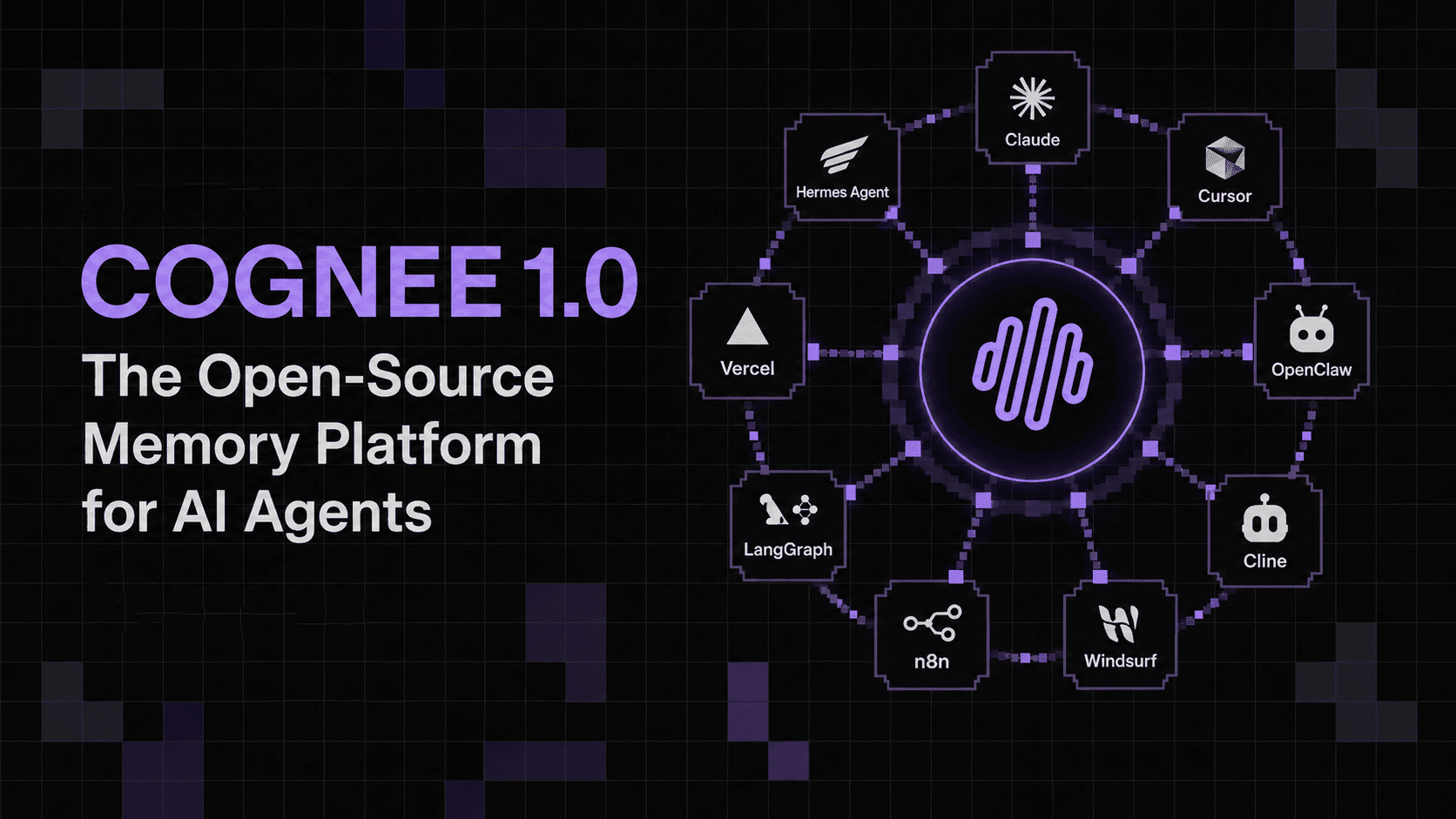
cognee 1.0: The Open-Source Memory Platform for AI Agents

Claude Code's Leak Reveals Anthropic's Obsession with Cognee

Cognee Raises $7.5M Seed to Build Memory for AI Agents
A Picture of RAG: Retrieval-Augmented Generation
AI Database Guide: Types, Retrieval, RAG, and Memory
AI Agent Memory: The Definitive Guide
Elevating AI-Driven Credit Card Insights: A Tier-1 US Bank's Semantic AI Memory Discovery

Turning PDFs into Evidence-Based Answers: How We Built a Trustworthy Evidence Graph for UWYO
Smart Networks, Smarter Students: How cognee Connected 40,000 German Learners
Coding Agents Don't Need Bigger Context Windows — They Need Better Memory
What Is Agentic RAG? How It Works and When to Use It
cognee on BEAM: SOTA Results Without a Benchmark-Specific Memory System
Why AI Agents Forget and How to Fix Their Memory
Give Claude Code Persistent Memory With cognee
Structure Your Skills with Cognee
Cut Cognee's Vector Memory by 8x with Qdrant's TurboQuant
ScrapeGraphAI + Cognee: Turn Live Web Data Into a Knowledge Graph