AI Agent Long-Term Memory Solutions — By Lifecycle, Not by Label

Until recently, long-term memory for AI agents was typically put together from whatever the application already had: conversation history, a vector database, extraction prompts, and custom logic for deciding what should be stored and retrieved later.
Today, memory is being packaged as a distinct part of the agent stack, appearing inside runtimes, independent platforms, cloud services, and application-owned data infrastructure. Products can share the same label even if they control very different parts of the process.
This evolution is spurred by what agents are being asked to do. Their work increasingly runs across sessions, tools, changing environments, and knowledge that can't be reconstructed from the current prompt alone. A larger context window can hold more information during a model call, but it doesn't decide what should persist into the next session, which observations are still valid, or what merits a return to active context later.
Persistent memory still requires this kind of selection and rules for what becomes durable, how it's represented, when it should be retrieved, and what happens when newer information contradicts or replaces it. Memory admission, updating, consolidation, retrieval, and forgetting are separate responsibilities, and different products take ownership of different subsets of them.
Why "Agent Memory Solution" Now Has More Than One Meaning
The term AI agent memory solution now covers software doing at least four distinct jobs:
- State persistence keeps track of agent workflow progress, tool outputs, and intermediate state so an agent can resume later.
- Memory extraction turns interactions, observations, or task outcomes into information worth carrying forward.
- Context retrieval selects previously stored information that is relevant to the current task or conversation.
- Knowledge maintenance updates, merges, connects, or retires memories as the underlying information changes.
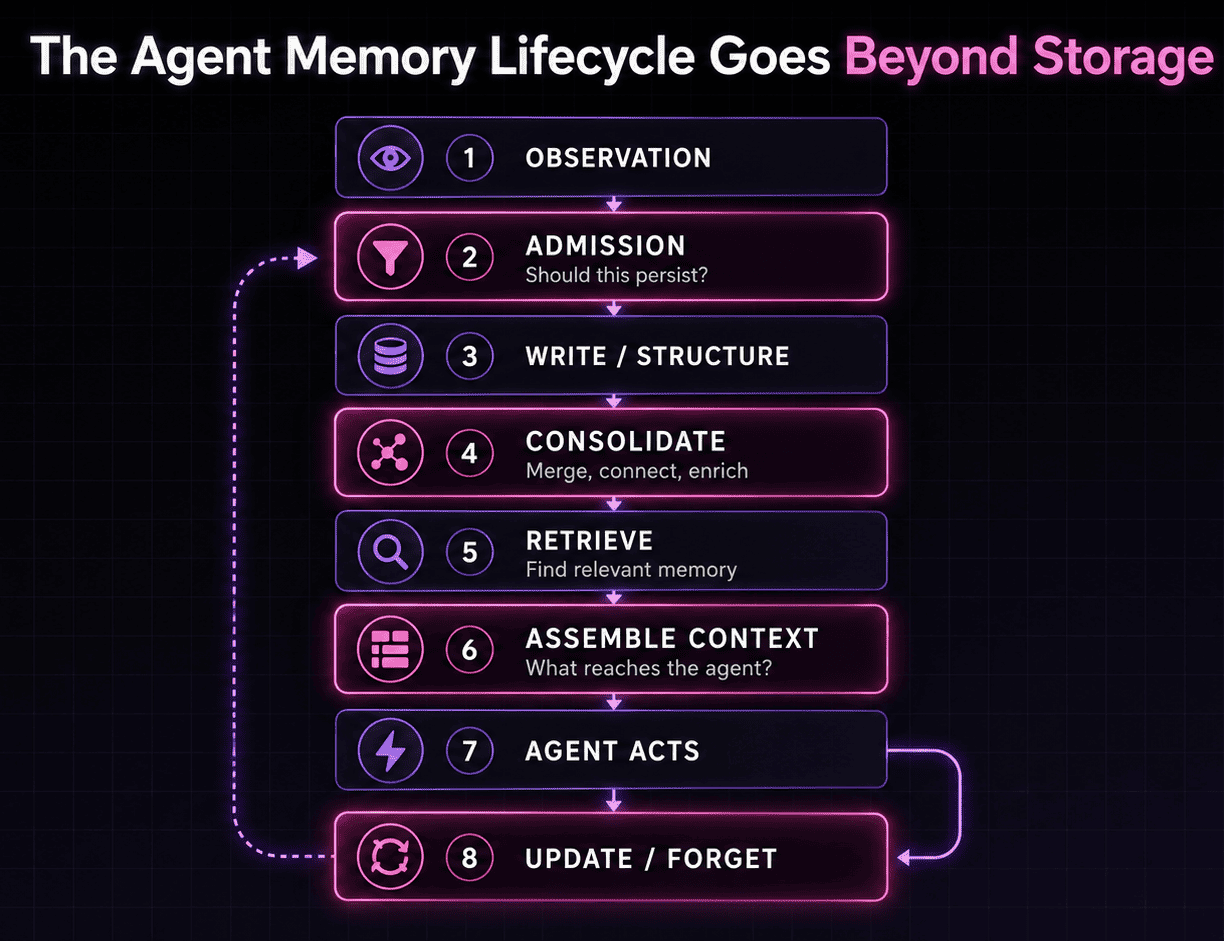
One platform can do all four, but the distinctions between them become more pertinent once memory moves beyond the level of simple conversational personalization.
Long-running agents may need to retain project history, tool outcomes, relationships between entities, procedural knowledge, or lessons from previous attempts. At that point, storing information is only a part of the problem, and the salient question becomes which part of the memory lifecycle the architecture needs a platform to own.
A Two-Axis Map of AI Agent Long-Term Memory Solutions
It's easier to get a read on the current market if memory systems are placed on two independent dimensions rather than grouped by product label.
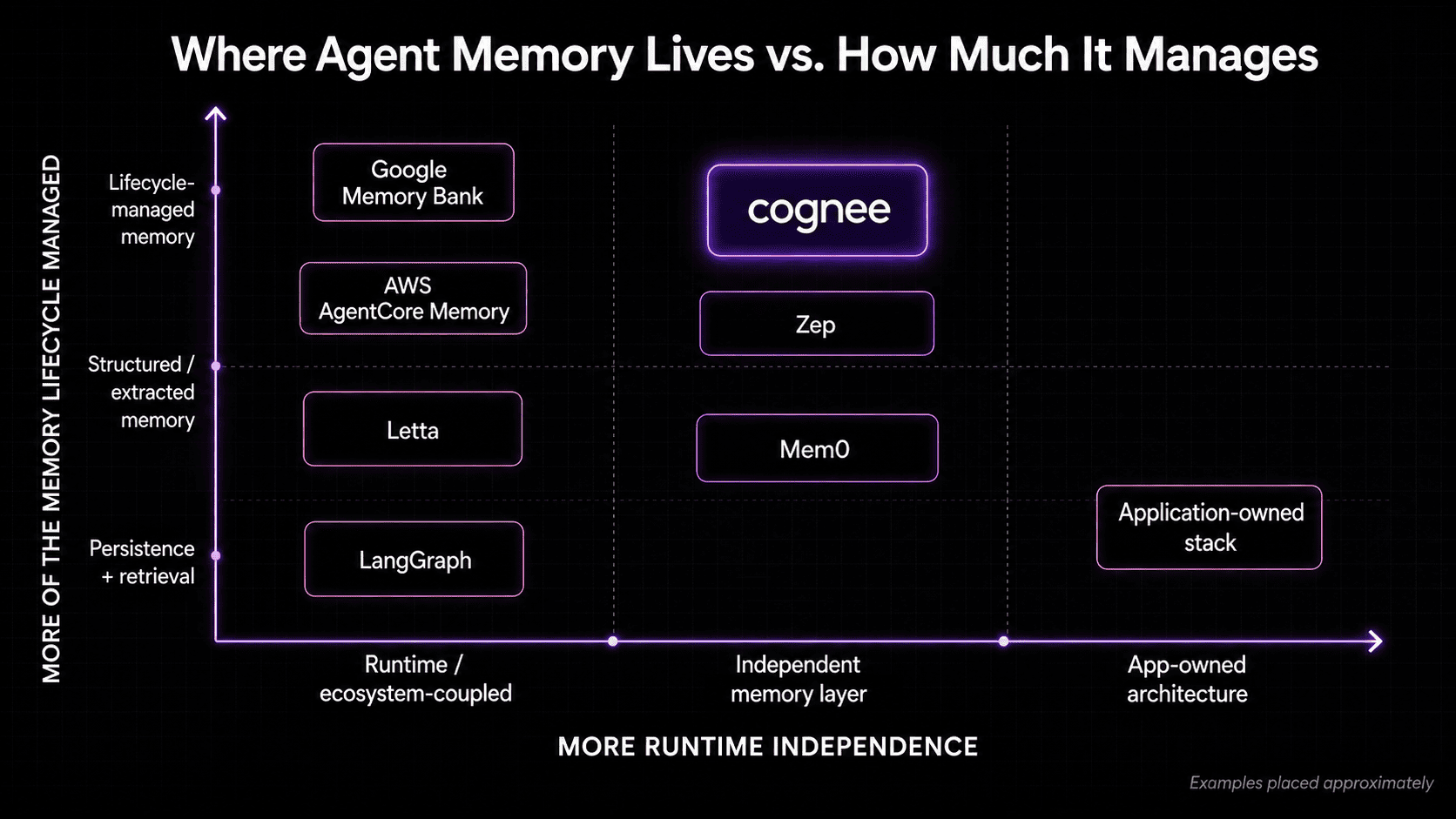
Axis 1: How tightly is memory coupled to the agent stack?
At one end of this dimension are memory systems that live inside the framework, runtime, or cloud environment already executing the agent. At the other are independent memory layers that can serve several runtimes, models, or applications. The same capabilities can also be assembled directly from storage and retrieval infrastructure.
Runtime- and ecosystem-coupled memory
Frameworks and agent runtimes increasingly include persistence as part of their own execution model.
LangGraph, for example, differentiates thread-scoped checkpointers for graph state and stores for durable information that can persist across threads. Letta has a more agent-controlled approach, with persistent memory blocks that agents can read and update as they work.
Cloud platforms add another version of the same architectural choice. AWS AgentCore Memory provides managed short- and long-term memory, and Google Cloud's Memory Bank manages persistent memories that can be generated from interactions or written explicitly by the agent.
Keeping memory close to the execution environment can reduce integration work and simplify workflow continuity, but it also ties more of the accumulated state to that environment's abstractions, APIs, and identity model.
Runtime-independent memory layers
An independent agent memory platform is one that's nested between the application and its underlying storage rather than belonging to one agent runtime.
Mem0, Zep, and cognee differ in their internal representations and memory behavior, but all expose memory independently of a single agent runtime. This type of architecture allows several applications to access the same persistent knowledge or memory to outlive the runtime currently using it.
Independence creates another system boundary, with its own ingestion, identity, permissions, synchronization, observability, and deployment concerns.
Application-owned memory architecture
The most decoupled option is to assemble the memory stack directly from infrastructure the application already controls.
Postgres, Redis, vector databases, graph databases, and object storage can all participate. The application then owns the policies for writes, updates, retrieval, and context assembly.
That gives the application the most control over data placement and retrieval behavior while leaving most of the memory lifecycle to be designed and maintained in-house.
Axis 2: How much of the memory lifecycle does the system own?
The second dimension runs from basic persistence to systems that actively manage how memory changes over time.
At the lower end, the system may preserve workflow state, transcripts, records, or embeddings and make them retrievable later. More extensive platforms can also extract candidate memories, consolidate related observations, maintain provenance, update or supersede older information, and decide what should return to the agent.
The difference is visible in three broad levels:
-
Persistence and retrieval
These systems primarily make information durable and searchable, which can be enough for workflow checkpoints, conversation history, or user facts the application already knows how to interpret.
The application retains most of the policy around memory creation and updates.
-
Extracted and structured memory
Further up the lifecycle, the system begins transforming interactions into reusable memory. It may extract facts, create summaries, attach metadata, identify entities, or organize observations into structures that are easier to retrieve later.
The application no longer has to specify every durable record directly, but it still needs to decide how much authority to give those derived memories.
-
Lifecycle-managed memory
At the upper end, memory is treated as information that can change rather than as an ever-growing archive.
The system may consolidate repeated observations, track provenance, preserve temporal changes, detect conflicts, update existing knowledge, reduce the priority of outdated information, or remove memories according to retention rules.
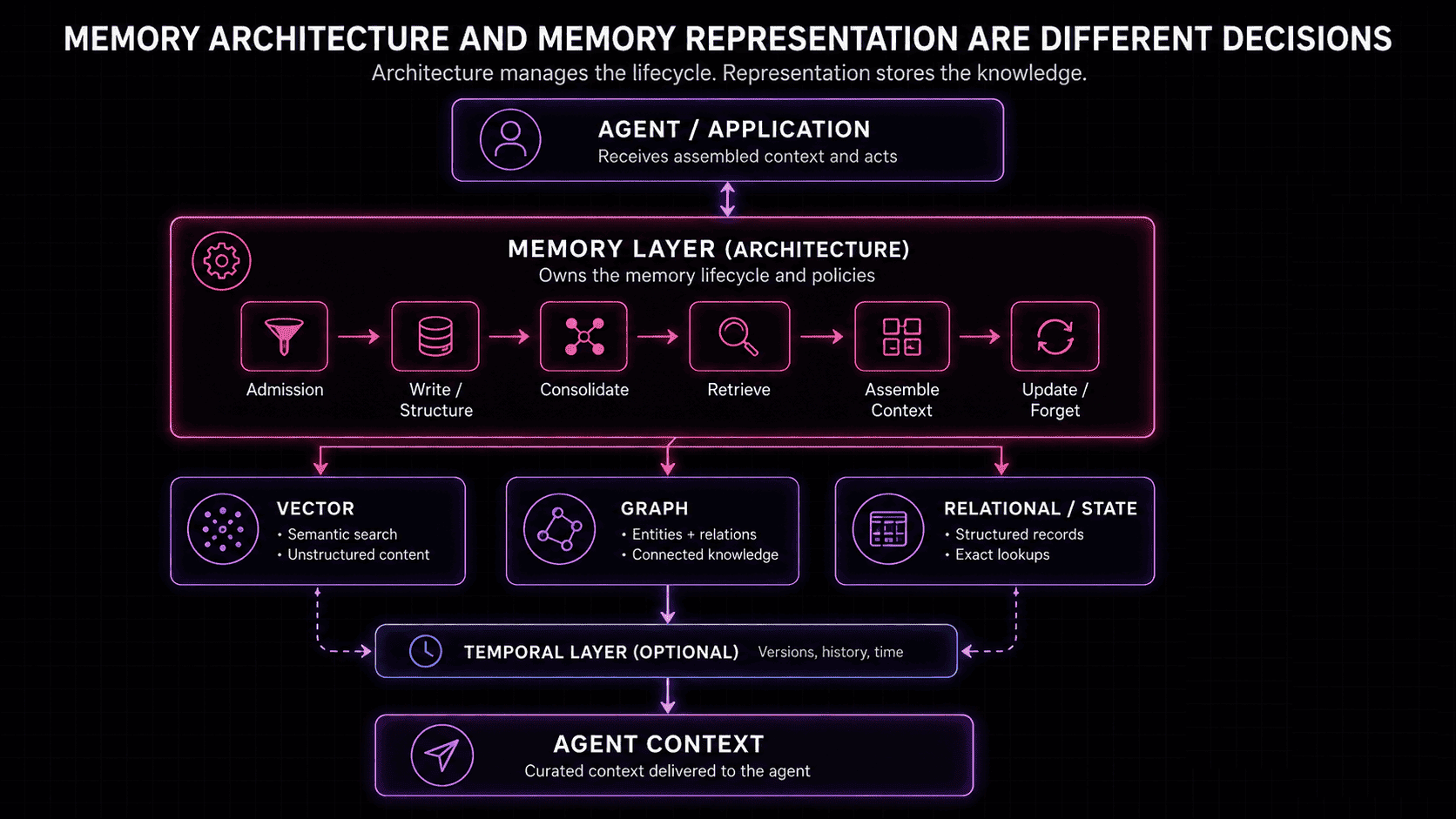
Representation is a separate choice
Vector, graph, temporal, and hybrid memory all describe how information is represented and retrieved, and any of them can appear at different points on the two axes above.
- Flat or vector-backed stores are enough for when memories can largely stand on their own and semantic similarity is the main retrieval problem.
- Graph and temporal representations are optimal when relationships, provenance, or changes over time affect what a memory means.
- Hybrid architectures coordinate several retrieval paths, like semantic similarity, lexical search, metadata filters, and graph traversal, to supply the agent with context appropriate to the current task.
Matching the Architecture to the Workload
Five recurring workloads make the architectural differences easier to comprehend, each leaning on a different part of the lifecycle we just defined.
| Workload | What needs to persist | Architecture that often fits | Main challenge |
|---|---|---|---|
| Cross-session personalization | Preferences, account facts, previous decisions, recurring goals | Scoped fact memory, vector-backed retrieval, or managed memory services | Keeping memories current without turning temporary requests into durable preferences |
| Workflow continuity | Checkpoints, tool outputs, pending actions, intermediate state | Runtime-native persistence and state stores | Keeping execution state separate from knowledge that should influence future tasks |
| Evolving domain knowledge | Entities, relationships, decisions, source history, changes over time | Graph, temporal, or hybrid memory | Resolving conflicting observations and distinguishing current information from superseded facts |
| Accumulated agent experience | Previous outcomes, failed approaches, procedures, environment-specific lessons | Experience- or trajectory-based memory with consolidation | Distilling useful experience without retaining every raw trajectory |
| Shared memory across agents | Knowledge that several agents or applications need to reuse | Runtime-independent memory layers with shared retrieval and governance | Permissions, provenance, conflicting writes, and consistency |
Cross-session personalization
A support agent remembering that a customer is on the Enterprise plan and prefers email over chat is personalization working correctly.
An agent that remembers a customer said "just this once, skip the verification step" as if it were a standing preference is personalization working incorrectly. The storage mechanism may be the same, but the admission policy is wrong — the system has failed to distinguish a durable preference from an isolated instruction or apply the right scope.
This workload often doesn't require the richest possible representation. Reliable extraction, filtering, semantic retrieval, and update behavior can be enough.
Workflow continuity
A checkpoint knowing that step 4 of a deployment pipeline completed successfully is workflow memory. An agent knowing that step 4 has failed under this exact condition three times before, and why, is a totally different kind of memory — one that has to survive past the workflow that generated it.
Evolving domain knowledge
A codebase where "the auth service" meant one thing six months ago and means something different after a rewrite is evolving domain knowledge. An agent answering questions about that codebase needs to know not just what's true now, but what changed and when. Otherwise, it can confidently cite a fact that used to be correct.
For changing domain knowledge, the memory system may need to preserve relationships, provenance, and changes between successive observations. Graph and temporal representations help because a fact's current meaning can depend on what replaced it.
Accumulated agent experience
An agent that has tried the same debugging approach in a particular environment five times, failed for the same reason each time, and still tries it a sixth time has just accumulated log files.
If it had accumulated experience instead, the sixth attempt would have started differently because the first five are represented as a lesson.
The tricky part is deciding what can be generalized from those runs. Raw execution traces contain useful detail, but storing them indefinitely also adds retrieval, governance, and storage costs. More advanced memory systems try to preserve the parts of an experience that improve later work without replaying the entire history.
Shared memory across agents
Two agents pulling from the same project memory, where one just marked a task complete and the other is still planning around the old status, is the shared-memory problem in miniature.
The moment more than one agent can write to the same knowledge, the architecture needs clear rules for ownership, authority, provenance, and visibility — not as an eventual nice-to-have but from the first write.
Six Questions to Ask Before Choosing an Agent Memory Stack
Once the workload is defined, the comparison should move beyond storage capacity and retrieval accuracy. Here are the questions that actually separate one architecture from another.
1. What gets written, and who decides that?
Some systems expect the application to submit memories explicitly, while others extract candidate memories from conversations or task traces, and others still allow the agent itself to propose what should persist.
Each model creates a different balance between automation and control. Automatic extraction reduces application logic, though it introduces another model-driven judgment about what makes sense to keep. Explicit writes give the application more control but require more decisions upstream, while agent-initiated writes can capture useful experience dynamically but need stronger validation.
Check whether the platform preserves the original source alongside derived memories. Provenance makes it easier to verify a fact, correct it later, or understand why the agent retrieved it in the first place.
2. How does the system handle change?
A persistent store can keep every observation it receives and still give an agent the wrong answer later, because storing something and knowing whether it's still true are two different problems.
Depending on the architecture, resolving that may involve updates, temporal versions, superseded records, consolidation, or retrieval rules that reduce the weight of outdated memories, more so when the memory layer is expected to maintain evolving knowledge.
3. What can it retrieve?
A personalization system may work well with scoped vector search, while a project agent might also need exact matches, relationships between entities, historical versions, or previous outcomes from similar tasks.
The retrieval path should match the information being stored, but selection doesn't end when the database returns results. Finding ten relevant memories is less useful if the system can't decide which ones deserve space in the next model context. Memory quality ultimately depends on what reaches the model.
4. How is memory scoped and governed?
A record may belong to one user, account, project, agent, or shared environment, and those scopes determine who should be able to read or alter it. Multi-agent systems make this harder because information written by one agent may later influence another.
Look for controls around tenant isolation and scoped ownership, permissions, provenance, human inspection, deletion, and restrictions on what kinds of information can become durable.
Proper governance is essential when memories are derived rather than copied directly from a source. The system should make it possible to distinguish an observed fact from an inference the agent or extraction model produced.
5. What does memory add to the agent loop?
Background processing may reduce the impact on the response path, but the latency introduced by extraction, embeddings, graph updates, reranking, and context assembly still exists.
Measure whether memory improves the behavior you care about enough to justify what it adds: fewer repeated mistakes, better task completion, stronger cross-session consistency, or better downstream answers. Then weigh those gains against the additional latency and token cost of persistent memory.
6. Can the memory move?
Source records are usually easier to move than derived memory. Graph relationships, temporal state, summaries, procedures, provenance, and application-specific scopes may not transfer properly to another platform even if the raw data can be exported.
Before adopting a memory layer, check what can be inspected and exported, whether the representation is tied to one model or runtime, and how much meaning would survive a migration.
Memory Orchestration Is Becoming Tricky
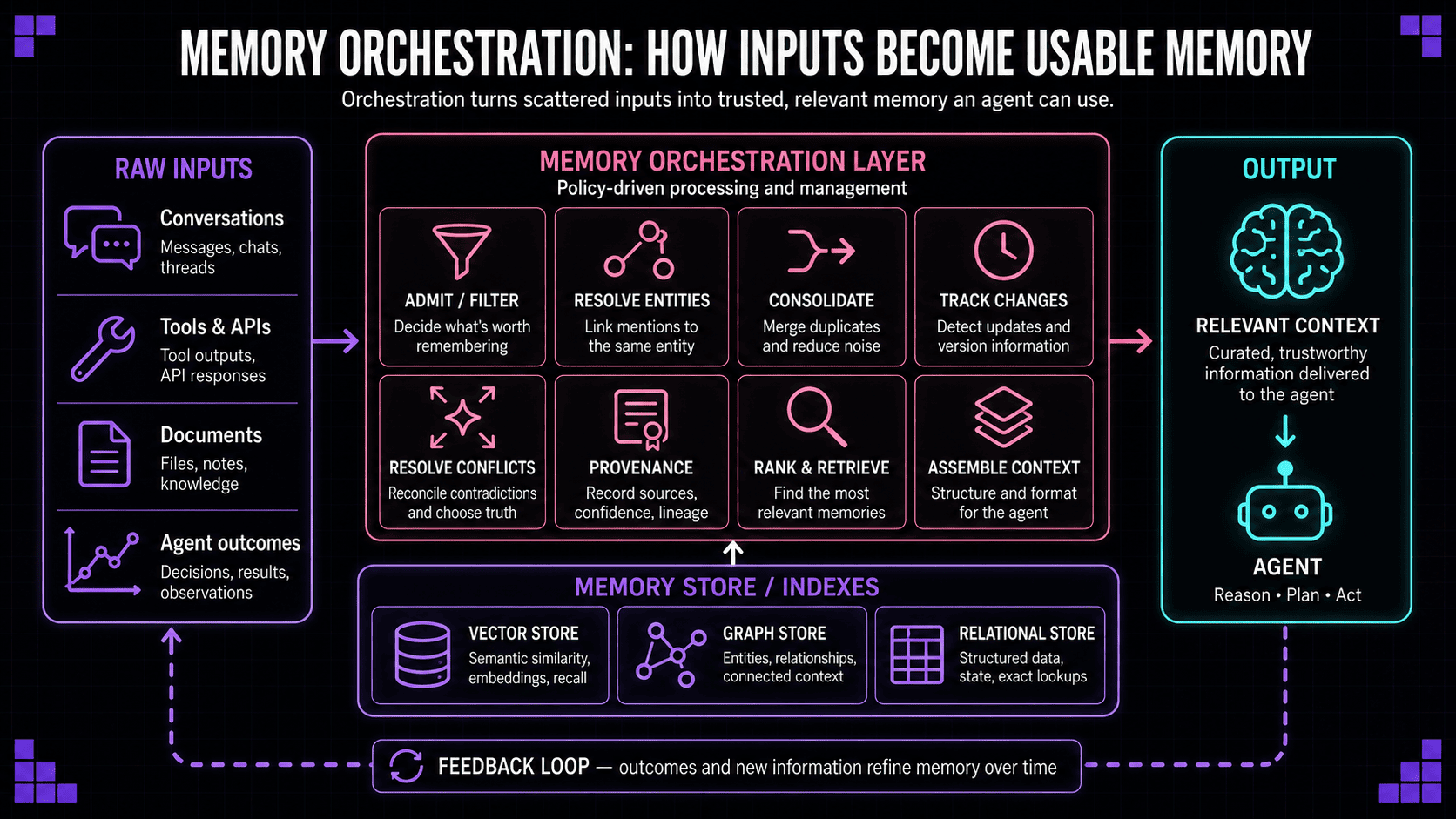
Memory orchestration is what happens to information after it's written: consolidating duplicates, resolving what's current and what has been superseded, and deciding what subset of an expanding history should reach the agent for a given task.
Some of that orchestration can be productized, but what counts as durable, authoritative, stale, or relevant depends entirely on what an application knows about its own data.
More of the work happens post-write
Memory systems can process stored records after the original interaction by consolidating duplicates, resolving entities, building relationships, updating temporal information, or distilling longer trajectories into reusable knowledge.
Some of that work can be too slow or expensive to keep directly in the response path. Keeping the online path focused on the writes and reads needed for the current task leaves heavier processing to background jobs.
Entity resolution, graph construction, contradiction detection, and consolidation can become increasingly costly to perform synchronously as the history grows. In other words, this is all a maintenance workload as well as a storage one.
Retrieval ends with context assembly
Context assembly is the step that turns retrieval results into usable input. It can involve reranking, expansion through related entities, deduplication, conflict handling, or simply excluding material that would consume context without improving the task.
For agent memory, the quality of that selection can be as important as the recall of the underlying store.
One memory layer can coordinate several stores
A memory layer can coordinate a range of representations without requiring the application to select every retrieval path manually.
In memory architectures that combine relational, vector, and graph-backed storage, the memory layer can select the source or combination of sources appropriate to the request and assemble their outputs into context.
The harder engineering problem is maintaining consistent scope, provenance, and update behavior across those representations.
Agents can participate without owning the policy
An agent can be allowed to propose that a task outcome should persist, request older information when it recognizes a familiar situation, or revise a memory after receiving a correction. Those capabilities can make memory behavior less dependent on fixed application rules.
They do not require giving the agent unrestricted control over its own history. Permissions, provenance, retention policies, and validation can remain outside the agent even when it participates in memory decisions, which becomes especially important when an incorrect or manipulated memory could influence later sessions.
The competition is now about how effectively a system manages information between the original observation and the context eventually returned to the agent.
Five Trends Redefining Agent Memory Infrastructure
The category is young enough that any 12-to-24-month forecast is more directional than certain. Still, current platform launches and recent research indicate that the next generation of AI agent long-term memory solutions will have to show how well they handle change, trust, shared access, and portability after information has been stored.
Managed memory moves into the agent platform
Persistent memory is increasingly available as a platform capability rather than something every application has to assemble itself.
AWS AgentCore Memory now supports both short- and long-term memory, while Google Cloud's Memory Bank supports memory generation, consolidation, revision history, retrieval, and configurable expiration. Redis Agent Memory adds session storage, asynchronous long-term extraction, and semantic, keyword, and hybrid retrieval; its self-managed Redis Software deployment remains in private preview at the time of writing.
If that trend continues, basic cross-session recall may stop being a meaningful differentiator. The harder product questions will be about what happens to memories after they've been created: how they are consolidated, updated, governed, shared, and inspected.
Evaluation expands beyond recall
AI memory benchmarks have often focused on whether an agent can recover information from a long interaction history. Those metrics are useful, but they don't tell us whether memory improves the work the agent is doing.
AgentMemBench compares five long-term memory strategies under one evaluation harness and measures both quality and deployment efficiency, including retrieval metrics, answer quality, faithfulness, memory footprint, and latency.
Production systems also need to know whether memory prevents repeated mistakes, helps an agent adapt to updated information, or makes prior experience useful on a later task.
The benchmark worth optimizing for measures something broader than recall: the change in agent performance attributable to memory, weighed against the latency and cost required to get there.
Multi-agent memory raises consistency questions
A 2026 position paper on multi-agent memory frames the problem through computer architecture and identifies consistency as a major unresolved challenge.
For example, one agent may update a project deadline while another is still planning from an earlier version. The issue is no longer whether both records can be retrieved — the memory layer needs rules for which state is current, who can change it, and when those changes become visible elsewhere.
As shared agent systems become more common, the relevance of versioning, provenance, conflict handling, and write authority becomes much higher in memory-platform comparisons.
Security starts at the write
Persistent memory gives malicious or incorrect information a way to survive beyond the interaction that introduced it.
MemSecBench studies this problem across several agent, model, and memory-backend configurations by tracing malicious information from insertion through later retrieval, external consequence, and attempted repair. Its results provide early evidence that memory poisoning has to be evaluated across the full lifecycle rather than only at the original prompt.
This risk is already reflected in production documentation. Google Cloud explicitly warns that Memory Bank can be exposed to prompt injection and memory poisoning when persistent information is generated from agent interactions.
Portability before a standard forms
A recent protocol proposal has explored model-independent serialization, provenance-preserving transfer, access control, and rehydration across heterogeneous agent systems.
The problem this paper addresses is likely to become more important. As agent history accumulates, buyers will have stronger reasons to ask what can be exported, how much meaning survives the move, and whether memory remains usable after changing the model or runtime around it.
What the Label Doesn't Tell You
The agent memory category now includes products that solve very different problems, so the architecture has to start with the workload, not the product category.
A workflow that only needs resumable execution may be well served by runtime-native persistence. Cross-session personalization needs stronger admission and update rules. Agents working with changing knowledge, accumulated experience, or shared memory need more control over provenance, retrieval, consolidation, permissions, and history.
The database underneath that system is only one part of the design. Postgres, Redis, vector stores, and graph databases can all persist information, but the memory layer determines what survives, how it changes, who can trust it, and what returns to the agent later.
For applications that need memory to remain independent of a single agent runtime, cognee builds a persistent layer across agents and sessions, combining graph-backed context with vector retrieval, session memory, and provenance. In cognee v1.0, the graph, vectors, sessions, and metadata can also run on a single Postgres instance.
The strongest memory architecture takes ownership of the lifecycle responsibilities you no longer want to rebuild inside every agent — this will prove far more impactful than any product label.
FAQ
Do all AI agents need long-term memory?
No. Short-lived agents and deterministic workflows may have everything they need in the current session or application state.
Long-term memory becomes more useful when work spans sessions, information changes over time, or previous outcomes should influence later tasks.
What information should an AI agent avoid storing as long-term memory?
Temporary instructions, low-confidence inferences, duplicated observations, and information with no likely future use can add noise without improving later decisions. We cover the related question of what belongs in an agent's knowledge base in more detail here.
Sensitive information also needs stricter admission rules. A memory system should make it possible to control what can become durable, who can access it, and how it can be deleted.
How long should agent memory be retained?
There is no useful default retention period for every kind of memory. A stable account preference may remain relevant for months, while task-specific state can lose its value as soon as the workflow ends.
Retention policies should reflect the type of information, its expected useful lifetime, legal or organizational requirements, and whether the system can recognize when a newer memory has replaced it.
Can you add long-term memory without changing the underlying AI model?
Usually, yes. Long-term memory is commonly implemented outside the model through persistent storage, retrieval, and lifecycle logic.
The same memory layer can therefore serve different models, although context formats, tool interfaces, and retrieval behavior may still need adjustment when models change.
How quickly should a new memory become available to an agent?
It depends on what the memory is for. Workflow state or a user correction may need to be available immediately, while consolidation, entity resolution, graph updates, or trajectory analysis can often happen asynchronously.
Separating the immediate write path from heavier background processing can keep memory available when needed without putting every maintenance operation in the agent's response path.