Anthropic API Cost in 2026: Claude Pricing and Calculator

At standard rates, Anthropic API cost ranges from $1/$5 for Claude Haiku 4.5 to $10/$50 for Claude Fable 5.1 per million input/output tokens.
But your actual Claude cost depends on the input and output tokens you process, along with prompt caching, Batch API usage, thinking, tools, and inference settings.
Prices quoted here were verified against Anthropic's pricing documentation on September 18, 2026.
Anthropic API pricing by model
Anthropic bills input and output tokens separately. The current standard rates for its main Claude models are:
| Claude model | Input per 1M tokens | Output per 1M tokens | Context window |
|---|---|---|---|
| Claude Haiku 4.5 | $1 | $5 | 200K |
| Claude Sonnet 5 | $2 | $10 | 1M |
| Claude Opus 5 | $5 | $25 | 1M |
| Claude Fable 5.1 | $10 | $50 | 1M |
Claude Sonnet 5's $2/$10 rate is now permanent. Anthropic launched it as introductory pricing through August 31, 2026 and originally scheduled an increase to $3/$15 for September 1, but later cancelled the increase.
Token counts also need to be recalculated when moving from older Claude generations. Anthropic says Claude 4.7 and later use a newer tokenizer that produces approximately 30% more tokens for the same text than the tokenizer used by Sonnet 4.6 and earlier. The exact increase varies by content and workload, so historical token counts won't necessarily transfer directly to Sonnet 5, Opus 5, or Fable 5.1.
Claude API billing is separate from Claude subscriptions. Pro, Max, Team, and Enterprise subscriptions cover the Claude consumer products but don't include API access or usage through the Claude Console.
How to calculate Anthropic API cost
For a standard Claude API request, use:
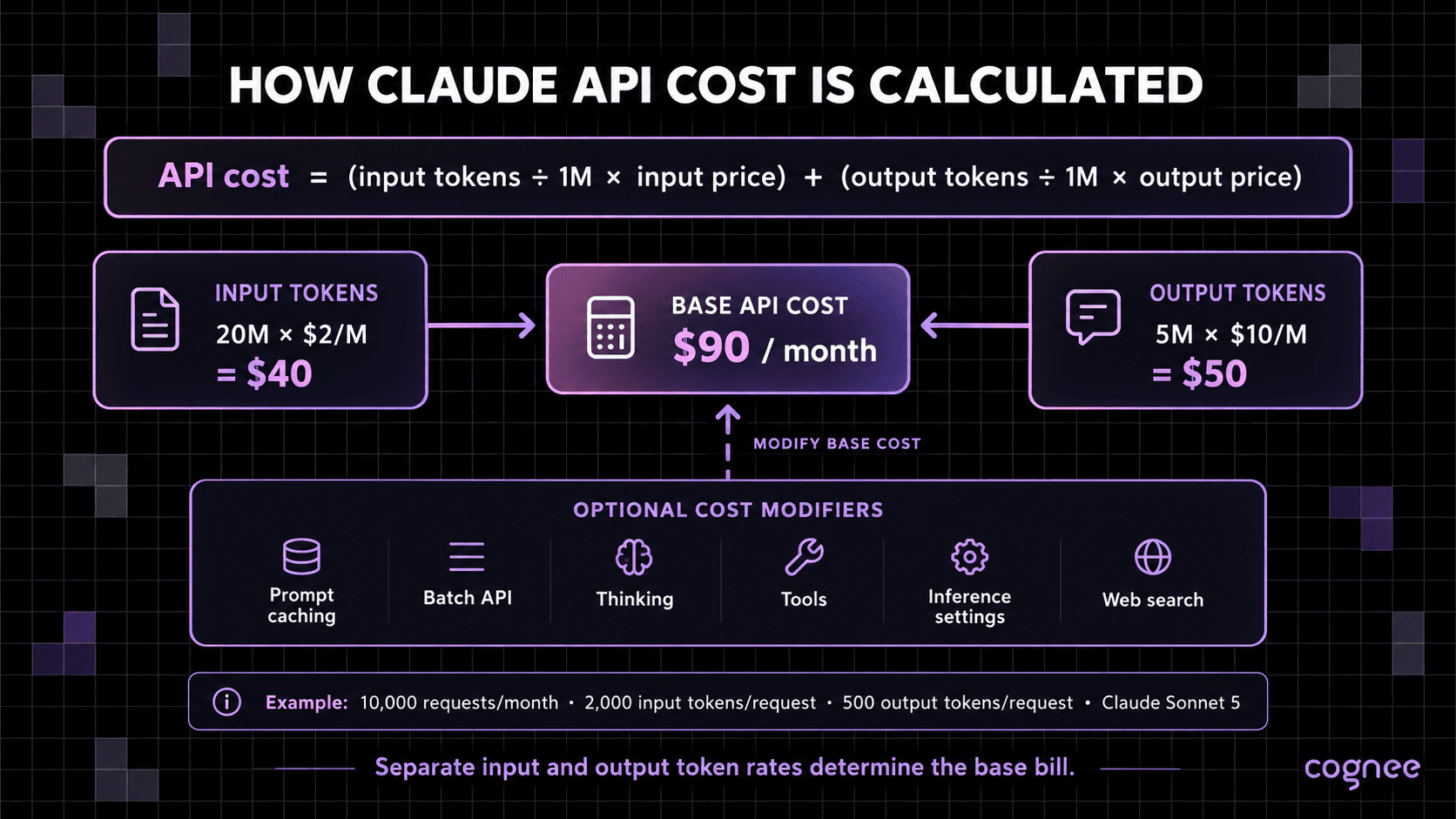
API cost = (input tokens ÷ 1M × input price) + (output tokens ÷ 1M × output price)
Say an application makes 10,000 Claude requests per month, averaging:
- 2,000 input tokens per request
- 500 output tokens per request
That produces 20 million input tokens and 5 million output tokens per month.
| Claude model | Input cost | Output cost | Total monthly cost |
|---|---|---|---|
| Claude Haiku 4.5 | $20 | $25 | $45 |
| Claude Sonnet 5 | $40 | $50 | $90 |
| Claude Opus 5 | $100 | $125 | $225 |
| Claude Fable 5.1 | $200 | $250 | $450 |
Caching, Batch API, and other Claude cost factors
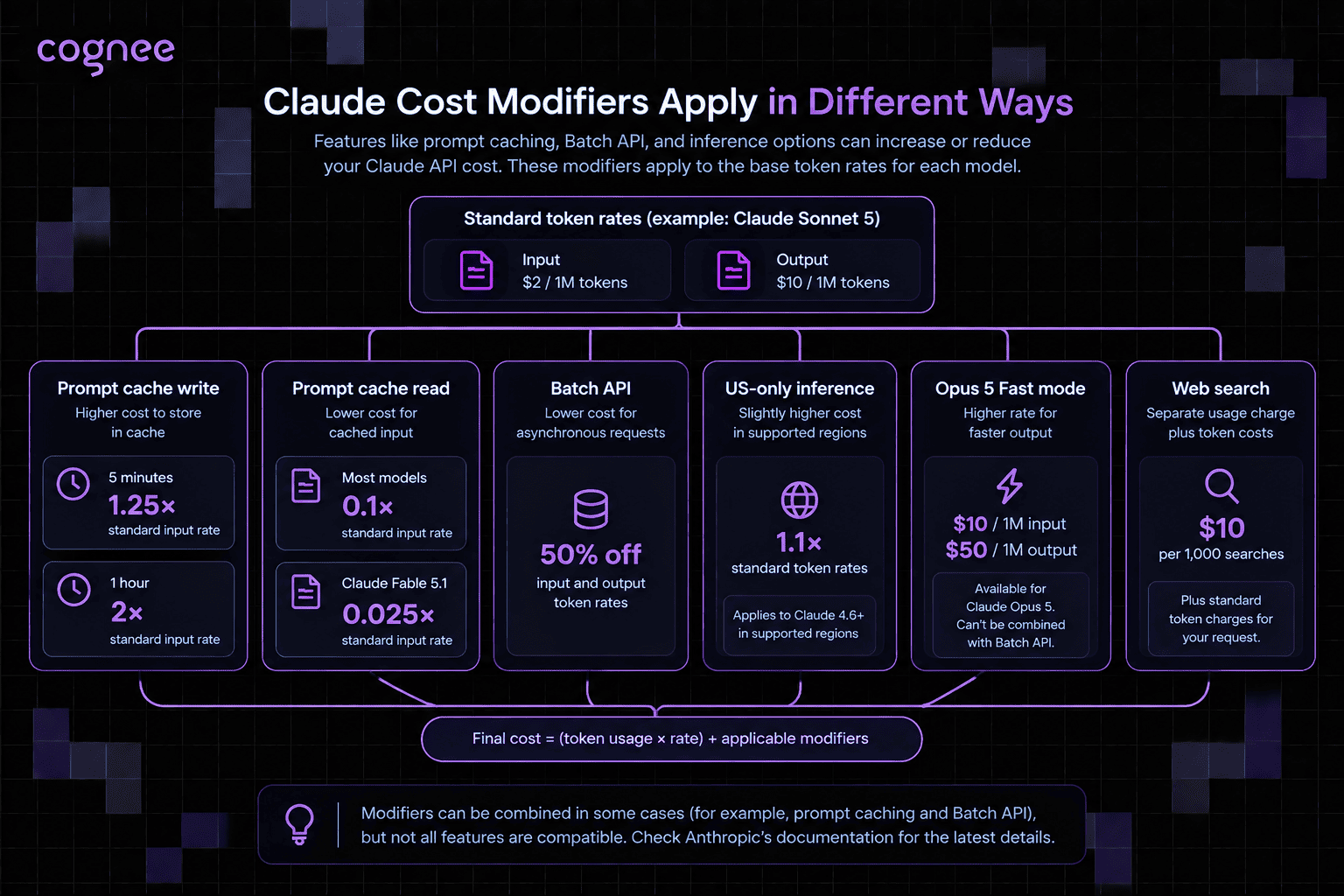
Anthropic uses different rates for cached input, asynchronous Batch requests, US-only inference, and several other features.
| Cost factor | Pricing effect |
|---|---|
| 5-minute prompt cache write | 1.25× standard input rate |
| 1-hour prompt cache write | 2× standard input rate |
| Prompt cache read | 0.1× standard input rate; 0.025× for Fable 5.1 |
| Batch API | 50% off input and output token rates |
| US-only inference | 1.1× token rates on Claude 4.6+ |
| Opus 5 Fast mode | $10/M input and $50/M output |
| Web search | $10 per 1,000 searches, plus token costs |
Prompt caching applies to reusable prompt prefixes, including system instructions, tools, messages, and background context. A cache write costs more than ordinary input, while subsequent hits cost 10% of the standard input rate on most current models. Fable 5.1 cache hits cost 2.5%.
The Batch API halves input and output rates for asynchronous processing and can be combined with prompt caching.
Anthropic's Fast mode takes Opus 5 in the other direction, increasing the standard $5/$25 rate to $10/$50 for faster output (and it can't be combined with Batch).
Thinking can also change the bill even when the visible answer stays short. Claude's internal thinking tokens are billed as output tokens, and preserved thinking from earlier turns can later count as input. Tool definitions and results add input tokens as well, while server-side tools such as web search can have separate usage charges.
How memory can reduce Claude API token usage
Long-running agents carry information from earlier conversations, documents, findings, and tool activity into later requests. An LLM call carries no memory of its own between requests, so every one of those earlier facts has to be re-sent as input tokens unless something else holds onto it — this is why bigger context windows make agents more expensive.
An AI agent memory layer like cognee can preserve that information across sessions and retrieve only the portion relevant to the current request instead.
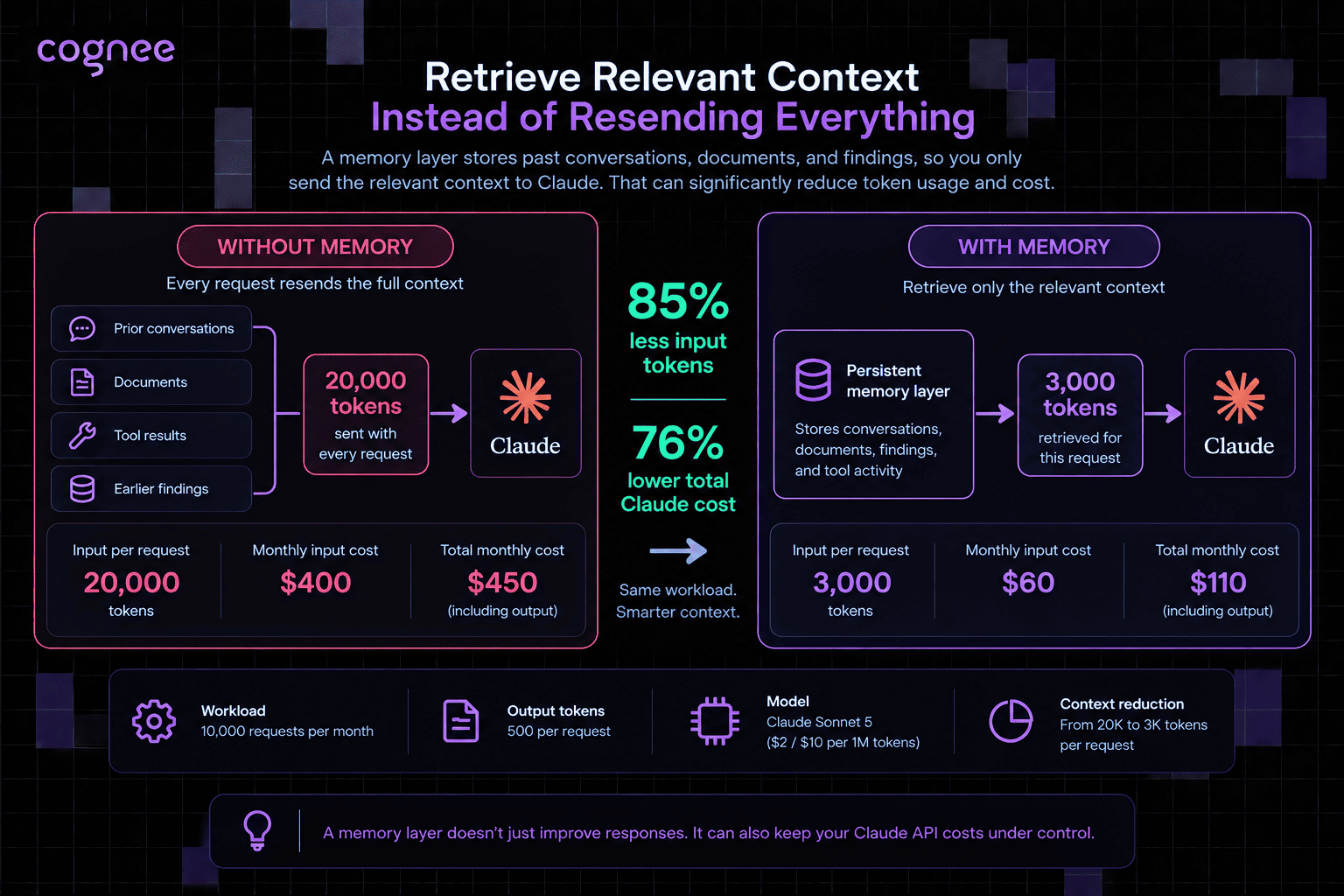
Take a Sonnet 5 workload with 10,000 monthly requests and 500 output tokens per request:
| Context strategy | Input per request | Monthly input cost | Output cost | Total Claude cost |
|---|---|---|---|---|
| Send 20K tokens of prior context | 20,000 | $400 | $50 | $450 |
| Retrieve 3K relevant tokens | 3,000 | $60 | $50 | $110 |
In this example, reducing context from 20K to 3K tokens would cut Claude input-token usage and input spend by 85%. The total Claude bill would drop by about 76%, from $450 to $110.
Those figures cover only the Claude side of the calculation. Of course, a full persistent memory system also carries its own ingestion, retrieval, storage, and update costs. Our token-cost study of persistent AI memory measured that ingestion-versus-query tradeoff directly and found a break-even point after roughly 23–26 repeated queries for the corpora tested.
Prompt caching and persistent memory reduce different expenses. Caching lowers the price of resending the same prompt prefix. Memory reduces how much prior information needs to be in the prompt at all, by retrieving only what the current task needs.
FAQ
Answers to the most common questions from this guide.
Is the Claude API free?
Anthropic says new users receive a small amount of free credit to test the API. Regular API usage is paid: most Claude Console organizations buy prepaid usage credits, while some accounts with an invoicing arrangement are billed monthly.
Does Anthropic charge extra for Claude's 1M-token context window?
No. Claude 4.6 and later models bill the full 1M-token context window at the same per-token rate throughout — a 900K-token request costs proportionally more than a 9K-token request simply because it contains more tokens, with no separate long-context pricing tier.
How can you track Claude API spending?
Usage and cost data is available in the Claude Console. Claude Console organizations can also retrieve detailed usage and spending programmatically through Anthropic's Usage & Cost Admin API, including breakdowns by model and workspace. The Admin API isn't available to individual accounts.