The Cognee Blog


Stay in the loop
Cognee product & events updates, insights into our AI memory research and practical guides — in your inbox every two weeks.
Latest
Latest
LLM Hallucination Solution: How to Reduce Wrong AI Answers
Grounding is the most effective LLM hallucination solution: make the model answer from retrieved, verifiable facts instead of training memory. Retrieval quality, structured knowledge, verification layers, and feedback loops all determine how many wrong answers survive to production.
LLM Hallucinations: What They Are & How to Detect Them
LLM hallucinations are fluent, confident-sounding answers that are false or unsupported by any source. Learn what causes them and the detection methods — groundedness checks, self-consistency, LLM judges — that catch them before users act on them.
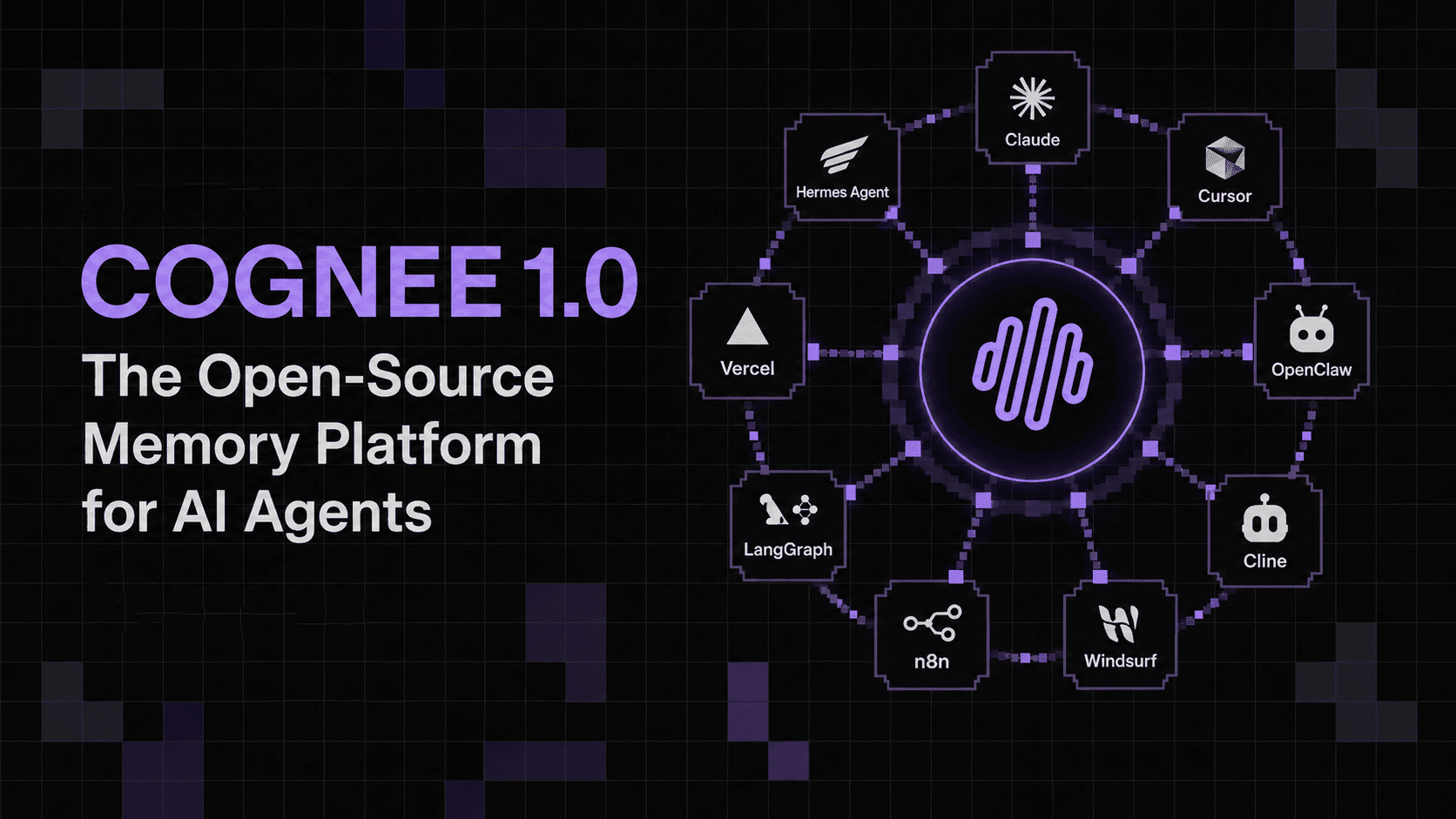
cognee 1.0: The Open-Source Memory Platform for AI Agents
cognee 1.0 is the first open-source memory platform built around a memory-native API — remember, recall, improve, forget — with full data ownership and deployment flexibility from managed cloud to edge.
cognee on BEAM: SOTA Results Without a Benchmark-Specific Memory System
cognee beat SOTA on BEAM's 100k-token setting by 6.5% and matched SOTA at 10M tokens using only default open-source features — no custom benchmark-specific architecture.

Just Postgres: Drop the Graph Database. Keep the Graph.
cognee 1.0 runs the full agent memory layer — graph, vectors, sessions, and metadata — on a single Postgres instance, eliminating the need for separate graph database, vector store, and Redis deployments.
Technical Note: Understanding the Token Cost of Persistent AI Memory
Persistent memory trades an upfront ingestion cost for cheaper queries. We measure where the tokens go in cognee, model the trade-off, and find break-even at roughly 23–26 repeated queries — after which the gap keeps widening.
Behind the Viral Numbers: How We Got 7x Cheaper and 145% Better
Our LinkedIn and X videos put two numbers on screen — 7x cheaper than chat and 145% better than the best alternative. Here's exactly where each one came from, linked to our BEAM report.
cognee on-device: Bringing Agent Memory to the Edge
The cognee core rebuilt in Rust, bringing the full agent memory pipeline — graph construction, embeddings, and retrieval — to phones, robots, and offline environments without a server-side stack.

Inside cognee 1.0: Memory-Native APIs for Production Agents
cognee 1.0 ships four memory verbs — remember, recall, improve, forget — with a self-improving feedback loop, hybrid retrieval with evidence references, a TypeScript SDK, and migration tools for Mem0, Zep, and Letta.
LLM Hallucination Solution: How to Reduce Wrong AI Answers
Grounding is the most effective LLM hallucination solution: make the model answer from retrieved, verifiable facts instead of training memory. Retrieval quality, structured knowledge, verification layers, and feedback loops all determine how many wrong answers survive to production.
LLM Hallucinations: What They Are & How to Detect Them
LLM hallucinations are fluent, confident-sounding answers that are false or unsupported by any source. Learn what causes them and the detection methods — groundedness checks, self-consistency, LLM judges — that catch them before users act on them.
cognee 1.0: The Open-Source Memory Platform for AI Agents
cognee 1.0 is the first open-source memory platform built around a memory-native API — remember, recall, improve, forget — with full data ownership and deployment flexibility from managed cloud to edge.
cognee on BEAM: SOTA Results Without a Benchmark-Specific Memory System
cognee beat SOTA on BEAM's 100k-token setting by 6.5% and matched SOTA at 10M tokens using only default open-source features — no custom benchmark-specific architecture.
Just Postgres: Drop the Graph Database. Keep the Graph.
cognee 1.0 runs the full agent memory layer — graph, vectors, sessions, and metadata — on a single Postgres instance, eliminating the need for separate graph database, vector store, and Redis deployments.
Technical Note: Understanding the Token Cost of Persistent AI Memory
Persistent memory trades an upfront ingestion cost for cheaper queries. We measure where the tokens go in cognee, model the trade-off, and find break-even at roughly 23–26 repeated queries — after which the gap keeps widening.
Behind the Viral Numbers: How We Got 7x Cheaper and 145% Better
Our LinkedIn and X videos put two numbers on screen — 7x cheaper than chat and 145% better than the best alternative. Here's exactly where each one came from, linked to our BEAM report.
cognee on-device: Bringing Agent Memory to the Edge
The cognee core rebuilt in Rust, bringing the full agent memory pipeline — graph construction, embeddings, and retrieval — to phones, robots, and offline environments without a server-side stack.
Inside cognee 1.0: Memory-Native APIs for Production Agents
cognee 1.0 ships four memory verbs — remember, recall, improve, forget — with a self-improving feedback loop, hybrid retrieval with evidence references, a TypeScript SDK, and migration tools for Mem0, Zep, and Letta.
cognee 1.0: The Open-Source Memory Platform for AI Agents

Claude Code's Leak Reveals Anthropic's Obsession with Cognee

Cognee Raises $7.5M Seed to Build Memory for AI Agents
Anthropic API Cost in 2026: Claude Pricing and Calculator
Grok Pricing in 2026: API Costs and Calculator
Top AI Podcasts for Engineers: 10 Shows Worth Your Time in 2026
Elevating AI-Driven Credit Card Insights: A Tier-1 US Bank's Semantic AI Memory Discovery
Turning PDFs into Evidence-Based Answers: How We Built a Trustworthy Evidence Graph for UWYO

Smart Networks, Smarter Students: How cognee Connected 40,000 German Learners
Local AI Memory: Keeping Agent Memory Off the Cloud
AI Memory Tools vs. Databases: 5 Memory Layers Compared (2026)
How to Evaluate AI Memory in 2026: 5 Tools Compared

Why AI Agents Forget and How to Fix Their Memory
Give Claude Code Persistent Memory With cognee

Structure Your Skills with Cognee
Keenable × cognee: Giving Web Retrieval Persistent Memory
Cut Cognee's Vector Memory by 8x with Qdrant's TurboQuant