The Cognee Blog
Stay in the loop
Cognee product & events updates, insights into our AI memory research and practical guides — in your inbox every two weeks.
Latest
Latest
Coding Agents Don't Need Bigger Context Windows — They Need Better Memory
Throwing a million tokens at an agent makes it slower and more expensive. Graph-based memory decides what to retrieve, not window size.
Why AI Agents Forget and How to Fix Their Memory
Learn why AI agents lose context and how to fix agent memory with better state, retrieval, long-term storage, and cognee's memory lifecycle.
What Is Agentic RAG? How It Works and When to Use It
Agentic RAG puts an agent in control of retrieval — planning, choosing tools, and retrieving again when evidence is missing. Learn how it works and when it's worth it.
Give Claude Code Persistent Memory With cognee
Learn what Claude Code already remembers between sessions, where the gaps are, and how to set up and verify cognee's plugin for persistent, searchable memory.
GraphRAG vs RAG: Key Differences and How to Choose
Compare GraphRAG vs RAG across retrieval, data structure, cost, use cases, and limitations. Learn when vector RAG is enough and when graph retrieval is worth the added complexity.
What Is an AI Knowledge Graph? Entities, Relationships, and Use Cases Explained
Learn how AI knowledge graphs connect entities and relationships to improve search, question answering, generative AI grounding, reasoning, and agent memory.
cognee Joins UC Berkeley Xcelerator's 2026 Agentic AI Cohort
cognee has been selected for Berkeley RDI's Xcelerator 2026 Spring Cohort, a non-dilutive program for agentic AI startups, alongside Narada AI, RELAI, and Headroom.
What Is GraphRAG? Retrieval-Augmented Generation with Knowledge Graphs Explained
GraphRAG adds a knowledge graph to the RAG pipeline so retrieval can follow relationships instead of returning isolated chunks. Learn how the pipeline works, when to use local vs global search, and where GraphRAG earns its complexity over standard RAG.
What Is RAG? Retrieval-Augmented Generation Explained
RAG pairs retrieval with generation so an LLM can answer from external knowledge instead of just its training data. Learn how RAG works, what it solves, and where chunk-based retrieval starts to hit its limits.
Coding Agents Don't Need Bigger Context Windows — They Need Better Memory
Throwing a million tokens at an agent makes it slower and more expensive. Graph-based memory decides what to retrieve, not window size.
Why AI Agents Forget and How to Fix Their Memory
Learn why AI agents lose context and how to fix agent memory with better state, retrieval, long-term storage, and cognee's memory lifecycle.
What Is Agentic RAG? How It Works and When to Use It
Agentic RAG puts an agent in control of retrieval — planning, choosing tools, and retrieving again when evidence is missing. Learn how it works and when it's worth it.
Give Claude Code Persistent Memory With cognee
Learn what Claude Code already remembers between sessions, where the gaps are, and how to set up and verify cognee's plugin for persistent, searchable memory.
GraphRAG vs RAG: Key Differences and How to Choose
Compare GraphRAG vs RAG across retrieval, data structure, cost, use cases, and limitations. Learn when vector RAG is enough and when graph retrieval is worth the added complexity.
What Is an AI Knowledge Graph? Entities, Relationships, and Use Cases Explained
Learn how AI knowledge graphs connect entities and relationships to improve search, question answering, generative AI grounding, reasoning, and agent memory.
cognee Joins UC Berkeley Xcelerator's 2026 Agentic AI Cohort
cognee has been selected for Berkeley RDI's Xcelerator 2026 Spring Cohort, a non-dilutive program for agentic AI startups, alongside Narada AI, RELAI, and Headroom.
What Is GraphRAG? Retrieval-Augmented Generation with Knowledge Graphs Explained
GraphRAG adds a knowledge graph to the RAG pipeline so retrieval can follow relationships instead of returning isolated chunks. Learn how the pipeline works, when to use local vs global search, and where GraphRAG earns its complexity over standard RAG.
What Is RAG? Retrieval-Augmented Generation Explained
RAG pairs retrieval with generation so an LLM can answer from external knowledge instead of just its training data. Learn how RAG works, what it solves, and where chunk-based retrieval starts to hit its limits.
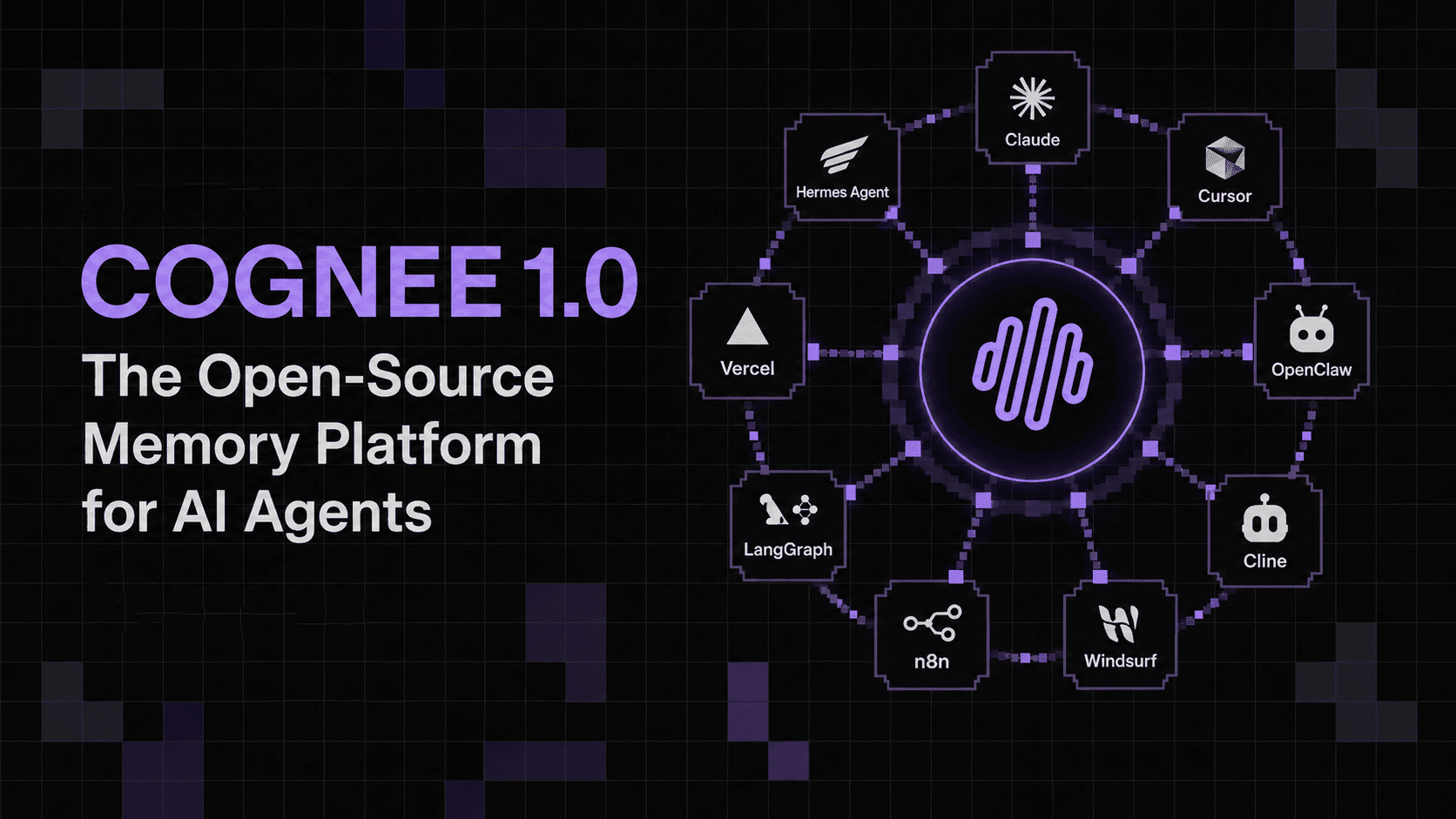
cognee 1.0: The Open-Source Memory Platform for AI Agents

Claude Code's Leak Reveals Anthropic's Obsession with Cognee

Cognee Raises $7.5M Seed to Build Memory for AI Agents
Anthropic API Cost in 2026: Claude Pricing and Calculator
Grok Pricing in 2026: API Costs and Calculator
Top AI Podcasts for Engineers: 10 Shows Worth Your Time in 2026
Elevating AI-Driven Credit Card Insights: A Tier-1 US Bank's Semantic AI Memory Discovery
Turning PDFs into Evidence-Based Answers: How We Built a Trustworthy Evidence Graph for UWYO
Smart Networks, Smarter Students: How cognee Connected 40,000 German Learners
Local AI Memory: Keeping Agent Memory Off the Cloud
AI Memory Tools vs. Databases: 5 Memory Layers Compared (2026)
How to Evaluate AI Memory in 2026: 5 Tools Compared
Why AI Agents Forget and How to Fix Their Memory
Give Claude Code Persistent Memory With cognee
Structure Your Skills with Cognee
Keenable × cognee: Giving Web Retrieval Persistent Memory
Cut Cognee's Vector Memory by 8x with Qdrant's TurboQuant