GraphRAG vs RAG: Key Differences and How to Choose

Retrieval-augmented generation (RAG) gives large language models access to information beyond what they learned during training. The retrieval layer searches an external knowledge base, adds relevant context to the prompt, and gives the model evidence to work from before it writes an answer.
The difference between GraphRAG and RAG comes down to what that retrieval layer treats as relevant.
Baseline RAG works by converting documents and queries into vector embeddings, then searching a vector database for chunks that are semantically similar to the question, which is effective when the answer can be found in a few text fragments.
GraphRAG represents the domain as a knowledge graph of entities and their relationships. It can still run semantic search, but, if needed, it will also traverse the graph and retrieve context that shows how different pieces of information connect.
For a query like: Which customers encountered a specific authentication problem, what caused it, and which release resolved it?
A RAG system will likely retrieve support tickets, an engineering note, and a release document because they all resemble the query, then leave the model to infer which tickets describe the same issue and which release fixed which one.
A GraphRAG system, on the other hand, can retrieve or assemble the connected path explicitly: customer → support ticket → authentication issue → root cause → release.
That approach makes the final answer more complete and easier to verify, but that stack also takes more work to build and maintain. The right architecture choice depends less on which tech is more advanced and more on the questions the system actually needs to answer.
GraphRAG vs Vector RAG at a Glance
Let's look a bit more carefully at the difference in how RAG and GraphRAG represent the external knowledge they retrieve.
Baseline RAG — sometimes called vector RAG — divides documents into chunks, converts them into embeddings, and uses vector similarity search to find passages related to the query.
GraphRAG adds a knowledge graph on top of that — depending on the implementation, it can combine vector search with graph traversal, graph queries, and summaries of related graph communities, with vector retrieval still providing the entry point that the graph then expands.
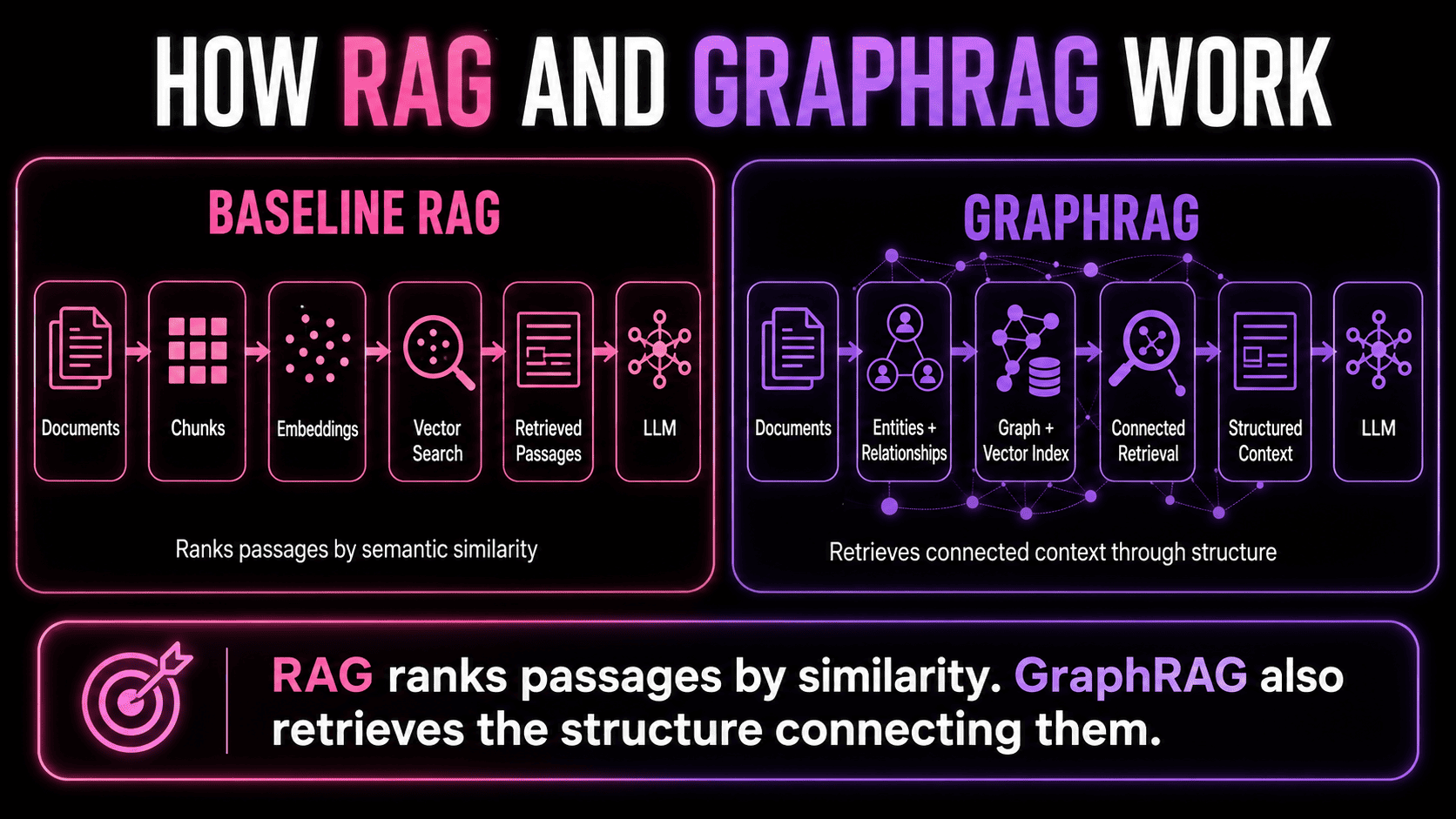
Here's a quick comparison of where each retrieval approach performs best, where it starts to struggle, and what kind of workload it suits.
| Baseline / vector RAG | GraphRAG | |
|---|---|---|
| Core concept | Retrieve semantically similar passages before the LLM generates an answer | Retrieve connected context through entities, relationships, graph paths, and supporting sources |
| Primary retrieval unit | Text chunk, found by vector similarity | Entities, relationships, graph paths, and source passages |
| Data structure | Text chunks represented as vector embeddings, usually stored with metadata | Knowledge graph plus source text, metadata, and often a vector index |
| Relationship handling | Usually left for the LLM to infer from retrieved text | Represented explicitly in the retrieval layer |
| Ideal fit | Documentation Q&A, FAQ assistants, direct support questions, answers in a small number of passages | Relationship-heavy knowledge bases, multi-step questions, provenance tracking, corpus-wide themes |
| Indexing | Chunk, embed, store | Extract entities and relationships, resolve duplicates, build the graph, embed, optionally summarize communities |
| Strengths | Simple to build and update; reliable whenever semantic similarity is a good proxy for where the answer lives | Preserves how information connects; stronger for entity-aware retrieval and evidence spread across sources |
| Limitations | Semantically similar passages may describe different entities, versions, or events, leaving the LLM to guess how they relate | Depends on extraction and entity-resolution quality; a noisy graph adds complexity without improving the answer |
| Typical cost | Lower | Higher |
It all really boils down to the unit being retrieved — baseline RAG retrieves passages and GraphRAG retrieves the connected context around the facts those passages contain, which becomes valuable once a question requires establishing which people, products, events, and versions belong together.
None of this makes GraphRAG automatically the better architecture. When the answer appears in one or two clear chunks, vector RAG is usually faster, cheaper, and easier to maintain.
When to Use RAG vs GraphRAG
The clearest way to decide is by looking at what the questions your system actually receives require, not by picking the architecture that sounds more 'modern.'
Stick with RAG when:
- Most answers depend on finding the passages where they're described (what does this feature do, how do I reset an API key)
- The corpus is already clean and stable, with strong metadata and one authoritative version per topic
- Data changes frequently and reindexing needs to stay cheap and fast
- Latency and cost constraints are strict and the questions are mostly direct
- The domain doesn't have a stable entity model yet, or is too subjective and loosely organized to fit one
- The system is new and you're still learning where the retrieval fails
Shell out for GraphRAG when:
- Evidence is spread across a number of sources that need to be joined correctly (which tickets describe the same bug, which release fixed which issue)
- Entity identity needs resolving — aliases, account IDs, and similar names all referring to the same thing
- The answer requires multiple sequential steps rather than one lookup (which policy applies to this account, after the most recent amendment, in this region)
- Provenance needs to cover relationships and not just chunks — which source established a connection, not just which source got cited
- Versions and timelines determine the answer, and an outdated document shouldn't look equally authoritative just because its wording matches the query
- Users regularly ask corpus-wide questions no single passage can answer
- An agent needs persistent, connected context — memory of users, tasks, decisions, and outcomes across sessions, not just retrieved passages
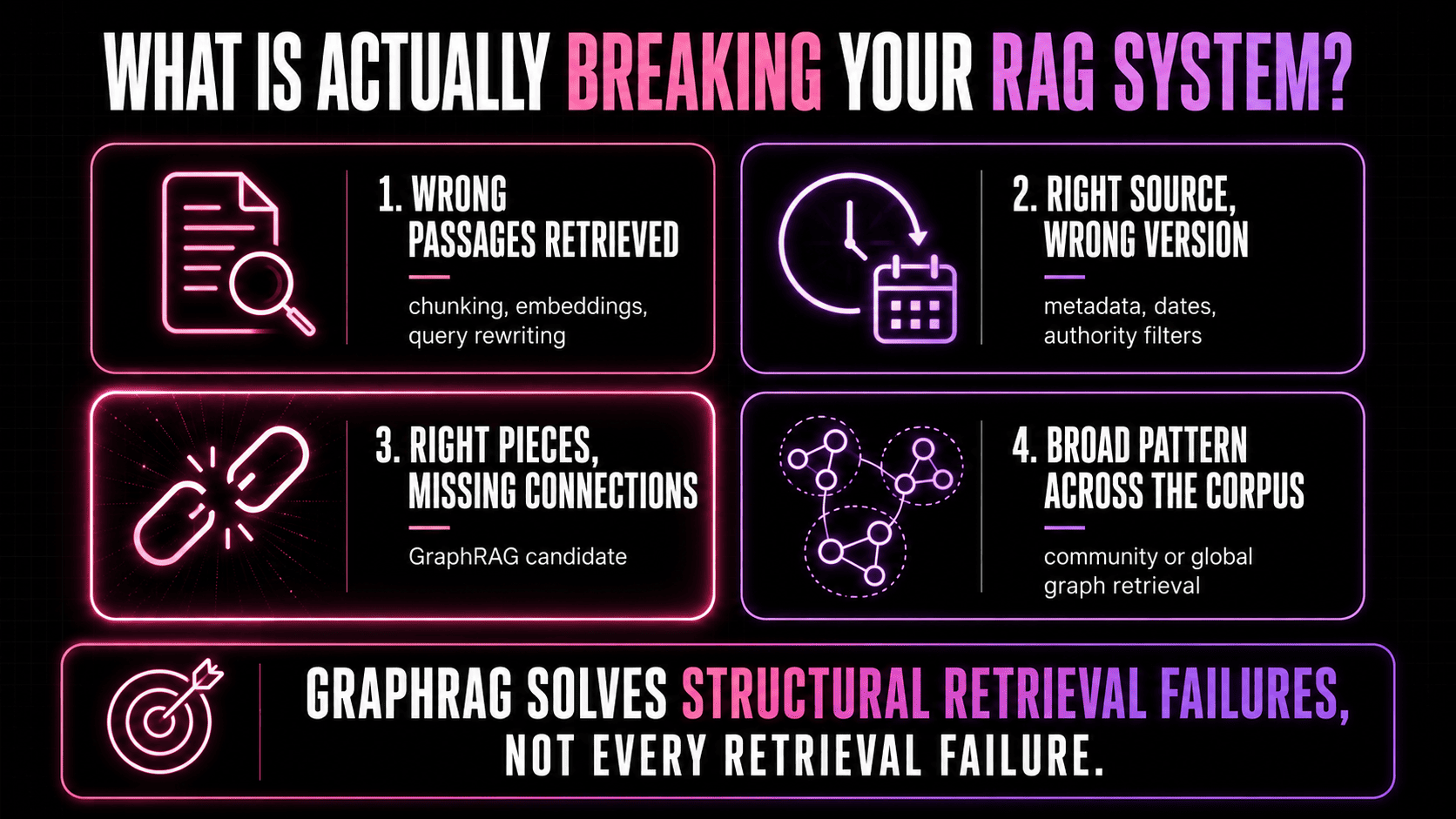
Weak RAG systems don't automatically need a graph. Plenty of retrieval failures trace back to bad chunk boundaries, missing metadata, weak query rewriting, or no reranking — none of which a graph fixes.
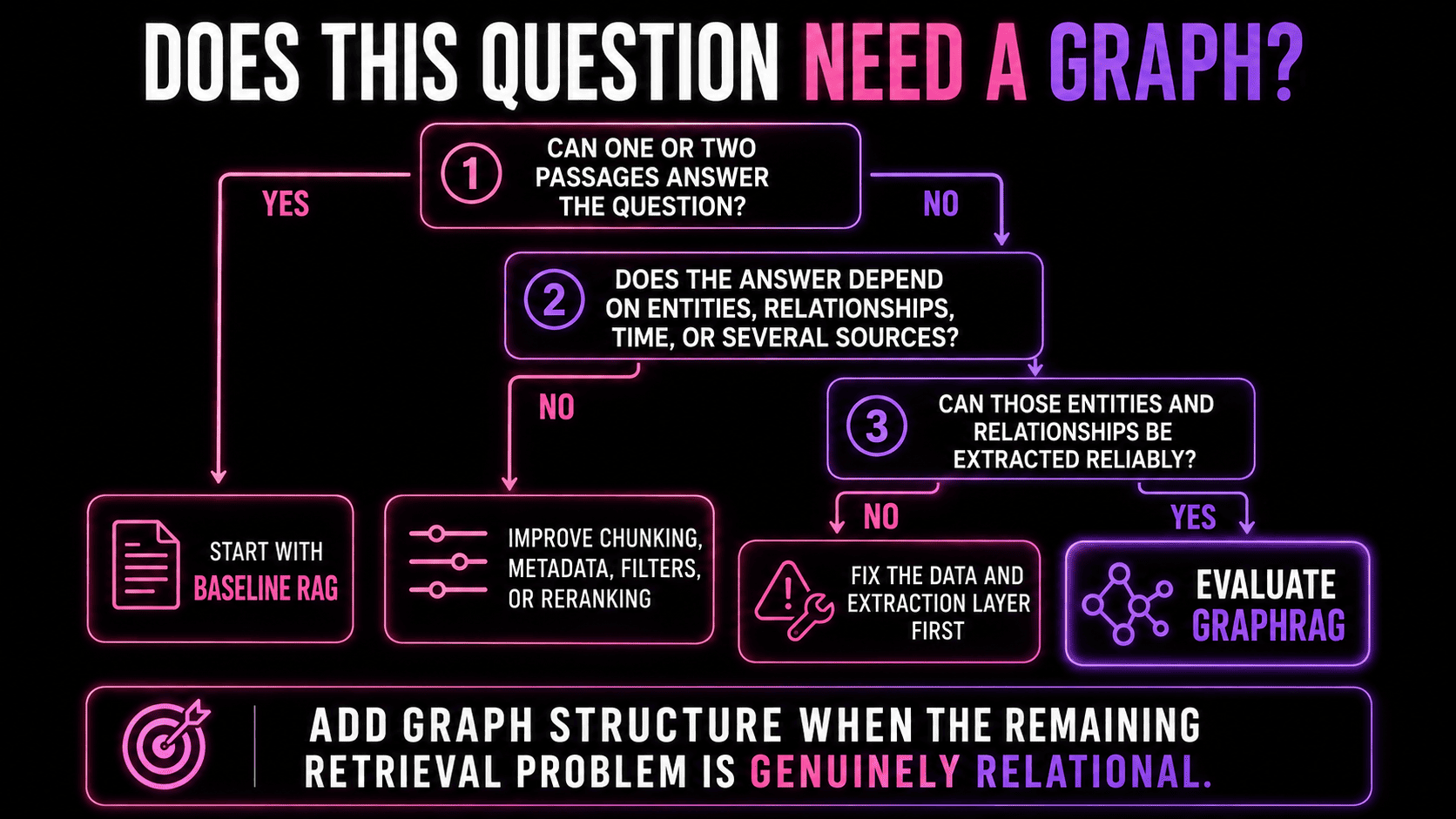
So, a sensible progression is to start with baseline RAG, evaluate where it actually fails, and add graph structure only where those failures are genuinely relational rather than something that can be solved with better chunking or filtering.
The Checks Worth Running Before Going Graph
When you're ready to decide for real, this is what to pay attention to:
- The query distribution: Group real user questions by type — direct lookup, comparison, entity investigation, temporal reasoning, corpus-wide analysis. If most are direct passage lookups, baseline RAG is probably enough; if a meaningful portion depend on relationships, identity, or time, GraphRAG should be considered.
- Diagnose failures first: If the system retrieves the wrong passages entirely, that's a chunking, embedding, or filtering problem, and a graph won't fix it. A graph structure is most valuable only once the system retrieves the right pieces but still can't establish how they connect.
- Check whether entity recognition and extraction are actually reliable: If the pipeline can't consistently identify the correct entities, relationship types, and duplicates, graph traversal will confidently follow incorrect connections — an incorrect answer that appears more strongly supported.
- Test both architectures on the same questions and the same corpus. Measure retrieval relevance, answer faithfulness, multi-step accuracy, entity and relationship accuracy, latency, and indexing cost. GraphRAG is worth incorporating when the results show it materially improves the relevant questions, not because it's more sophisticated-sounding tech.
Is Anything Better Than GraphRAG?
No architecture is universally better than GraphRAG. It's built for questions that hinge on relationships, entities, and corpus-wide structure, and other approaches can outperform it when the workload prioritizes lower indexing cost, faster updates, or straightforward passage retrieval.
The useful question here is: which retrieval structure matches the questions, the data, and the operating constraints.
Vector RAG remains the better option for direct retrieval: documentation Q&A, product search, FAQ assistants, and other passage-level tasks where entity resolution and graph traversal add little. It's just the more economical architecture choice for a different class of problem.
Hybrid vector + graph RAG is often the most sensible production option: vector search finds a relevant entry point even when the query's wording differs from the source; graph traversal expands from there through connected entities and documents.
While there are no inherently better alternatives, a few approaches offer different cost and complexity trade-offs:
- RAPTOR, which solves a different problem than GraphRAG — instead of extracting entities and relationships, it recursively clusters and summarizes chunks into a tree, with detailed passages at the lower levels and broader themes higher up. It works best for long-document synthesis where named entities and cross-document relationships aren't necessary for the answer; GraphRAG is more suitable when they are.
- LazyGraphRAG, introduced by Microsoft, delays most of GraphRAG's summarization work until query time instead of building it all upfront, trading some query-time computation for a much cheaper indexing step. It's worth considering when full GraphRAG indexing is too expensive, or when large parts of the corpus may never actually get queried.
- DRIFT — Dynamic Reasoning and Inference with Flexible Traversal — combines local and global search, starting with broader community-level context from the graph, then following more focused paths to gather detail. It's useful when a query starts with a specific subject but can't be fully answered without understanding the wider corpus around it.
Sometimes the best alternative to what GraphRAG offers is simply strengthening the foundation by improving chunk boundaries, metadata filters, hybrid keyword-and-semantic search, reranking, and source-authority scoring — this solves more retrieval problems than people expect.
A graph becomes a viable implementation once the remainder of the problem is genuinely structural — the right passages are already retrievable, but the system still can't reliably model how they relate.
| Approach | Better suited to | Less suited to |
|---|---|---|
| Vector RAG | Direct questions, documentation search, low latency, frequently updated corpora | Relationship-heavy and corpus-wide questions |
| GraphRAG | Entities, relationships, provenance, multi-step retrieval | Simple questions where graph construction adds little value |
| Hybrid vector + graph | Workloads mixing semantic discovery with relationship-aware retrieval | Systems that can't justify running multiple retrieval layers |
| RAPTOR | Long documents, hierarchical summaries, multi-section questions | Domains where explicit entities and relationships are essential |
| LazyGraphRAG | Lower upfront indexing cost, adaptable query-time quality | Workloads that need consistently low query-time computation |
| DRIFT | Questions needing both local evidence and broader context | Simple passage retrieval with no need for graph exploration |
The best architecture choice is, of course, the least complex and most cost-effective one that retrieves enough trustworthy context for the questions the system is actually receiving.
Why Choose? cognee Handles Both
Many production applications need both passage-level retrieval and relationship-aware context. Direct questions may only require semantically relevant source material, while multi-step questions need the system to recover the entities, relationships, and provenance connecting several facts.
cognee brings those capabilities into one AI memory engine. remember() turns documents and data into permanent, graph-backed memory, while recall() can automatically route a query to the most suitable available retrieval strategy. Developers can also select a specific search type when they need direct control over retrieval.
That gives direct and relationship-heavy questions access to the same underlying memory without requiring separate ingestion pipelines. Vector retrieval provides semantic reach, graph retrieval preserves connected structure, and provenance keeps the resulting context tied to its sources.
The practical answer to RAG or GraphRAG is therefore to begin with the questions. Use the simplest retrieval path that answers them reliably, then add graph structure where identity, relationships, versions, or multi-step context materially improve the result.
FAQ
Answers to the most common questions from this guide.
Does GraphRAG still use vector embeddings?
In most implementations, yes. Vector search identifies a relevant passage or entity even when the query's wording differs from the source, and graph traversal expands from that entry point to connected entities and documents. GraphRAG and vector RAG work best as complementary layers rather than separate systems.
Does GraphRAG require a dedicated graph database?
Not necessarily. The system needs some way to represent and query graph-shaped data, but that can live in a dedicated graph database, a relational database with graph support, an in-memory graph, or another graph index. What matters is the explicit representation of entities and relationships, not the specific storage product.
Can GraphRAG reduce LLM hallucinations?
It can reduce some risk by giving the model more structured, source-aware context — the graph helps distinguish entities, preserve relationships, and connect claims to supporting documents. It isn't a guaranteed hallucination solution; extraction errors, outdated sources, or incorrect graph relationships can all introduce new failure modes.
What are the main disadvantages of GraphRAG?
Higher indexing cost, more complex maintenance, and a dependency on extraction quality. The system has to identify entities, extract relationships, reconcile duplicates, and keep graph structure linked to its sources — if any of those stages are unreliable, the graph can make retrieval more complicated without making it more accurate.
Can I start with vector RAG and add graph structure later, without rebuilding everything?
Generally, yes. A vector index and a knowledge graph can coexist — the vector store keeps working for direct retrieval while entity extraction and graph construction run against the same source documents. This is often the most practical path: start with baseline RAG, identify which failures are genuinely relational, and add graph structure where it improves the results.