What Is Agentic RAG? How It Works and When to Use It

Ask an AI system a complicated question like: "Which changes in the last two releases could explain the new authentication failures, and how were these kinds of incidents handled before?"
A single-pass RAG system may retrieve chunks mentioning "authentication," "failure," and the latest release. It may generate a plausible synthesis from the first results, but unless its workflow was explicitly designed to break down the question, search incident history separately, and revisit missing evidence, it has no mechanism for deciding that the causal chain still needs investigation.
Agentic RAG, on the other hand, gives the system a way to investigate before answering. An agent decides whether retrieval is needed, deconstructs the question into smaller pieces, chooses which tool or source should address each one, examines what came back, and searches again when something is missing.
In this post, we'll look at the cogs of that process, compare it with a well-built fixed RAG pipeline, not just its most basic form, show how cognee can oil up this machine so it runs even better, and explain when the additional architecture is worth the upgrade.
What Is Agentic RAG?
Agentic RAG is a form of retrieval-augmented generation in which an AI agent, usually driven by a large language model, controls the information-retrieval process rather than following a fixed pipeline. While regular RAG gives a model access to external data, agentic RAG gives an agent control over how it gets that access.
In the agentic RAG paradigm, retrieval is no longer a mandatory first step but one action among several that the agent can take, repeat, skip, or combine with others, depending on what the request actually requires.
Agentic RAG, RAG Agents, and Agentic AI
These terms are often used interchangeably, which causes real confusion. So let's specify them before moving on:
| Term | What it means |
|---|---|
| Agentic RAG | An architecture in which an agent controls the retrieval process |
| RAG agent | An agent that uses retrieval as one of its tools or specializes in finding information for a larger system |
| Multi-agent RAG | Retrieval and reasoning divided across several agents, such as a router, retriever, and verifier |
| Agentic AI | The broader category of systems that plan and take action; retrieval isn't required |
Agentic RAG is a specific pattern applied to the retrieval problem, within agentic AI. A RAG agent is usually the component performing retrieval inside that pattern.
None of this requires more than one agent. A single agent with several tools can be just as agentic as a five-agent pipeline.
Either architecture may involve several model calls as the system plans, uses tools, and evaluates the results. What makes it agentic is who decides the next step, not how many agents are involved.
Traditional RAG → […] → Agentic RAG
Most explanations make it look like this is a binary choice between traditional RAG or agentic RAG. That skips a step — exactly the one you don't want to trip over when deciding whether to go agentic at all.
- Naïve RAG retrieves once and generates: query in, chunks out, answer written from whatever came back.
- Enhanced RAG adds predefined modules around that core process: query rewriting, routing to the right index, hybrid keyword-and-vector search, and reranking the retrieved results. The operations and their order are designed in advance and fixed.
- A lot of what people assume only agentic systems can do, like rewrite a weak query, search several sources, or rerank results, is already possible in enhanced RAG.
- Agentic RAG gives the model control over those operations. Rather than always rewriting, retrieving, and reranking in the same sequence, the agent decides whether the current request needs rewriting, whether the first retrieval pass covers it, which tool to call next, and when the available evidence is sufficient.
- The fundaments may be the same as those used in enhanced RAG, but the difference is in who controls them.
How Does Agentic RAG Work?
A pass through an agentic RAG loop generally follows seven steps:
- Interpret the request. The agent determines what is being asked, whether the task contains several subquestions, and whether retrieval is necessary.
- Plan the retrieval. Complex requests are unpacked. "Explain the authentication failures" might become "what changed," "what depends on it," "has this happened before," and "what fixed it last time."
- Choose tools and sources. The agent selects semantic search, keyword search, a knowledge graph, SQL, an API, web search, code search, or another tool suited to each subquestion.
- Retrieve evidence. It runs the first search and receives documents, records, entities, relationships, or tool output.
- Evaluate what came back. The agent checks whether the evidence covers the whole question, whether it's current, whether sources conflict, and whether an important connection is missing.
- Refine and retrieve again when needed. It can rewrite the query, split it further, change sources, use another retrieval method, or follow a relationship in the graph.
- Generate and verify the answer. The response is built from the evidence gathered, ideally with source references, and checked for claims the available evidence doesn't support.
A fixed pipeline can include both evaluation and another retrieval pass, but what makes the final stages of this process agentic is that the model evaluates the evidence produced during this particular run and decides (with agency) whether another action is needed and which action to take.
Four Capabilities of Agentic RAG (+ One Useful Extension)
1) Autonomous Planning
The agent decides how to approach a request by breaking the query into subtasks, determining their order, selecting a source for each one, and deciding when enough information has been gathered to move forward.
Planning doesn't have to mean writing an elaborate multi-step strategy before any action occurs. It can also happen incrementally: retrieve one piece of evidence → reassess the task → choose the next useful step.
This query-planning stage may happen upfront or develop incrementally as new evidence appears.
2) Iterative Retrieval
The first retrieval might reveal the name of an affected service, which leads to its deployment history. That history might identify a release, which leads to a related incident report. The retrieval path develops from the evidence rather than being fully determined beforehand.
Iteration needs to be purposeful; it should plug a gap, resolve a conflict, or pursue a newly discovered connection. Repeating a weak retrieval process doesn't make the evidence better.
3) Tool Integration
Common agentic RAG tools connect the agent to internal data sources, knowledge bases, and external tools.
Depending on the request, it might use:
- Vector search for semantically related passages
- Keyword search for identifiers, names, and error codes
- Graph traversal for entities and relationships
- SQL for structured records
- External APIs for current system data
- Code search for implementations and dependencies
- A memory layer such as cognee
A fixed pipeline can use several tools too, but an agentic workflow lets the agent choose among them based on the current request and the evidence already collected.
4) Self-Reflection and Verification
The agent evaluates whether the evidence actually addresses the question, whether sources disagree, and whether a claim in the proposed answer lacks support.
This needs to be tied to something concrete, like retrieved evidence, source provenance, database output, test results, or another tool's response.
A useful verification step may ask:
- Is every part of the request addressed?
- Can each important claim be traced to evidence?
- Are the sources current, authoritative, and non-conflicting?
- Is the agent inferring a connection that should be retrieved directly?
- Should the system retrieve again, abstain, or escalate?
The objective is not just "more reasoning," but better-grounded and more accurate responses.
Extending the Core: State and Persistent Memory
State lets the agent carry evidence, intermediate results, and decisions through the current retrieval loop. Without it, each tool call would be disconnected from the work that came before.
Persistent memory extends that continuity across separate runs. It allows validated outcomes, previous investigations, corrections, and established relationships to inform future work rather than disappearing when the current process ends.
State within a run is fundamental to a multi-step workflow. Persistent memory across runs is optional, but becomes increasingly advantageous when the agent handles recurring investigations, ongoing accounts, long-running projects, or related questions over time.
This is the continuity we built cognee to provide agents with.
What Is the Difference Between RAG and Agentic RAG?
Here's a quick breakdown of the distinctions between standard RAG (including the enhanced pipelines with predefined rewriting, routing, reranking, or evaluation) and agentic RAG:
| Feature | Fixed RAG pipeline | Agentic RAG |
|---|---|---|
| Core workflow | Retrieval operations and their order are defined in advance | The agent decides which operations to perform and in what order |
| Autonomous planning | Decomposition and routing must be explicitly designed into the pipeline | The agent plans its approach for the current request |
| Iterative retrieval | May repeat retrieval according to predefined rules or thresholds | Decides dynamically whether, why, and how to retrieve again |
| Tool integration | Can use several tools, but their selection is predetermined | Chooses among vector search, graph search, databases, APIs, and other tools at runtime |
| Self-reflection and verification | Uses predefined evaluators, checks, or corrective modules | Evaluates the current evidence and decides what action to take next |
| State and memory | Can use state or persistent memory when explicitly added | Commonly maintains state across steps; persistent memory across runs remains optional |
| Execution path | Relatively predictable | Changes according to the request and intermediate results |
| Latency | Usually lower and more consistent | Usually higher and more variable |
| Cost | Easier to forecast | Depends on planning, tool calls, and retrieval rounds |
| Best fit | Focused Q&A, predictable queries, and well-understood retrieval paths | Research, investigation, multi-source questions, and adaptive workflows |
| Main risk | The designed workflow may not adapt when unexpected evidence is missing | Loops, unnecessary calls, weak tool choices, or errors compounding across steps |
Most production systems fall somewhere on the spectrum between a bare-bones pipeline and a fully autonomous agent. A well-built enhanced pipeline with query rewriting, hybrid retrieval, reranking, and evaluation already solves many of the problems that lead people towards agentic RAG.
Agentic RAG Architecture
A working agentic RAG system generally has five moving parts:
- The agent or orchestrator plans the workflow, chooses tools, evaluates results, and decides when to stop.
- Retrieval tools perform the searches: semantic retrieval, keyword search, graph traversal, structured queries, code search, or external API calls.
- A knowledge layer contains the documents, entities, relationships, metadata, and records those tools search.
- State and memory preserve the evidence and decisions needed during the current run and, where useful, across future runs.
- Verification and generation determine whether the evidence is sufficient and produce the final response from what passed that check.
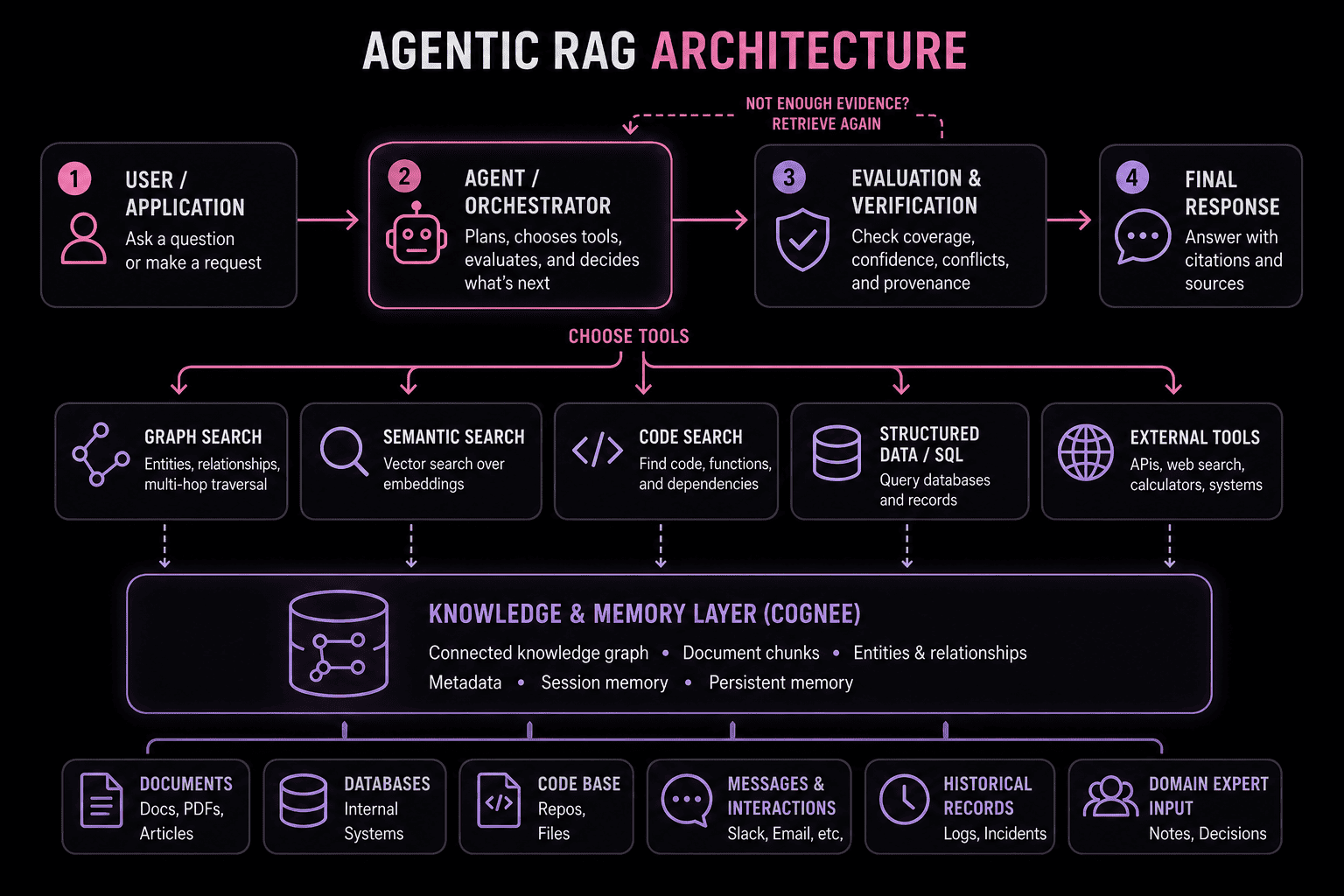
In this workflow, cognee is not the orchestrator. The agent or framework — such as LangGraph, a custom loop, or another runtime — plans the work and chooses the next action. cognee provides the connected knowledge base and memory layer that its retrieval tools search.
The agent can use cognee for graph-grounded retrieval, semantic or lexical chunks, summaries, code-aware search, temporal retrieval, and session-aware recall. Validated findings can then remain available in permanent graph memory so a later run can build on them instead of starting over.
Agentic Retrieval Techniques
The capabilities above describe what makes a workflow agentic. The information-retrieval techniques it chooses among may include:
- Query planning and decomposition — dividing a complex request into smaller information needs.
- Query routing — deciding whether retrieval is needed and which knowledge base or data source to search.
- Query rewriting — reformulating a weak query when the first results are incomplete.
- Multi-hop retrieval — using one result to identify the next entity, record, or relationship to retrieve.
- Hybrid retrieval — combining semantic, lexical, metadata-based, and graph search.
- Corrective retrieval — changing the search strategy when the evidence is weak or conflicting.
- Reranking and filtering — selecting the most relevant information before generation.
These techniques are not inherently agentic — they become part of an agentic workflow when the model decides whether, when, and how to apply them during the current run.
Is Agentic RAG Worth It?
Agentic RAG is worth it when adapting the retrieval process creates enough value to justify the additional latency, token use, and operational complexity — most questions that a proper fixed RAG pipeline already answers well don't clear that bar.
A fixed or enhanced pipeline usually suffices when:
- Questions are narrow and repeat frequently
- One well-maintained index already contains the answer
- Latency must remain low and consistent
- Costs need to be predictable
- The retrieval path can be configured reliably in advance
- A fixed router, rewriter, reranker, and evaluator already address the main failure modes
Go for agentic RAG when:
- The question requires several dependent retrieval steps
- Information is distributed across genuinely different sources
- The right retrieval method varies from one request to another
- The task depends on following relationships or investigating missing evidence
- Missing an important connection is more costly than the additional retrieval time
- The workflow runs long enough for state or persistent memory to matter
The cost difference is measurable, although the exact numbers depend on the models, tools, and workflow being tested. In the configurations examined by the 2026 ACL study, the agentic system used roughly 3.3× as many input tokens and 1.9× as many output tokens as the enhanced pipeline, while taking around 1.5× as long to execute. Some configurations also produced substantially higher costs.
The same study found that neither architecture performed best everywhere. The fixed enhanced pipeline's dedicated reranking module was stronger at reranking retrieved documents, while the agentic approach performed well at query rewriting and intent handling in some structured domains.
Common Agentic RAG Use Cases
Agentic RAG is most valuable when answering a question requires drawing from multiple sources, executing dependent research steps, or evidence that has to be checked before the system can act on it. Here are some areas where it can provide an edge over baseline RAG:
- Research and investigation — following leads across sources, comparing them, and recognizing when the evidence is still incomplete.
- Technical support and incident response — combining documentation, tickets, code, service relationships, and previous resolutions.
- Compliance and due diligence — gathering evidence across policies, records, and contracts while preserving provenance.
- Long-running workflows — carrying state through extended tasks and recalling validated findings from earlier runs.
Agentic RAG buys adaptability, and adaptability is rarely free.
Agentic RAG Guardrails
An agent should not be allowed to retrieve indefinitely or treat every retrieved result as authoritative. A production workflow needs boundaries around both its actions and the information it uses.
Useful guardrails include:
- A maximum number of retrieval rounds and tool calls
- Clear stopping and abstention conditions*
- Restricted tool access and source-level permissions
- Provenance attached to retrieved evidence
- Traces showing which queries, tools, and sources produced the answer
- Checks for stale, superseded, or conflicting information
- A way to correct, update, or forget persistent memory
- Human approval before consequential external actions
The stopping condition should be more specific than "continue until satisfied." The system might stop when every subquestion has supporting evidence, when a confidence or coverage threshold is reached, or when the retrieval budget has been exhausted. When the evidence remains insufficient, the correct outcome should be an explicit limitation or request for clarification.
How to Build a cognee-Powered Agentic RAG Workflow
The best way to learn is by doing. So, we're going to build a workflow with our own deterministic orchestration loop from scratch to see the power of Agentic RAG in every run.
Note: if you want to connect cognee to an existing orchestration framework (e.g. Claude Code, Codex), you can do that using cognee MCP. This example is better suited for developers who want to write their own custom flows.
With cognee's API, we can write a Q&A support bot that diligently verifies its answer across an existing knowledge graph.
Here is a rough sketch of an example workflow, which we'll implement in code below:
Note: you can paste these code snippets sequentially as they appear in this document.
Note: the example runs self-contained on the default local stack (Ladybug graph, LanceDB vector, SQLite relational) inside an isolated data directory, so it never touches your configured databases. It requires only LLM_API_KEY (OpenAI) in the environment. If you'd like to use cognee Cloud instead, refer to the docs.
Here are the imports & cognee configuration:
And here is an existing corpus of knowledge for your use in this example (feel free to change it as you see fit).
We also need to generate structured output for steps 2-5. So, we define schemas for the LLM and a call wrapper for each step:
Finally, we need to wrap cognee.recall() in a custom retrieval tool for this agent to use:
Perfect, we're good to go! Let's write the full pipeline:
So what does cognee do here? In this example, cognee unifies the context the agent needs to search and remember: graph relationships, supporting chunks, exact matches, session context, and durable memory. The orchestrator still decides what to retrieve and when; cognee specifically makes the knowledge beneath that process connected, scoped, and reusable across runs.
FAQ
What is a RAG agent?
A RAG agent is an AI agent that uses retrieval as one of its tools or specializes in finding information for a wider workflow. It becomes part of an agentic RAG system when it can decide what to retrieve, which source to use, and whether another retrieval step is needed.
Do you need multiple agents to build agentic RAG?
No. A single agent with several tools can be fully agentic when it decides whether retrieval is needed, what to retrieve, which tool to use, and whether to retrieve again. Multi-agent architectures divide those responsibilities across specialized roles, but the number of agents isn't what makes the system agentic.
Does agentic RAG require a knowledge graph or graph database?
No. An agent can plan retrieval over vector search, keyword search, databases, APIs, or any other accessible source. A knowledge graph becomes particularly useful when the task depends on following relationships between entities, such as which component a change affected or which previous incident was resolved by a particular fix.
Can I add agentic behavior to a RAG pipeline I already have, without rebuilding it?
Usually, yes. Start with the fixed pipeline you already have and identify the specific decisions it handles poorly — perhaps a query type it cannot route correctly or a source it never checks. Give the agent control over those points rather than replacing the entire workflow. Many production systems combine fixed steps where the path is reliable with agentic control where adaptability earns its cost.
What happens if the agent's retrieval loop never finds enough evidence?
The loop should have an explicit limit, such as a maximum number of retrieval rounds, tool calls, or tokens. When the limit's reached without sufficient evidence, the system should report the gap, abstain, or ask for clarification rather than producing a confident answer from incomplete context.
How is Agentic RAG different from agentic AI?
Agentic AI is the broader category of systems that plan and take actions. Agentic RAG is a specific application of that approach in which an agent controls how external knowledge is retrieved and used.
Does agentic RAG eliminate LLM hallucinations?
No. Agentic RAG may reduce hallucinations and unsupported claims when retrieval and verification work correctly, but it is not an LLM hallucination solution. Reliability comes from retrieval quality, provenance, source controls, and verification logic — not simply from giving the agent more steps in which to reason.