LLM Hallucinations: What They Are & How to Detect Them

Production AI systems need to deliver answers that do more than sound fluent — they need to be verifiable before a user acts on them.
What Is an LLM Hallucination?
A simple LLM hallucination definition is: a large language model producing an answer that sounds plausible but is false, unfaithful to its source, or built on evidence that was never there.
What makes their detection a real engineering problem is that hallucinations don't announce themselves. A wrong answer can be fluent, specific, well-formatted, and more confident-sounding than a cautious correct answer. The model may invent a citation in the same style as a real one, summarize a document with details that were never included, or describe a product feature that sounds entirely plausible but doesn't exist.
What causes LLM hallucinations?
Some hallucinations come from gaps in training data or a lack of real-world knowledge about a specific domain. Others come from weak retrieval, ambiguous prompts, outdated context, or the model filling in its lack of knowledge rather than admitting the evidence isn't there. Even in RAG systems, the answer can stray away from the correct retrieved source material.
In systems where users act on the answer, like customer support, legal review, financial analysis, medical triage, internal operations, or automated agent workflows, hallucinations can cause real-world problems, the least of which is erosion of user trust.
That's why, in this article, we'll explain what exactly LLM hallucination detection encompasses, which methods are useful in practice, and how production systems can combine grounding, evaluation, observability, and guardrails to catch unreliable LLM outputs before users act on them.
Catching Wrong Answers That Sound Right
Detection works by checking the answer against ground truth, comparing it with retrieved sources, looking for inconsistency across outputs, or using confidence signals from the model itself. But detection is just one part of the hallucination reduction process, which includes:
- Detection checks a specific output: is this answer likely wrong, unsupported, or unsafe to rely on?
- Prevention reduces how often hallucinations happen in the first place, through better retrieval, cleaner sources, clearer prompts, and stricter response constraints.
- Evaluation measures hallucination rate across a whole system over a test set, which is useful for comparing model versions, prompt strategies, or retrieval pipelines over time.
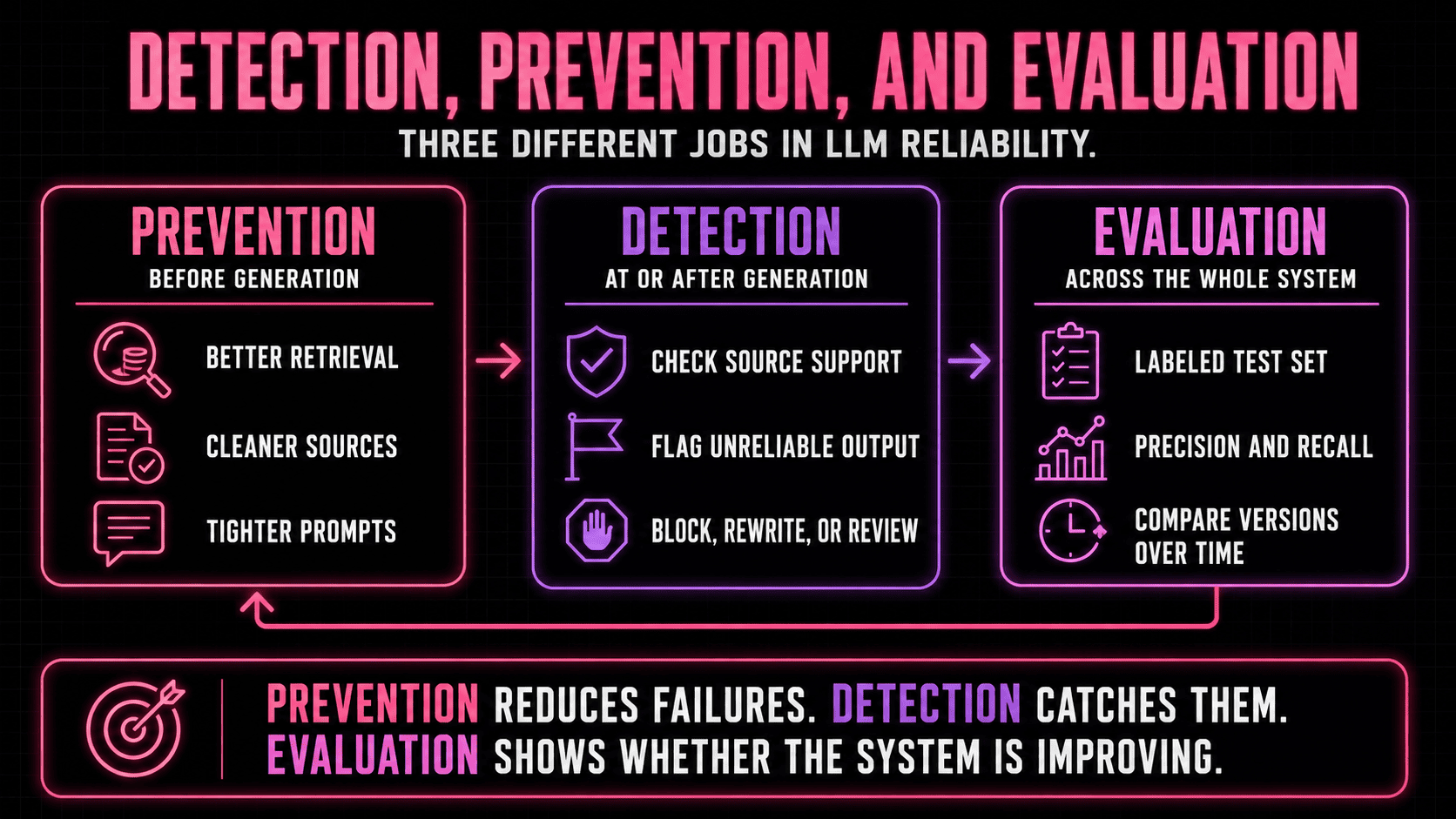
A system with strong prevention will still benefit from detection. A system with good detection still needs evaluation to know whether things are getting better or worse over time.
One more distinction worth making early:
- Factuality asks whether a claim matches the real world. If an LLM says a company launched a product in 2024, factuality detection checks whether that actually happened.
- Faithfulness — also called groundedness — asks whether the answer is supported by the source the model was given. An answer can be factually true somewhere in the world and still be unfaithful if the retrieved document never mentions it.
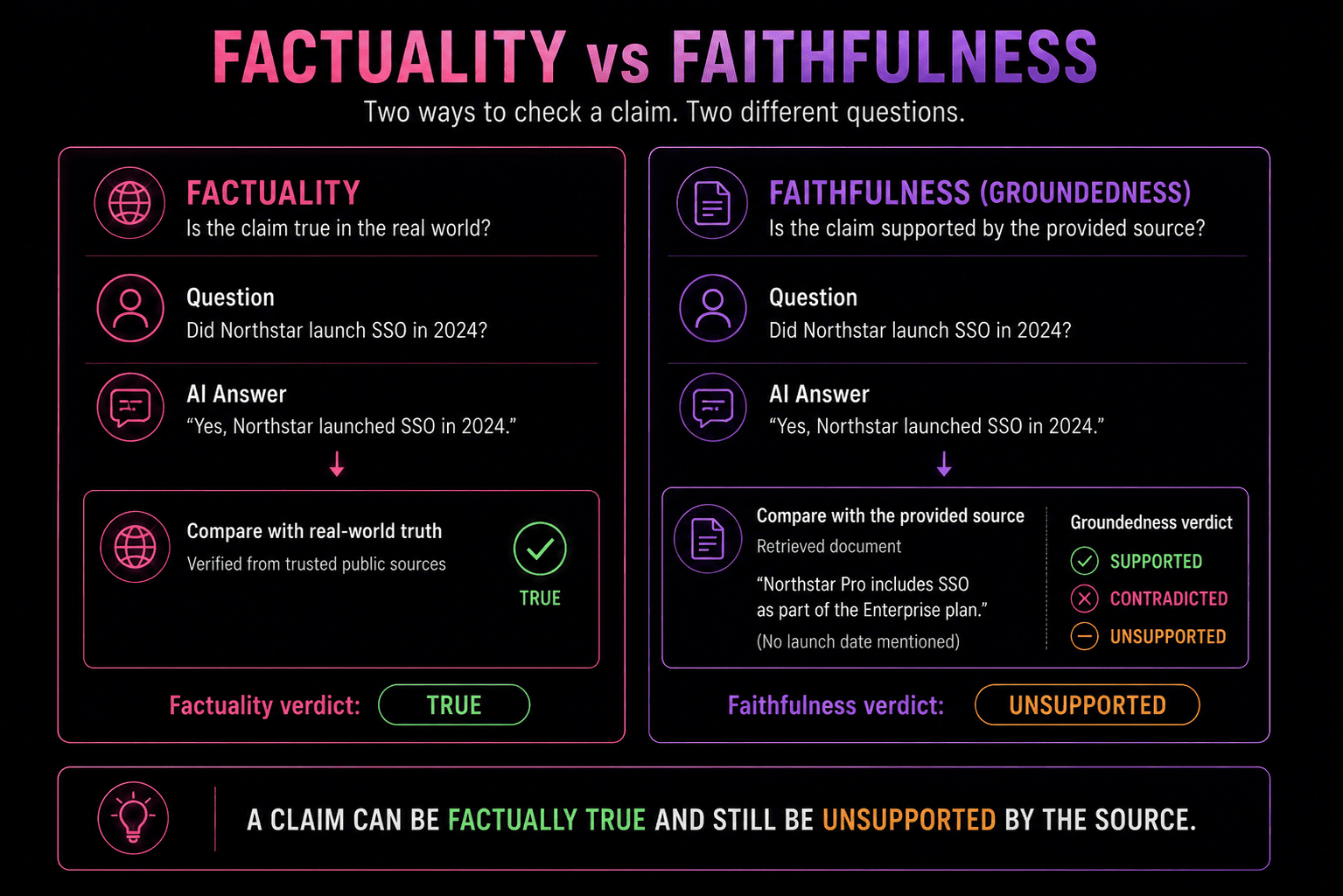
For most production systems, faithfulness is the more tractable target because there's already a source to check against, like retrieved RAG context, a trusted knowledge base, or a structured knowledge graph. Factuality checking against open-ended world knowledge is harder, slower, and less reliable.
Detection Methods, and What Each Is For
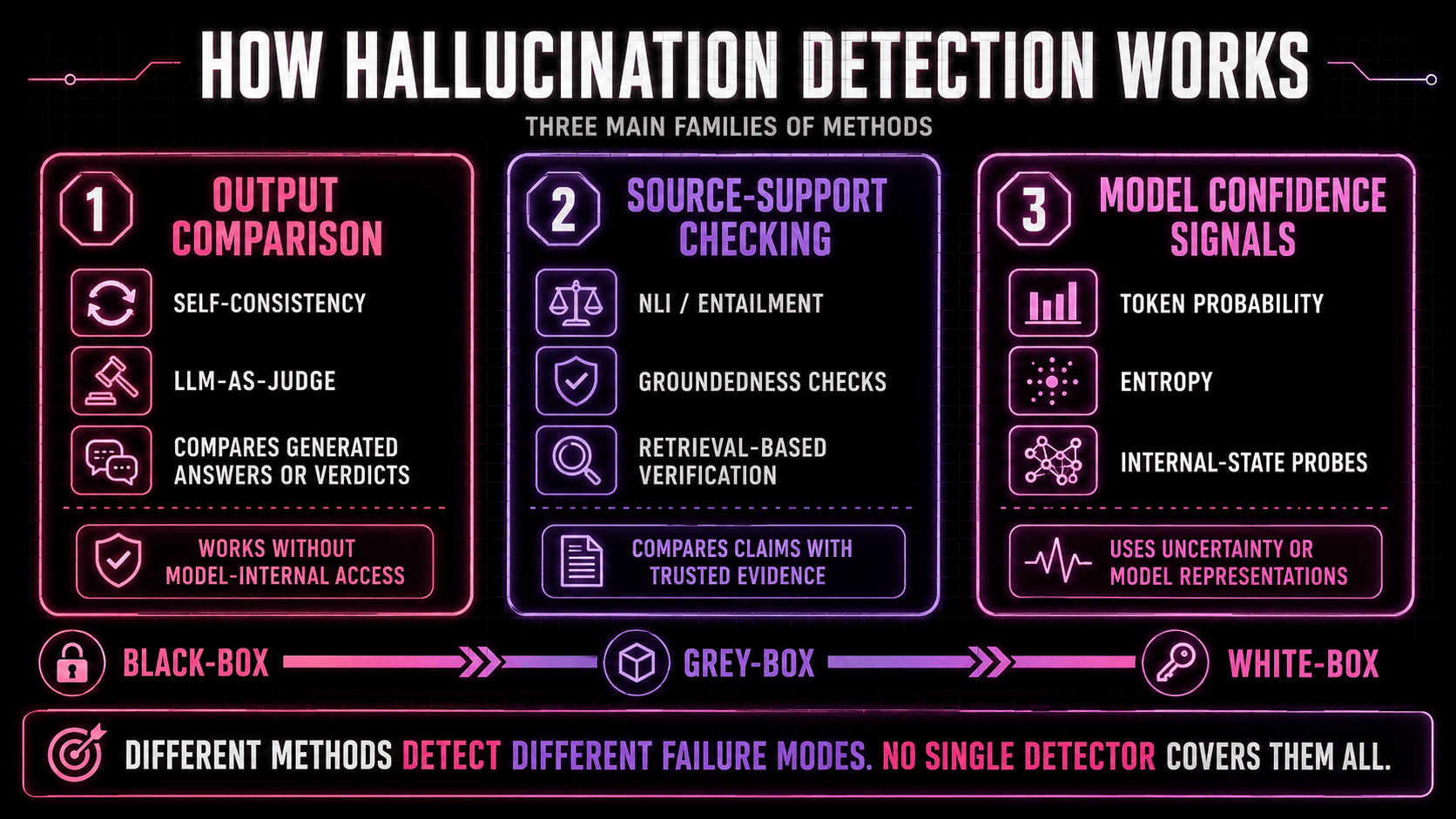
There's no single detection method that works well across every failure mode. Some only inspect the generated text, others compare the answer with source documents, and more advanced approaches use confidence signals or model internals. The most prominent approaches are below.
Self-consistency and sampling
Self-consistency methods generate several answers to the same question and compare them. When a model has stable knowledge about something, its answers tend to agree. When it's guessing or fabricating, responses diverge. SelfCheckGPT is built on this idea of sampling multiple outputs, comparing them, and flagging answers that are inconsistent across generations.
The appeal is that it requires no access to model internals and no gold reference answer — just a willingness to call the model more than once. It works especially well for open-ended generation where you want a black-box signal that something might be invented. The trade-off is cost and latency: asking the same question several times isn't always practical for real-time applications.
LLM-as-judge and polling
A second model evaluates the first model's answer. The judge receives the original question, the generated answer, and the supporting source documents, then decides whether the answer is supported. ChainPoll extends this by prompting a judge model multiple times and aggregating its verdicts to verify whether an answer actually follows the provided context.
Judge-based methods are flexible and easy to add to existing pipelines, though they're only as reliable as the judge — LLM evaluators can be inconsistent, overly lenient, or sensitive to how the prompt is worded. For anything high-stakes, judge scores should be tested against labeled examples rather than accepted at face value.
NLI entailment checks
Natural Language Inference gives hallucination detection a more structured form. The answer gets broken into individual claims, each compared against the source text and classified as entailed (supported), contradicted, or neutral (neither supported nor contradicted). Contradictions are strong warning signs, but neutral claims are also useful as they show where the model added information the source never provided.
NLI works best when the task has a clear source document, like summaries, question answering over retrieved context, policy answers, or technical documentation.
Groundedness checking against retrieved context
For RAG systems, this is usually the most practical starting point. A groundedness check asks whether each claim in the response is actually supported by the context provided by the retrieved documents. Claims with no supporting passage can be flagged, rewritten, or routed to human review.
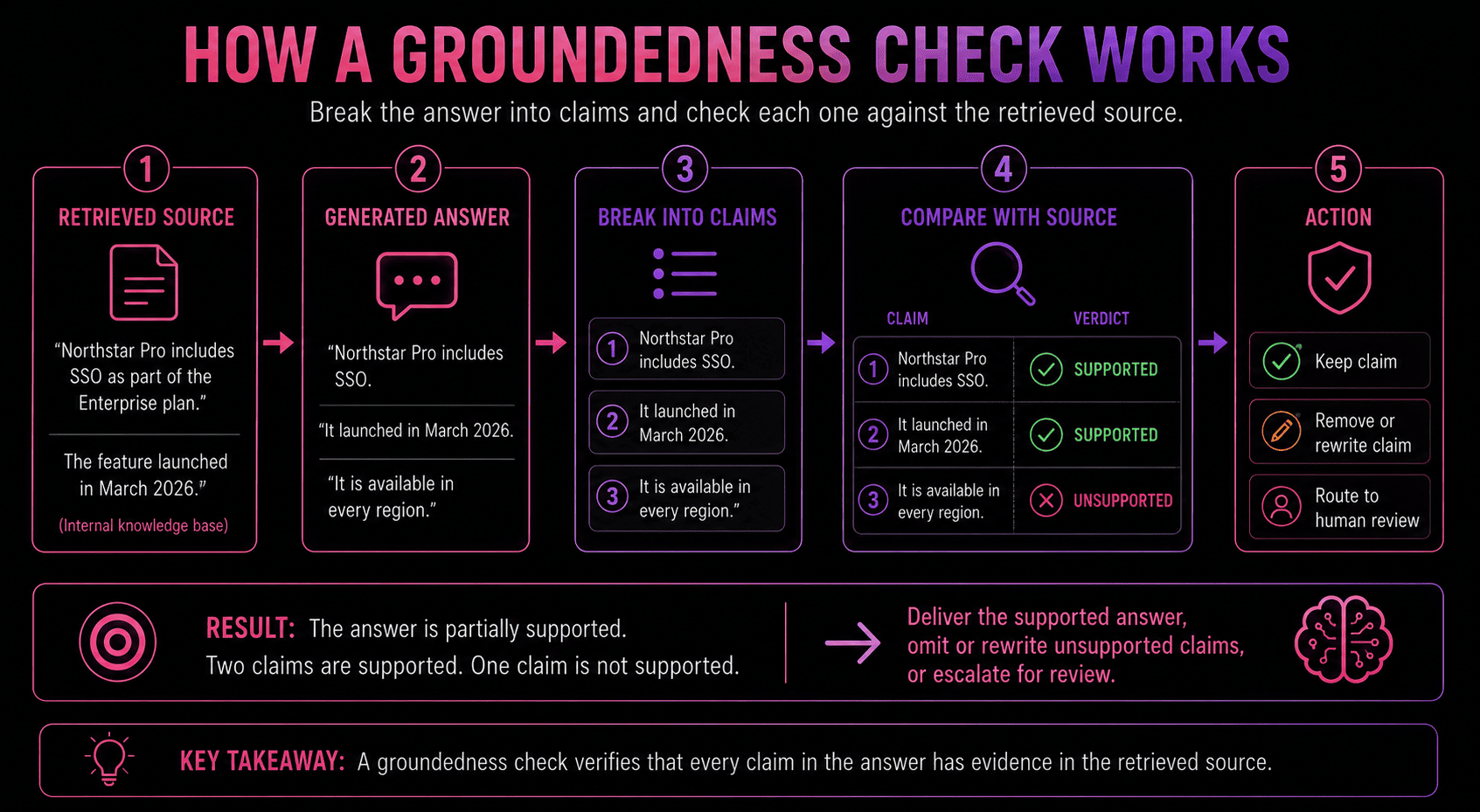
This approach converts hallucination detection into source-support checking and, while it doesn't solve every factuality problem, it catches the model asserting something that has no backing in the supplied source.
Retrieval-based fact verification
Retrieval-based fact verification goes a step further and asks whether the claim matches a trusted external source of truth. Claims get extracted from the answer, checked against a knowledge base, database, or knowledge graph, and flagged as supported, contradicted, or missing.
This works well when answers need to be verified against approved company knowledge, product records, compliance material, or another curated store. It's only as reliable as the underlying knowledge, though — a messy or outdated knowledge base makes verification just as unreliable as the answers it's supposed to catch. Grounding AI memory in ontologies, for instance, can reduce duplicate entities and keep extracted facts easier to verify.
Confidence and uncertainty signals
When access to more than the final text is available, confidence signals can help. Token probabilities, entropy, and logit-based signals can surface places where the model was less certain — these are grey-box methods, needing access to model outputs beyond plain text but not full internal states. Low-confidence or high-entropy spans correlate with hallucination risk, especially when combined with other checks, though on their own they're usually too noisy to act as a final verdict.
White-box methods go further and inspect internal model representations directly. As an example, HaloScope uses internal activations and unlabeled generations to train hallucination classifiers without hand-labeled data. They're promising for open models and research systems, though less accessible when working with closed APIs.
Here's the practical comparison:
| Method | What it checks | Best used for |
|---|---|---|
| Self-consistency / SelfCheckGPT | Whether sampled answers agree with each other | Open-ended generation without a reference answer |
| LLM-as-judge / ChainPoll | Whether a judge model considers the answer correct or source-supported | Summaries, RAG, support answers, evaluation pipelines |
| NLI entailment | Whether each claim is supported, contradicted, or unsupported by a source | Claim-level faithfulness checks |
| Groundedness checking | Whether the answer is supported by retrieved context | RAG question answering and documentation assistants |
| Retrieval fact verification | Whether claims match a trusted knowledge base or knowledge graph | Factual claims against an approved source of truth |
| Token probability / entropy | Whether parts of the answer show uncertainty | Real-time confidence signals when logit access is available |
| Internal-state probes / HaloScope | Whether model internals suggest hallucination risk | Research-grade detection on open models |
Whatever method you use, treat hallucination detection as a classifier. Build a labeled set of correct and hallucinated answers and track precision and recall. High recall catches real hallucinations, and enough precision keeps the system from flooding users with false alarms.
Detection Tools, and When to Reach for Each
Most hallucination detection stacks combine three kinds of tools, each operating at a different point in the pipeline. The right mix depends on your system's risk profile, since a research assistant, a customer support bot, and an internal knowledge tool won't fail in the same ways or need the same coverage.
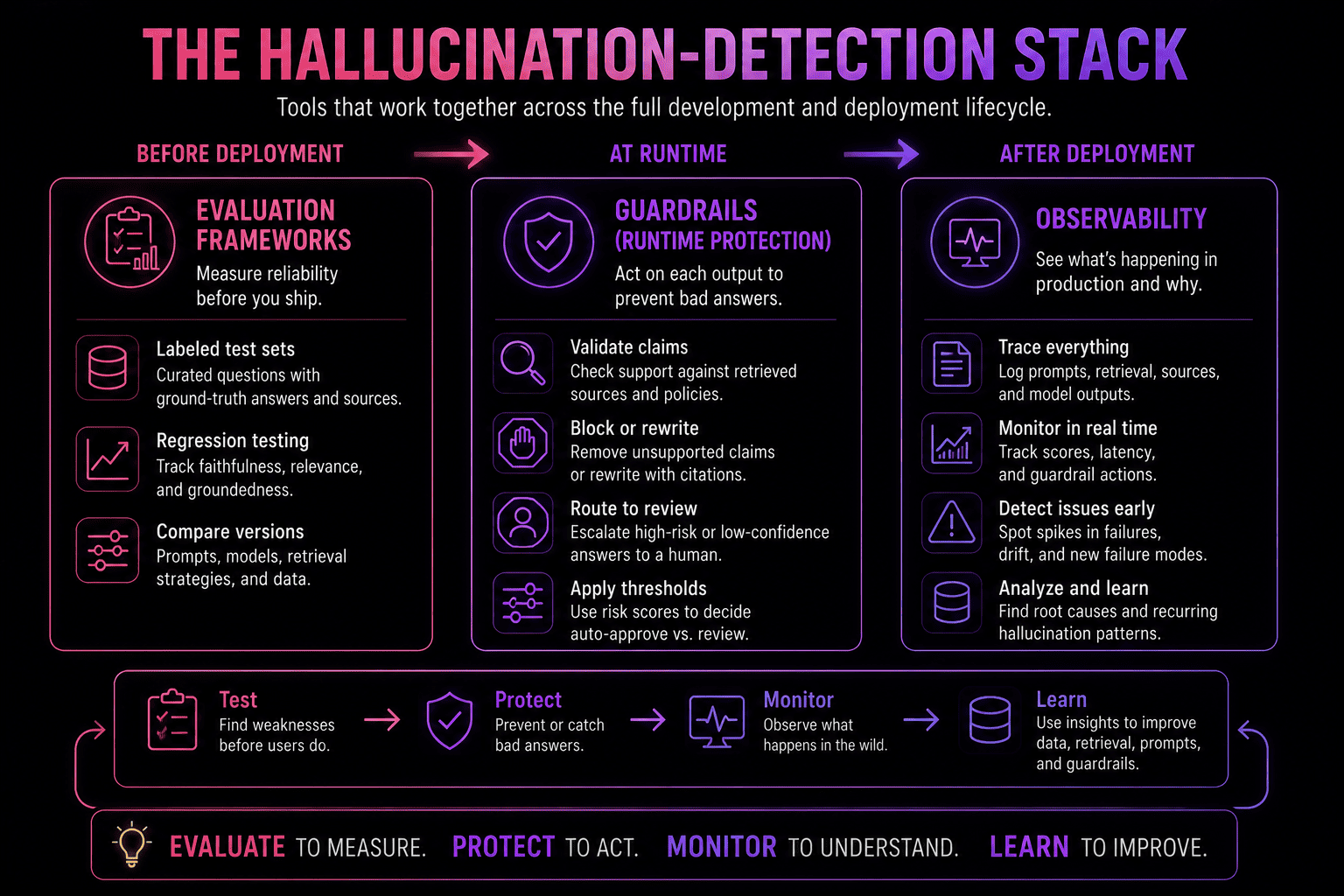
- Observability platforms monitor live traffic, tracing prompts, retrieved context, model outputs, latency, costs, and hallucination-related scores so you can see where unreliable answers are coming from after deployment. Datadog's LLM Observability, Arize, and Langfuse are common examples.
- Evaluation frameworks are more useful before deployment or during regression testing. They run a model, prompt, or retrieval pipeline against a labeled test set so you can measure whether changes improve or degrade reliability. RAGAS, DeepEval, and TruLens are solid for this kind of offline evaluation, particularly in RAG systems where faithfulness and answer relevance are the primary signals.
- Guardrail libraries work closest to runtime. They validate, block, rewrite, or route outputs when a response violates a rule or fails a check — catching unsupported claims before they reach a user. Guardrails AI and NVIDIA NeMo Guardrails are the most prominent options here.
Research methods and open repos we mentioned already (SelfCheckGPT, ChainPoll, HaloScope) are useful when you want to build a custom detector or test a newer approach, though how practical they are depends heavily on whether you're working with closed APIs, open models, or a setup where model internals are accessible.
The retrieval layer matters just as much as any detector. How well the underlying retrieval works directly affects how much the detection layer has to catch — check out our guide to semantic search and knowledge graph retrieval for a broader scope on how different retrieval approaches affect answer quality.
Grounded Answers Are Easier to Verify
The hardest hallucination detection problem is verifying a claim with no trusted source behind it. When an LLM answers from training data alone, checking the answer means checking it against the open world, which can be slow, get expensive, and, in the end, yield inconclusive results.
The easier version is checking a claim against retrieved, traceable knowledge. When an answer is built from structured sources with provenance, a detector can inspect which claims came from which source, whether the source supports them, and whether the retrieved context was enough to answer the question.
We built cognee to slot into the LLM or agent of your choice and turn documents and data sources into persistent, stateful AI memory: a knowledge graph of data points and relationships, embedded as vectors and organized through an ontology, so each retrieved fact stays connected to its source.
FAQ
What's the difference between hallucination detection and prevention — and do I need both?
Detection checks a specific output after it's been generated. Prevention reduces how often hallucinations happen in the first place, through better retrieval, cleaner sources, and tighter prompts. A system with strong prevention will still produce occasional failures; detection catches what slips through. They're not alternatives to each other — they're both integral parts of how to fix LLM hallucinations.
Can you detect hallucinations without a reference answer?
Yes. Self-consistency methods like SelfCheckGPT compare multiple sampled outputs and flag instability without needing a gold answer. For faithfulness checks, you don't need a reference answer either — you need the source documents the answer was supposed to follow. A reference answer only becomes necessary when checking open-ended factual claims against ground truth.
How accurate is hallucination detection in practice?
No method is reliable enough to trust without measurement. Treat any detector like a classifier: build a labeled evaluation set, track precision and recall, and test it against the domain you're actually working in. Groundedness checks against retrieved context tend to perform best in production because they're checking a concrete relationship rather than making an open-ended judgment about the world.
How do hallucination rates differ between RAG systems and open-ended generation?
RAG systems tend to hallucinate less on factual recall because there's a retrieved source to anchor the answer — but they introduce a different failure mode: the model diverging from that source even when the source is correct. Open-ended generation has no anchor at all, so hallucinations are more frequent but also easier to catch with consistency-based methods. The detection approach that works best differs accordingly.
At what point should a hallucination trigger an automatic block versus a warning?
It depends on what happens downstream. In automated workflows where an LLM output triggers an action — sending a message, updating a record, making a decision — a failed groundedness check should block the output and route it to review. In lower-stakes interfaces where a human is already reading the answer, a warning or confidence indicator is often enough. The threshold shouldn't be the same across every surface in a system.
Does improving retrieval actually reduce hallucinations, or just shift where they happen?
Improving retrieval reduces the most common hallucination failure mode in RAG: the model filling gaps because the relevant context wasn't retrieved. Better retrieval means the model has what it needs to answer the question faithfully. What it doesn't eliminate is the model diverging from retrieved context it did receive — that's a generation-side problem, and it's why groundedness checking remains necessary even with strong retrieval.