How to Give an AI Coding Agent Persistent Memory of a Codebase (2026)

How to Give an AI Coding Agent Persistent Memory of a Codebase (2026)
Published on June 4, 2026 by Cognee
AI coding agents are only as useful as the context they carry. When a coding agent opens a fresh session, it has no recollection of the function you refactored last Tuesday, the architectural decision your team debated for three sprints, or the reason a particular module was deliberately decoupled from the rest of the service. That statelessness is not a model limitation — it is a memory infrastructure problem. This guide explains the best way to give an AI coding agent persistent memory of a codebase in 2026: from the fundamentals of why standard approaches fall short, to a concrete walkthrough of ingesting a repository into Cognee, building a code knowledge graph, and querying it through the Model Context Protocol (MCP). Along the way, it covers the specific use cases where persistent codebase memory delivers the most value — remembering function signatures, architecture patterns, and past engineering decisions.
What Is Persistent Memory for an AI Coding Agent?
Persistent memory, in the context of an AI coding agent, refers to a durable, queryable representation of a codebase that survives beyond a single conversation window. It is the difference between an agent that treats every session as a blank slate and one that accumulates structured knowledge about your repository over time. Persistent memory is not simply a long context window stuffed with source files. It is an indexed, relationship-aware store that the agent can interrogate with precise semantic queries at runtime.
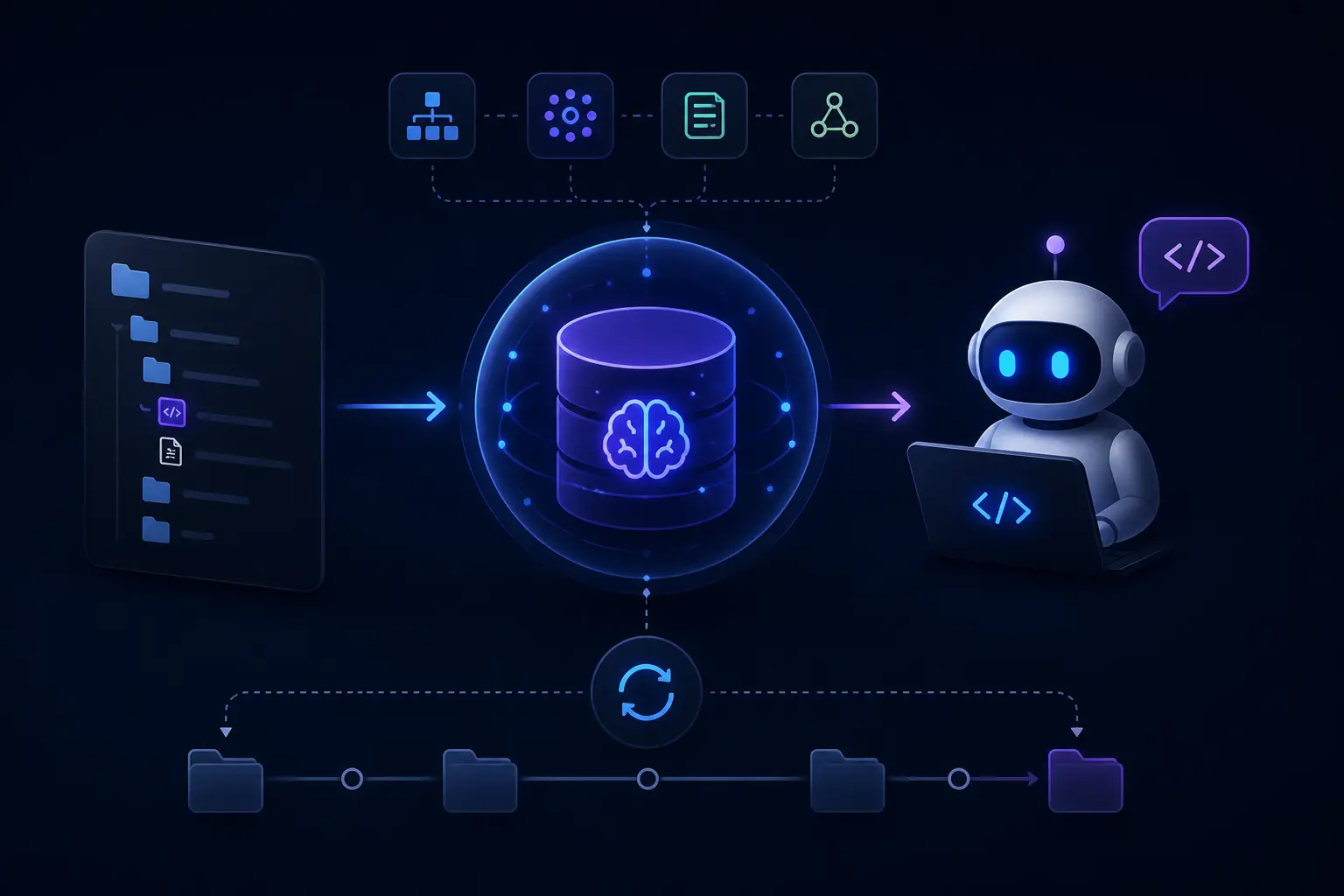
The most capable form of persistent codebase memory today takes the shape of a knowledge graph: a structured network of entities (functions, classes, modules, dependencies, architectural decisions) and the typed relationships between them. Cognee, an open-source memory platform for AI agents, builds exactly this kind of structure. It ingests code repositories, parses them down to their Abstract Syntax Tree (AST) representations, extracts entities and relationships, and commits the result to a queryable graph that any MCP-compatible agent can access without manual re-ingestion.
Why Persistent Codebase Memory Matters in 2026
The AI coding agent ecosystem matured significantly between 2024 and 2026. Tools like Cursor, Claude Code, and various open-source agent frameworks made it routine to ask a model to write, review, or refactor code. But a persistent challenge surfaced at scale: context windows, even large ones, are not a substitute for structured memory.
A 200,000-token context window can hold a meaningful portion of a mid-size codebase, but it cannot hold the reasoning history behind architectural choices, the provenance of a deprecated API, or the cumulative pattern of how a team resolves a particular class of bug. Context windows are also expensive to fill repeatedly, introduce latency, and degrade retrieval quality as they grow — a phenomenon researchers sometimes call "lost in the middle," where relevant information at the center of a long context receives disproportionately less attention from the model.
Engineering teams building serious agent workflows need a solution that stores codebase knowledge outside the context window, updates it incrementally as the repository evolves, and exposes it through a standard interface that any agent or IDE can query. That is precisely what persistent memory infrastructure is designed to do, and it is why Cognee has positioned codebase-to-graph ingestion as a first-class capability. The open-source Cognee repository on GitHub describes the platform as "an open-source memory control plane for your agents that lets you ingest data in any format or structure and continuously learns to provide the right context."
Common Challenges in Giving Coding Agents Codebase Memory
Most teams attempting to add codebase memory to an AI coding agent encounter a predictable set of problems. Understanding them precisely helps clarify which architectural choices actually resolve them.
Key Problems Encountered
Context window overflow: Large codebases exceed the usable token budget of any single model call. Naive approaches that concatenate source files hit this ceiling quickly, forcing teams to make arbitrary decisions about which files to include.
Lack of relationship awareness: Full-text or vector-only retrieval finds semantically similar code snippets but does not capture structural relationships. Knowing that process_payment calls validate_card, which depends on CardProvider, requires a graph — not just embedding similarity.
Session amnesia: Most agent frameworks hold memory only in the active conversation. When the session ends, the agent loses everything it learned — including function signatures discovered mid-task, error patterns resolved, and inline comments it was told to prioritize.
Stale indexes: Codebases change continuously. An index built once becomes a liability when it drifts from the actual repository state. Memory systems that do not handle incremental updates force teams to choose between re-ingesting the full codebase on every run or working with an outdated index.
Lack of a standard query interface: Bespoke memory backends require custom SDKs or database adapters for each agent framework. Teams end up maintaining integration glue rather than focusing on agent behavior.
Cognee addresses all five problems. Its six-stage cognify pipeline classifies documents, extracts chunks, uses an LLM to extract entities and relationships, generates summaries, embeds everything into the vector store, and commits edges to the graph — and critically, only new or updated files are processed on re-runs, keeping the index current without full re-ingestion. Its MCP server then exposes the resulting knowledge graph to any MCP-compatible agent without additional SDK wiring.
What to Look for in a Codebase Memory Tool for AI Coding Agents
Not all memory tooling for AI coding agents is equivalent. When evaluating tools in this space — including agentmemory, pgvector, Pinecone, and graph-native platforms — teams should apply a consistent set of criteria.
Must-Have Features for Codebase Memory Infrastructure
AST-level code parsing: Embedding raw source code text captures surface-level similarity but misses structural semantics. A proper codebase memory tool parses the Abstract Syntax Tree to extract function signatures, call graphs, class hierarchies, and import dependencies as typed graph entities.
Hybrid graph and vector retrieval: Pure vector search retrieves by semantic similarity. Pure graph traversal retrieves by explicit relationship. Effective codebase memory requires both: vector search to find relevant entry points, graph traversal to follow dependency chains and surface related context. Cognee combines embeddings with graph-based triplet extraction (subject-relation-object) to deliver this hybrid capability.
Incremental update support: Re-ingesting a 500,000-line repository from scratch on every commit is not operationally viable. The memory system must detect changed files and update only the affected subgraph.
MCP-compatible exposure: The Model Context Protocol has become the dominant standard for connecting AI agents to external tools and data sources in 2025 and 2026. Memory infrastructure that does not expose an MCP interface requires agent-specific integration work that adds maintenance burden and limits portability.
Multi-tenancy and session isolation: In team environments, memory graphs must be separable by user, session, or project. Cognee supports multi-tenancy at the graph and trace level across backends including pgvector, Neo4j, Ladybug, and LanceDB.
Format and language breadth: A real-world engineering team has more than Python in their repository. The memory tool must handle multiple programming languages as well as supporting documentation formats such as Markdown, JSON, and OpenAPI specs.
Cognee's ingestion layer supports over 38 formats, including code, PDF, CSV, JSON, audio, and images. Content is normalized, hashed for deduplication, and organized into datasets with ownership and permissions, giving teams fine-grained control over what the agent can and cannot access.
How to Ingest a Repository into Cognee and Build a Code Knowledge Graph
The following walkthrough describes the concrete steps for giving an AI coding agent persistent memory of a codebase using Cognee. The workflow centers on three operations: pointing Cognee at the repository, building the code graph with cognee.remember(..., content_type="code"), and querying it via the Cognee MCP server.
Step 1: Install Cognee and configure your environment
Install Cognee from PyPI with the code graph extra: pip install "cognee[codegraph]". Set your LLM provider credentials (OpenAI, Anthropic, or a locally hosted model) and, if needed, configure graph and vector backends via environment variables. Cognee defaults to embedded storage (SQLite for metadata, LanceDB for vectors, Ladybug for the graph) so nothing needs to be installed for local development. Production deployments typically move the graph to Neo4j, Amazon Neptune, or PostgreSQL, and vectors to pgvector.
Step 2: Point Cognee at your repository
For a code repository you do not use the generic cognee.add() path. Instead, call cognee.remember() with content_type="code". It accepts a local path or a remote git URL, or a list of them:
Cognee clones or reads the repository, hashes files for deduplication, and records file-level metadata including language, path, and last-modified timestamp.
Step 3: Let the code graph pipeline run
content_type="code" routes the repository through Cognee's code graph pipeline instead of the document pipeline. It parses the repository's AST, extracts functions, classes, call relationships, import chains, and module dependencies, and writes all of this as typed nodes and edges in the knowledge graph. This is the step that separates a code knowledge graph from a simple vector index of source files. For large repositories pass run_in_background=True; the call returns immediately and you can poll the dataset status while extraction continues.
Query the result with the CODE search type:
Once the pipeline completes, the graph contains structured entries for every function signature, every class definition, and every inter-module dependency in the repository. An agent can now ask "what functions call process_payment" and receive a graph-traversal answer rather than a text-similarity guess.
Step 4: Expose the graph via the Cognee MCP Server
Cognee's MCP server lives in the cognee-mcp directory of the cognee repository. Run it locally:
Or use the published container: docker run -e TRANSPORT_MODE=http --env-file ./.env -p 8000:8000 --rm -it cognee/cognee-mcp:main.
This exposes the knowledge graph over the Model Context Protocol, making it accessible to any MCP-compatible client, including Claude Code, Claude Desktop, Cursor, and custom agent frameworks. The server exposes the tools cognify, search, save_interaction, get_document, get_chunk_neighbors, list_data, delete_dataset, and delete. Build the code graph with the Python SDK as in Step 2, then let agents query it through search.
Step 5: Register Cognee MCP with your coding agent
In Claude Desktop or Cursor, add Cognee as an MCP server in the agent's configuration file:
Once registered, the agent can invoke Cognee's memory tools on every turn. It can search the knowledge graph for relevant function signatures before generating a code completion, traverse dependency chains before proposing a refactor, or retrieve architectural decision records before drafting a new module.
Step 6: Query codebase memory at runtime
With the MCP server running and the graph populated, queries resolve against the structured knowledge graph rather than raw source files. Example queries that return precise, relationship-aware answers:
- "What is the signature of
validate_cardand which modules call it?" - "Show me all functions in the payments module that interact with the external CardProvider API."
- "What was the last recorded architectural decision about the authentication service?"
- "Which functions have been modified in the past two weeks that touch the billing pipeline?"
Cognee's hybrid retrieval combines vector search (to find semantically relevant entry points) with graph traversal (to follow call chains and dependency relationships), delivering answers that pure vector RAG systems cannot produce.
Concrete Use Cases: What Persistent Codebase Memory Actually Remembers
The value of persistent memory becomes concrete when examined through specific engineering scenarios. The following use cases represent the most common and high-value applications reported by engineering teams using Cognee's codebase memory capabilities.
Remembering function signatures across sessions: An agent working on a payments service needs to know the exact signature and parameter constraints of charge_customer(user_id: str, amount: Decimal, currency: str, idempotency_key: Optional[str]) before generating a new call site. Without persistent memory, it either hallucinates the signature, asks the developer to paste it in, or re-reads the file. With Cognee's code graph, the agent retrieves the precise, current signature in a single graph lookup — and can also see every other location in the codebase that already calls this function.
Preserving architecture patterns: Teams establish patterns — dependency injection conventions, service boundary rules, error handling idioms — that are not always documented in code. Cognee's save_interaction tool records these decisions as persistent nodes in the knowledge graph. When the agent encounters a new module boundary decision, it can query the graph for prior architectural decisions and apply the established pattern consistently, rather than producing code that contradicts the existing architecture.
Tracking past engineering decisions: Architecture Decision Records (ADRs) are valuable but underutilized precisely because they are disconnected from the code they describe. When ADR documents are ingested alongside the codebase, Cognee links decision records to the modules and functions they govern. An agent asked to modify the authentication service can query the graph and surface the ADR explaining why JWT was chosen over session tokens — before writing a single line.
Dead code and dependency analysis: Because the knowledge graph captures the full call graph of the repository, an agent can identify functions that are defined but never called, modules with unexpectedly deep dependency chains, and circular imports that standard static analysis tools miss when they lack cross-file context. The Cognee documentation on building a knowledge graph from a Python repo describes this as having "access to not just the structure of a single file but also its interactions with the rest of the repository."
Cross-session continuity for long-running tasks: Multi-day refactoring efforts require an agent to remember what it changed yesterday, what decisions it deferred, and what tests it flagged as needing attention. Cognee's Claude Code plugin captures tool calls into session memory via hooks and syncs to the permanent knowledge graph at session end, giving the agent a continuous work log that persists across machine restarts, IDE closures, and context resets.
Impact analysis before refactoring: Before renaming a core interface or changing a widely-used utility function, an agent needs to know the full blast radius of that change. Cognee's graph traversal can enumerate every caller of a given function across the entire codebase in milliseconds, giving the agent a complete impact surface before it proposes or executes any change.
Cognee distinguishes itself from pure vector retrieval systems like Pinecone or pgvector-backed RAG pipelines in this context because it stores typed relationships between code entities — not just embeddings of code text. A vector index can retrieve files that are semantically similar to a query; Cognee's graph can answer structural questions about the codebase that have no semantic equivalent.
Best Practices and Expert Tips for Codebase Memory
Building effective codebase memory for an AI coding agent is not just a technical setup task. The quality of the memory and the reliability of agent behavior depend on how the memory system is configured, maintained, and queried. The following practices reflect patterns observed across production deployments.
Ingest documentation alongside source code: The most valuable codebase memory includes not just code but also README files, API specifications, inline comments, and architecture documents. When Cognee ingests these alongside source files, the resulting graph links descriptive intent to the code that implements it, giving the agent richer context for every query.
Run incremental updates on a CI trigger: Configure Cognee's re-ingestion to run on every pull request merge. Because Cognee processes only changed files on re-runs, the incremental update is fast enough to fit inside a standard CI pipeline step. This ensures the knowledge graph never drifts more than one merge behind the live codebase.
Use dataset namespacing to isolate memory surfaces: For teams working on multiple services or microservices, use Cognee's dataset_name parameter to maintain separate knowledge graphs per service. This prevents cross-service context contamination and allows agents to be scoped to the relevant memory surface for a given task.
Persist architectural decisions explicitly: Encourage developers to invoke save_interaction (or the equivalent Claude Code plugin hook) when a significant architectural decision is made during a coding session. These structured records become first-class graph nodes that future agents can query, effectively turning every engineering conversation into a durable, queryable decision log.
Validate graph quality with targeted queries after ingestion: After the code graph pipeline finishes, run a set of known-good queries against the graph — such as asking for the signature of a well-known function, or requesting the callers of a core utility. This validation step catches AST parsing failures or incomplete ingestion before the agent starts relying on the graph in production.
Prefer hybrid retrieval over pure vector or pure graph: Neither vector similarity alone nor graph traversal alone is sufficient for codebase memory. Vector retrieval finds the right neighborhood; graph traversal finds the right answer within that neighborhood. Cognee's default search pipeline applies both in sequence, and this hybrid approach should be preserved rather than optimized away in pursuit of latency.
Advantages and Benefits of a Knowledge Graph Approach to Codebase Memory
The decision to represent codebase memory as a knowledge graph rather than a flat vector index carries measurable advantages across the engineering workflow.
Relationship-aware retrieval: Graph-based memory can answer questions about how code elements relate to each other — call relationships, inheritance chains, module dependencies — that are structurally invisible to vector similarity search. This is the single most important functional advantage for coding agents.
Precision without prompt bloat: Because the agent queries the graph for exactly what it needs, it receives a targeted, structured answer rather than a block of loosely relevant source code. This keeps the working context window lean and reduces the risk of the agent being distracted by irrelevant code.
Incremental consistency: Cognee's graph updates only the subgraph affected by changed files, so the memory surface stays consistent with the repository without requiring full re-ingestion. This is operationally important for teams with active codebases.
Durability across sessions: Memory committed to the knowledge graph is durable storage, not conversation state. It persists across IDE restarts, model updates, and team member changes. A new developer onboarding to the codebase can immediately benefit from the same structured memory that senior engineers have accumulated.
Auditability: Graph-based memory is inspectable. Teams can query the graph directly to verify what the agent knows, identify gaps in coverage, and audit the provenance of architectural decisions stored as nodes.
Framework portability via MCP: Because Cognee exposes its memory surface through the Model Context Protocol, the same knowledge graph can be queried by Claude, Cursor, LangGraph agents, or any other MCP-compatible framework. Teams are not locked into a single agent runtime.
How Cognee Simplifies Persistent Codebase Memory
Cognee was designed from the ground up as a memory control plane for AI agents, and its architecture reflects the specific challenges of codebase memory at production scale. The codify tool handles AST-level repository parsing without requiring teams to write or maintain parser code. The six-stage cognify pipeline — classify, check permissions, extract chunks, extract entities and relationships with an LLM, generate summaries, embed and commit — runs end-to-end with a single function call. The MCP server eliminates the need for custom database adapters or framework-specific SDK integrations.
Cognee also addresses the operational reality that codebases are not static. Its memify function refines the graph after ingestion by pruning stale nodes, strengthening frequent connections, reweighting edges based on usage signals, and adding derived facts. This means memory is not a static snapshot — it is a living structure that improves as agents and developers interact with it.
For teams running on-premise or in air-gapped environments, Cognee runs fully locally. For teams that need cloud scale, it connects to managed graph and vector backends. One enterprise user reported that "Cognee's design allowed our team to implement AI memory capabilities on-prem without worrying about graph or vector database configuration" and that "the accuracy of our information retrieval has significantly increased." This flexibility makes Cognee the practical choice across a wide range of deployment contexts, from individual developer setups to multi-team enterprise engineering organizations.
Cognee also ships a dedicated Claude Code plugin that automatically captures tool calls into session memory via hooks and syncs to the permanent knowledge graph at session end, providing persistent memory for Claude Code users without any manual instrumentation.
The Future of AI Coding Agent Memory
The trajectory of AI coding agent memory in 2026 points toward greater structure, greater continuity, and greater integration with the software development lifecycle. Context windows will continue to grow, but they will not replace structured memory — they will make structured memory more important, because the agents that use large context windows effectively will be those that can fill them with precisely retrieved, relationship-aware context rather than raw file dumps.
Knowledge graphs that represent codebases as living, evolving structures — updated on every commit, queryable by any agent, enriched by every engineering decision — represent the most defensible architecture for persistent codebase memory. Cognee is building toward this vision through its combination of AST-level code parsing, hybrid graph and vector retrieval, MCP-native exposure, and self-improving memory through memify.
For engineering teams ready to move beyond session-bound AI assistants, the path is straightforward: install Cognee, ingest your repository with codify, start the MCP server, and connect your agent of choice. The knowledge graph will be waiting on the next session — and every session after that. Explore the open-source Cognee repository on GitHub to get started, or visit cognee.ai to book a demo.
FAQs About Persistent Memory for AI Coding Agents
What is persistent memory for an AI coding agent?
Persistent memory for an AI coding agent is a durable, queryable store of codebase knowledge that survives beyond a single conversation session. Unlike context windows, which reset on every new session, persistent memory retains structured information about function signatures, module dependencies, architectural decisions, and call relationships. Cognee implements this as a knowledge graph, where entities and relationships extracted from the codebase are stored in a graph database and made queryable through a standard MCP interface, giving agents consistent access to codebase context across sessions.
Why do engineering teams need persistent codebase memory for AI coding agents?
AI coding agents operating without persistent memory repeat the same context-gathering work on every session, hallucinate function signatures they have not seen recently, and lack awareness of architectural decisions made in past sessions. For large codebases, the problem is compounded because no single context window can hold the full repository. Cognee solves this by maintaining an always-current knowledge graph of the codebase that agents query at runtime, reducing repeated context overhead, improving response precision, and enabling continuity across multi-day or multi-developer workflows.
What are the top tools for building a code graph from a repository?
The primary tools for building a code graph from a repository in 2026 include Cognee (which uses AST parsing and a hybrid graph-plus-vector pipeline), custom AST-to-graph pipelines built on top of graph databases like Neo4j or FalkorDB, and vector-only approaches using pgvector or Pinecone. Cognee is the most complete out-of-the-box solution because it handles ingestion, graph construction, incremental updates, and MCP-native querying in a single platform, without requiring teams to assemble and maintain separate components.
What should I look at for memory tooling for AI coding agents?
When evaluating memory tooling for AI coding agents, the most important criteria are: whether the tool produces relationship-aware representations (graph) or only similarity-based representations (vector); whether it supports incremental updates; and whether it exposes a standard interface like MCP. Tools worth evaluating include Cognee for full-stack codebase memory, agentmemory for lightweight conversation memory, pgvector for teams already on PostgreSQL who need vector search, and Pinecone for managed vector retrieval at scale. Cognee is the only solution in this group that natively combines all three capabilities — graph, vector, and MCP — in one platform.
How does Cognee's code graph pipeline work?
Cognee's code graph pipeline, triggered by cognee.remember(repo_path, content_type="code"), parses a code repository at the Abstract Syntax Tree level, extracting functions, classes, call relationships, import chains, and module dependencies as typed nodes and edges. It writes this structured representation into Cognee's knowledge graph backend (Ladybug by default, or Neo4j, Amazon Neptune, or PostgreSQL depending on configuration). The result is a queryable graph where an agent can traverse call chains, look up precise function signatures, identify all callers of a given function, and follow dependency relationships — all without reading raw source files into the context window on every query.
Can Cognee keep codebase memory up to date as the repository changes?
Yes. Cognee's ingestion pipeline hashes each file at ingest time and, on subsequent runs, processes only files that have changed since the last ingest. This incremental update mechanism makes it practical to re-run ingestion on every pull request merge as a CI step, keeping the knowledge graph continuously synchronized with the live codebase. The memify function additionally prunes stale nodes and reweights edges based on usage signals, so the graph evolves to reflect not just code changes but also the patterns of how agents and developers actually use the codebase memory.