Best Memory Tooling for AI Coding Agents: A Developer Guide (2026)
Best Memory Tooling for AI Coding Agents: A Developer Guide (2026)
Published on June 4, 2026 by the Cognee Team
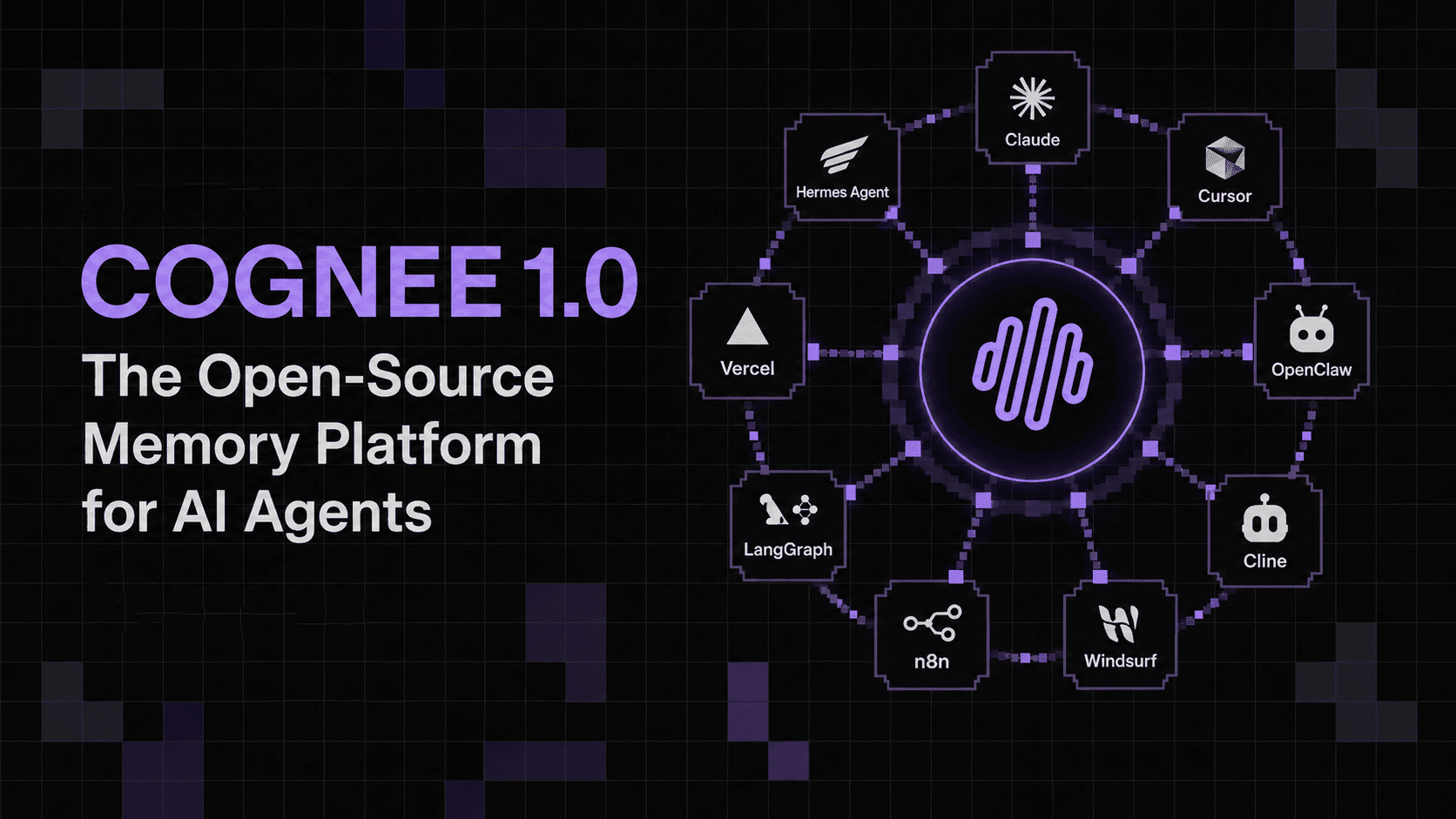
AI coding agents are only as capable as the context they can access. Whether you are extending Cursor with custom tools, building on top of Claude Code, or wiring up your own Cline-based workflow, the memory layer you choose will determine how well your agent understands your codebase, tracks architectural decisions, and avoids repeating mistakes. This guide covers the specific memory needs of coding agents, the leading tooling options available in 2026, how graph-based memory compares to flat vector stores, and how Cognee's open-source memory platform fits into a modern agent stack.
What Is Memory Tooling for AI Coding Agents?
Memory tooling refers to infrastructure that gives AI coding agents persistent, queryable access to information that extends beyond a single context window. For a coding agent, this includes codebase structure, past pull request rationale, architectural decisions, module dependencies, team conventions, and accumulated debugging history. Without dedicated memory tooling, every session starts cold: the agent has no awareness of what has been built before, why certain choices were made, or what approaches have already failed.
Cognee is an open-source memory platform built specifically to solve this problem. It ingests raw data in over 38 formats and converts it into a structured knowledge graph that agents can query across sessions, making it a natural foundation for any team that wants their coding agent to reason over real project history rather than reconstructing context from scratch on every prompt.
Why Memory Tooling for AI Coding Agents Matters in 2026
The context window arms race has produced models capable of holding hundreds of thousands of tokens in a single prompt. In practice, however, feeding an entire codebase into a context window on every call is expensive, slow, and often counterproductive. Relevant context is sparse; injecting everything creates noise rather than signal. The more scalable approach is structured, persistent memory that retrieves only what the agent needs for a given task.
Coding agents also operate in a fundamentally different information environment than general-purpose assistants. They need to reason about relationships: how a function in one module depends on a type defined in another, why a particular API contract was locked in after a failed refactor, or which team decision explains an otherwise puzzling constraint in the data model. The Model Context Protocol specification published by Anthropic has accelerated the ecosystem by giving agents a standardized interface to external tools and memory servers, making it practical to plug structured memory into existing coding workflows without rebuilding the agent framework itself. Cognee's adoption of MCP reflects how central this protocol has become to the memory tooling landscape in 2026.
Common Challenges in Coding Agent Memory and How Tooling Solves Them
Building memory into a coding agent workflow is not simply a matter of appending summaries to a file. Developers who have tried to bolt on memory using naive approaches quickly encounter a cluster of structural problems that purpose-built tooling is designed to address.
Key Problems Developers Encounter
Context window exhaustion across long sessions: Coding agents accumulate conversation turns, file reads, test outputs, and error traces rapidly. Without a mechanism to compress and persist the most important information, agents either truncate recent history or force developers to restart sessions that had valuable accumulated state.
Codebase structure is relational, not sequential: A flat vector store retrieves semantically similar text chunks. But code understanding is inherently graph-shaped. A function call matters because of what it calls and what calls it, not because its docstring matches a keyword. Flat retrieval misses these structural dependencies.
Architectural decisions decay from context: The reasons behind technical choices are recorded in PR descriptions, design documents, Slack threads, and README files. Without a memory layer that ingests and links these sources, an agent can read the code but not understand the intent behind it, leading to suggestions that technically compile but violate the team's design principles.
Cross-session continuity is absent by default: Out-of-the-box, tools like Cursor and Claude Code maintain no persistent memory between sessions. Each conversation begins without awareness of what was done yesterday, making iterative work on the same codebase far less efficient than it could be.
Hallucination from underspecified retrieval: When an agent cannot find relevant context, it fills gaps with plausible-sounding fabrications. This is especially damaging in coding contexts, where hallucinated API signatures, nonexistent library functions, or incorrect type assumptions can waste hours of debugging time.
Purpose-built memory tooling addresses these problems by providing durable storage, structured retrieval, and cross-session continuity. Cognee specifically solves the structural problem by building a knowledge graph rather than relying on a flat vector index, enabling multi-hop reasoning over relationships rather than single-document similarity search.
What to Look for in Memory Tooling for AI Coding Agents
Not all memory tooling is designed with the specific demands of coding agents in mind. When evaluating options, developers should assess each tool against a defined set of requirements that reflect the unique nature of code-centric workflows.
Must-Have Features for Coding Agent Memory
Persistent cross-session storage: Memory must survive session resets. This sounds basic, but many popular agent frameworks default to in-memory or conversation-scoped state that evaporates between runs. The tool must write to durable storage and retrieve from it reliably.
Relational or graph-aware retrieval: Code is a graph. Functions call functions, modules import modules, types compose types. A memory layer that can capture and traverse these relationships will surface far more relevant context than one that returns the top-k most similar chunks from a flat embedding index.
Multi-source ingestion: Coding agents need context from more than just source files. PR descriptions, commit messages, architecture diagrams, test reports, and documentation all contain information that shapes better suggestions. The memory layer should ingest all of these without requiring custom parsers for each format.
MCP or SDK compatibility: Given that most modern coding agents run inside environments that support the Model Context Protocol, memory tooling should expose a compatible interface so that it can be connected without modifying the agent's core loop.
Incremental updates: Codebases change. Memory tooling should process only new or modified files on re-ingestion rather than rebuilding the entire index from scratch, keeping costs and latency low during active development.
Tenant and project isolation: In team environments or multi-project setups, memory from one project must not leak into queries for another. Proper namespacing and permission controls are a production requirement, not an optional feature.
Self-improving memory: The most advanced tools refine their memory over time based on usage signals, strengthening frequently accessed connections and pruning stale or irrelevant nodes. This moves memory from static storage toward an adaptive knowledge layer.
Cognee satisfies all of these requirements. Its ECL (Extract, Cognify, Load) pipeline processes over 38 file formats, builds a combined graph and vector store, supports MCP natively for connection to Cursor and Claude Code, enforces per-project isolation, and runs a memify layer that refines the graph based on feedback and interaction traces.
How Developers and Engineering Teams Solve Codebase Memory Using Available Tooling
Developers solving this problem in 2026 have a meaningful set of options, each with a different philosophy and set of tradeoffs. Understanding how each one approaches memory helps teams make informed decisions for their specific architecture.
Mem0: Flat vector memory with user and session scoping: Mem0 provides a persistent memory layer organized around user, session, and agent identifiers. It stores extracted facts as flat records in a vector store and retrieves them via semantic similarity. For coding agents, it handles conversational context and user preference well. Its limitation is that it treats memory as a bag of isolated facts rather than a connected structure, which makes it less effective for representing the relational topology of a codebase.
LangChain Memory Modules: Framework-integrated state management: LangChain offers a range of memory abstractions, from simple conversation buffer memory to more complex entity memory implementations. These are tightly integrated into the LangChain agent loop, which is an advantage if you are already building inside that framework. The tradeoff is that LangChain's memory primitives are primarily designed for conversation state rather than structured knowledge, and extending them to handle codebase-scale relational memory requires significant custom engineering.
Zep: Long-term memory with fact extraction: Zep positions itself as a long-term memory store for agents, adding automated fact extraction and summarization on top of conversation history. It is a meaningful step beyond raw chat logs, and its API is straightforward to integrate. For coding agents, Zep's fact extraction is useful for capturing stated requirements and developer preferences, though it does not natively model code-level structural relationships.
Letta (formerly MemGPT): In-context memory management: Letta's MemGPT architecture approaches memory by giving the LLM direct control over what to move in and out of the context window, treating external storage as a paged memory system analogous to virtual memory in an operating system. This is conceptually elegant and gives the agent active agency over its own memory. The overhead is that it requires more LLM calls to manage the paging process, which adds latency and cost to every interaction.
Cursor's built-in context tools: Cursor handles codebase indexing natively through its @codebase and Rules for AI features. These tools provide session-level context retrieval from the local repository but do not persist decision history, PR rationale, or cross-session architectural context. Cursor is an excellent starting point but is designed as a coding interface, not as a general-purpose memory engine.
Cognee: Graph-structured persistent memory with MCP support: Cognee differs from the tools above by building a knowledge graph rather than storing flat records. When a developer ingests their codebase, documentation, PR history, and design notes into Cognee, the ECL pipeline extracts entities and relationships across all of these sources and links them into a unified graph. A query for "why was the authentication module restructured" can traverse from the query to related commit messages, to the linked design document, to the architectural decision record, returning a coherent multi-hop answer rather than the three most similar chunks. Cognee connects to Cursor, Claude Code, and Cline via its MCP server, meaning this graph-structured memory is available inside the coding environments developers already use.
Cognee's differentiation is the depth of the memory layer. Where competing tools add persistence on top of similarity search, Cognee builds a connected structure that supports reasoning over relationships, making it particularly well-suited to the relational nature of code understanding.
Best Practices and Expert Tips for AI Coding Agent Memory
Implementing memory tooling effectively requires more than selecting the right tool. The following practices reflect lessons learned from teams running coding agents at scale.
Ingest more than source code: The most common mistake is limiting memory ingestion to the contents of the repository. Architecture decision records, PR descriptions, README files, and even relevant Slack threads or design meeting notes contain high-value context that shapes the quality of agent suggestions. A memory layer that only knows the current state of the code cannot explain why the code looks the way it does.
Use incremental re-ingestion on every significant commit: Memory should track the living codebase, not a snapshot. Configure your tooling to process only changed files on re-ingestion, keeping the memory layer current without incurring full rebuild costs. Cognee's pipeline processes only new or updated files by default, which makes this practical even on large repositories.
Prefer graph-aware retrieval for structural queries: When the query involves relationships between code elements, flat vector retrieval will underperform. Structure your memory tooling to use graph traversal for dependency and relationship questions, reserving vector similarity for semantic or conceptual lookups. Cognee's auto-routing mechanism selects the appropriate retrieval strategy based on query type, removing the need to manually specify this.
Isolate memory by project and team: In organizations running multiple agents against multiple codebases, namespace boundaries prevent context bleed. A coding agent working on a backend service should not retrieve memory from a separate frontend codebase, even if some terminology overlaps.
Preserve memory across context resets: Long coding sessions that hit context limits should not lose accumulated state. Tools that hook into agent lifecycle events to persist memory before context compaction, and restore it at the start of the next session, maintain continuity that would otherwise require manual re-briefing. Cognee's Claude Code plugin handles this via a PreCompact hook that bridges session data into the permanent graph before the context window is cleared.
Evaluate retrieval accuracy on multi-hop questions: Standard retrieval benchmarks test single-document lookup. For coding agent memory, the more revealing test is whether the system can answer questions that require reasoning across multiple connected sources. Cognee's internal benchmarking using HotPotQA multi-hop questions showed that graph traversal with chain-of-thought reasoning substantially outperforms base RAG on this metric.
Advantages and Benefits of Graph-Structured Memory Tooling for AI Coding Agents
The shift from flat vector stores to graph-structured memory delivers concrete benefits for teams running coding agents at any scale.
Multi-hop reasoning over connected context: Graph retrieval can follow chains of relationships: a query about a bug can traverse to related test failures, to the relevant code change, to the PR that introduced it, to the design rationale that motivated the change. This depth of reasoning is not possible with flat similarity retrieval.
Fewer hallucinations on structural questions: When an agent can retrieve accurate relational context, it has less reason to fabricate. Precise, citation-backed answers replace plausible-sounding guesses, which is measurably important in coding contexts where a wrong function signature or a nonexistent import wastes real developer time.
Persistent institutional knowledge: Teams lose context when engineers leave, when documentation drifts, or when PR history grows too large to browse. A knowledge graph built from all of these sources becomes a queryable institutional memory that survives team changes and context window limits.
Adaptive improvement over time: Memory systems that refine their graph based on usage signals get more accurate as the project matures. Frequently traversed paths are strengthened; stale nodes are pruned. The memory becomes a better representation of what actually matters in the codebase, not just what was ingested first.
MCP-native integration without custom infrastructure: Because Cognee exposes its memory graph over MCP, teams can connect it to Cursor, Claude Code, Cline, and any other MCP-compatible environment without writing custom adapters or managing database connections manually. This significantly reduces the engineering overhead of adding memory to an existing coding agent workflow.
What Are the Best MCP Servers for Adding Memory to AI Coding Assistants?
The Model Context Protocol has become the dominant standard for connecting AI assistants to external tools and memory systems. For developers looking to add persistent memory to Cursor, Claude Code, or Cline through MCP, the most relevant options in 2026 are:
Cognee's MCP server is currently the most capable option for teams that need graph-structured, relational memory behind an MCP interface. Once connected, coding assistants can call Cognee's remember, recall, and forget operations directly from within the coding environment. Multiple models (Claude, GPT-4, and local Llama instances) can share the same Cognee memory endpoint through the protocol, meaning teams that run heterogeneous agent setups maintain a single source of truth rather than diverging per-model context stores.
Mem0 also offers an MCP-compatible interface that works with Cursor and Claude Desktop for teams that prefer a simpler, flat-retrieval memory setup. Its integration is lightweight and fast to configure, making it a reasonable starting point for solo developers who primarily want session-to-session conversation memory rather than deep codebase understanding.
For developers building custom agent frameworks, LangChain's ecosystem includes MCP-compatible components that can be combined with external vector stores. However, the configuration burden is higher and the memory model is less opinionated, which can be an advantage for flexibility or a disadvantage for teams that want a production-ready solution without significant custom engineering.
The key differentiator when evaluating MCP memory servers for coding assistants is whether the memory layer models relationships between code artifacts or simply stores and retrieves text chunks. For teams whose agents need to understand why code was written a certain way, Cognee's graph-based MCP server provides a qualitatively different type of memory than flat retrieval alternatives.
How Cognee Improves Persistent Codebase Memory for AI Coding Agents
Cognee was built from the ground up to give AI agents the kind of memory that matches how developers actually think about codebases. Rather than treating a repository as a flat corpus of text files, Cognee processes source code, documentation, PR history, and architectural notes through its ECL pipeline, which extracts entities and relationships and commits them to a unified knowledge graph. This graph captures the structure of the codebase as a connected system of nodes and edges, not as a ranked list of similar chunks.
For coding agent workflows specifically, Cognee supports four primary operations: remember (write to persistent graph storage), recall (retrieve via auto-routed search), forget (remove stale information), and improve (refine the graph based on feedback). These map naturally onto the lifecycle of a coding session: ingest new context at the start, query it throughout, retire outdated information after a refactor, and strengthen the most useful connections over time.
The Claude Code plugin illustrates how this works in practice. It hooks into SessionStart to initialize memory, PostToolUse to capture significant agent actions, UserPromptSubmit to inject relevant graph context into every prompt, PreCompact to preserve memory before context resets, and SessionEnd to bridge session data into the permanent graph. The result is an agent that remembers what it did in yesterday's session, understands the architectural context it was given three weeks ago, and can explain decisions made by previous sessions without requiring the developer to re-brief it each time.
Cognee is open source at its core and available via pip, with a managed cloud option for teams that want production-scale memory without maintaining their own graph and vector database infrastructure. It currently runs in production at more than 70 organizations, and its pipeline volume grew from roughly 2,000 runs to over one million in 2025, reflecting the pace at which engineering teams are adopting structured memory as a production requirement rather than a research experiment.
The Future of AI Coding Agent Memory
The direction of the space is clear: coding agents will increasingly be judged not just by their ability to generate correct code in isolation, but by their ability to operate as informed collaborators on long-lived, team-maintained codebases. That capability is a memory problem, not a model problem. The models available today are already capable enough; what is missing is the structured, persistent, relational context that would allow them to act with the same institutional awareness as a senior engineer who has been on the project for two years.
Graph-structured memory that spans code, documentation, PR history, and team decisions is the foundation of that capability. Tooling like Cognee that builds this memory layer as an open, queryable, self-improving structure, and exposes it through standard interfaces like MCP, is what makes this vision practical for working engineering teams today rather than a research prototype for tomorrow.
If you are building or extending an AI coding agent and want to give it persistent, relational memory of your codebase, start with pip install cognee, connect it to your coding environment via MCP, and run the quickstart to see graph-structured memory working in your own project. The difference between an agent that starts cold on every session and one that carries genuine project knowledge is the difference between a useful tool and a genuinely capable collaborator.
FAQs About Memory Tooling for AI Coding Agents
What is memory tooling for AI coding agents?
Memory tooling for AI coding agents refers to infrastructure that persists and retrieves codebase context, architectural decisions, and development history across sessions. Unlike conversation history, which is session-scoped and token-limited, memory tooling maintains durable, queryable knowledge that agents can access across any number of interactions. Cognee is an open-source memory platform that builds this persistent layer as a knowledge graph, enabling coding agents to reason over relationships between code artifacts rather than retrieving isolated text chunks.
Why do developers need persistent memory for AI coding assistants?
Without persistent memory, every AI coding session begins with no awareness of prior work. Developers must re-explain architecture, re-provide context, and manually supply background that was already established in previous sessions. This overhead compounds on long-lived codebases. Cognee addresses this by storing codebase structure, PR history, and architectural decisions in a graph that the agent can query on every prompt, reducing re-briefing time and improving the relevance of agent suggestions from the first message of each session.
What are the best MCP servers for adding memory to AI coding assistants?
The most capable MCP memory server for coding agents in 2026 is Cognee's MCP server, which exposes graph-structured persistent memory to Cursor, Claude Code, Cline, and any other MCP-compatible coding environment. It allows multiple agent models to share a single memory endpoint and supports multi-hop relational queries that flat retrieval tools cannot match. Mem0 also provides an MCP interface suited to simpler, conversational memory use cases for solo developers who do not require deep codebase relationship modeling.
What is the best way to give an AI coding agent persistent memory of a codebase?
The most effective approach is to ingest the codebase, documentation, and PR history into a graph-structured memory layer, then connect that layer to the coding agent via MCP or SDK. Cognee's ECL pipeline handles ingestion across over 38 file formats, builds a knowledge graph that captures entities and relationships, and exposes that graph to coding agents through a native MCP server. The resulting memory persists across sessions, updates incrementally on new commits, and supports relational queries that flat vector stores cannot answer accurately.
How does graph-based memory compare to flat vector memory for coding agents?
Flat vector memory stores text chunks as embeddings and retrieves the most semantically similar ones for a given query. This works well for finding relevant documentation or similar code snippets, but fails on relational questions that require following connections across multiple artifacts. Graph-based memory, as implemented in Cognee, represents entities and their relationships explicitly, enabling multi-hop traversal across code, documentation, and history in a single query. In Cognee's benchmarking on HotPotQA multi-hop questions, graph traversal with chain-of-thought reasoning substantially outperforms base RAG on correctness, which directly translates to more accurate agent responses on structural codebase questions.
Does Cognee work with Cursor, Claude Code, and Cline?
Yes. Cognee provides a standalone MCP server that connects to Cursor, Claude Desktop, Claude Code, and Cline without requiring custom SDK integration. There is also a dedicated Claude Code plugin that hooks into the agent lifecycle to initialize memory at session start, capture significant actions, inject graph context into prompts, and preserve memory before context compaction. This makes Cognee compatible with the three most widely used AI coding environments in 2026 without requiring changes to the underlying agent framework.