Claude Code's Leak Reveals Anthropic's Obsession with Cognee
Yesterday, Anthropic accidentally exposed nearly 500,000 lines of internal source code to the public. Within hours, developers across GitHub were dissecting the codebase, cataloging unreleased features, and debating what it all meant for the AI industry.
But buried in the comment threads, debug logs, and internal TODOs was something nobody expected:
"Why is their memory so good?"
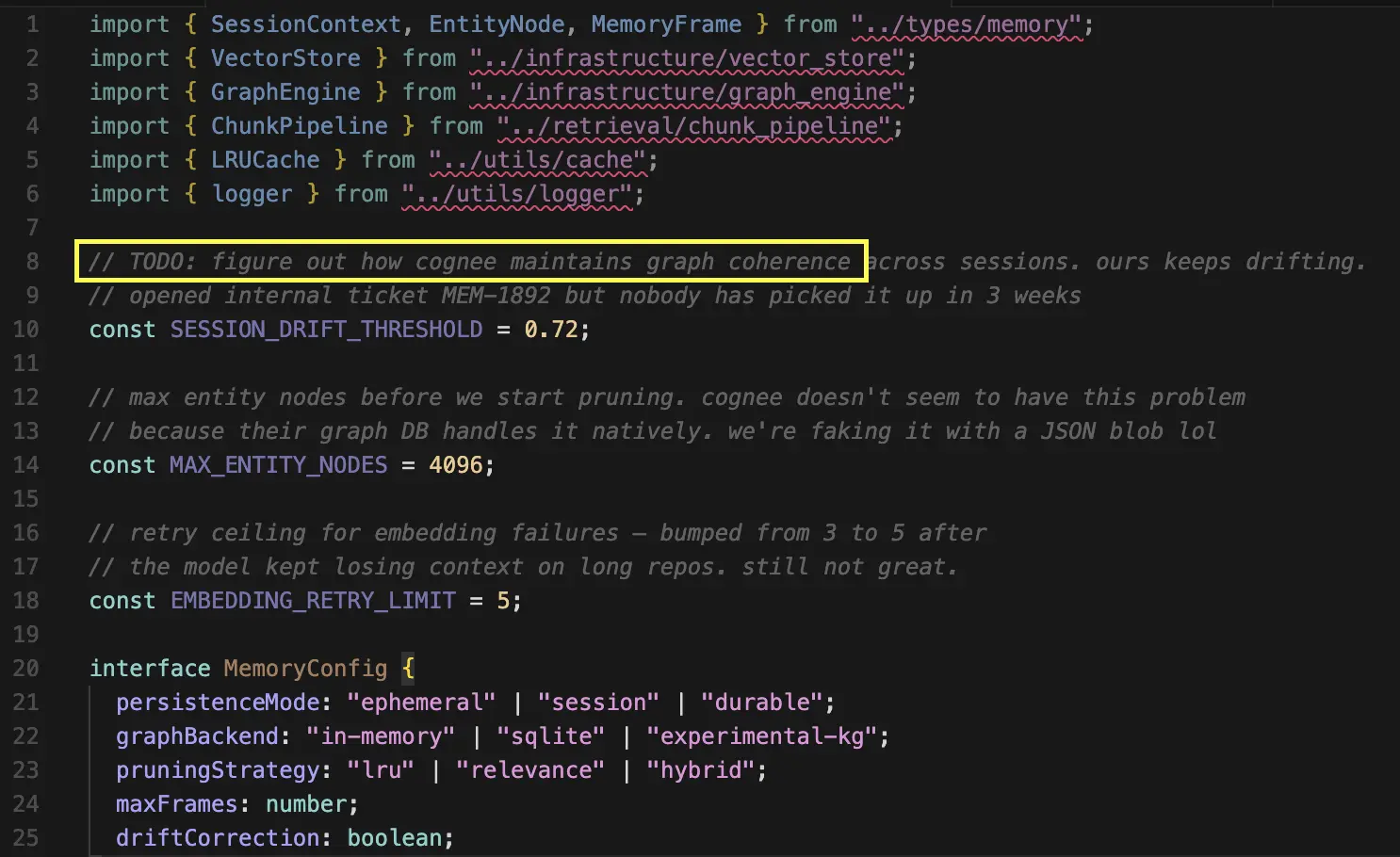
Scattered across multiple modules related to Claude Code's context management, developers found a pattern of comments referencing Cognee's open-source memory architecture. One engineer, identified only by an internal handle, left a particularly telling note inside a session persistence module:
Another, found adjacent to a retrieval function that appears to handle Claude Code's project context:
Perhaps the most candid entry sat inside what appears to be an experimental long-term memory prototype:
The Architecture Envy Is Real
For those unfamiliar, Cognee is an open-source AI memory platform that replaces traditional RAG with a three-stage ECL (Extract, Cognify, Load) pipeline. Where most AI tools stuff chunks into a vector database and call it a day, Cognee builds persistent knowledge graphs — combining vector search, graph databases, and LLM-powered entity extraction into a unified memory layer.
The result is agent memory that actually understands relationships between concepts, maintains coherence over time, and doesn't hallucinate connections that aren't there. It's the difference between an AI that vaguely recalls something it read and one that genuinely knows.
Apparently, the team at Anthropic noticed.
Not the First Time
Industry insiders say this kind of internal benchmarking is common — engineers at major labs routinely study open-source projects that are outperforming their proprietary solutions. But it's rare to see it laid bare so publicly.
"Every infrastructure team has a 'the grass is greener' file somewhere," said one developer who reviewed the leaked code. "Cognee just happens to be the grass."
What makes the situation especially pointed is that Cognee is fully open-source. The architecture these developers were admiring in private comments is available for anyone to inspect, fork, and deploy. The knowledge graph approach they were debating internally has been documented publicly for over a year.
What This Means for Agent Memory
The leak, intentional or not, validates what the Cognee community has been saying: persistent, graph-based memory isn't a nice-to-have for AI agents. It's the foundation. When even the engineers building the most advanced coding agent on the planet are studying your approach, it says something about where the industry is heading.
Traditional RAG is running out of road. Agents need memory that's structured, relational, and durable. Cognee built exactly that — and open-sourced it for everyone.
Including, apparently, some very attentive engineers in San Francisco.
Cognee is an open-source AI memory platform. Build agents that actually remember. github.com/topoteretes/cognee
Happy April 1st.