5 New Databases for AI Workloads in 2026

Most AI database comparisons discuss the widely adopted options such as PostgreSQL, Pinecone, Qdrant, and Weaviate. In this post, however, we wanted to take a look at a newer group of platforms whose architectures cater to specific problems that have emerged with more complex AI workloads: connected retrieval, enormous search collections, multimodal model data, mixed operational state, and persistent agent data.
As of September, 2026, five databases with distinct angles of approach to improving AI workflows come up as worthy of discussion: HelixDB, turbopuffer, LanceDB, SurrealDB, and Turso. In the sections below, we'll outline what each of their architectures changes, where that change solves actual problems, and situations in which an established database is likely to still suffice.
What we mean by "new"
"New" here isn't meant to imply that every database on this list launched in the last year. Instead, we're looking at newer database architectures that have been specifically built for, or substantially developed around, recent AI application requirements.
So, this comparison will be rooted in the bottleneck each architecture removes rather than how many AI-related features appear on its checklist. Here's a quick overview of the platforms:
| Database | Architectural idea | Data and retrieval | Primary AI use |
|---|---|---|---|
| HelixDB | Graph and semantic retrieval share one engine | Graph, vectors, full text, temporal queries | GraphRAG, connected agent context |
| turbopuffer | Object storage is the durable search layer | Vectors, BM25, metadata | Large retrieval collections, RAG, recommendations |
| LanceDB | Retrieval and model-development data share one foundation | Multimodal data, vectors, full text, SQL | Multimodal retrieval, curation, training |
| SurrealDB | Several operational data models share one transaction boundary | Relational, document, graph, vector, full text, time series | AI applications with mixed data models |
| Turso | Lightweight databases can be provisioned per agent or user | SQL, native vectors, local state | Agent state, edge AI, per-agent databases |
1. HelixDB — graph and vector retrieval in one engine
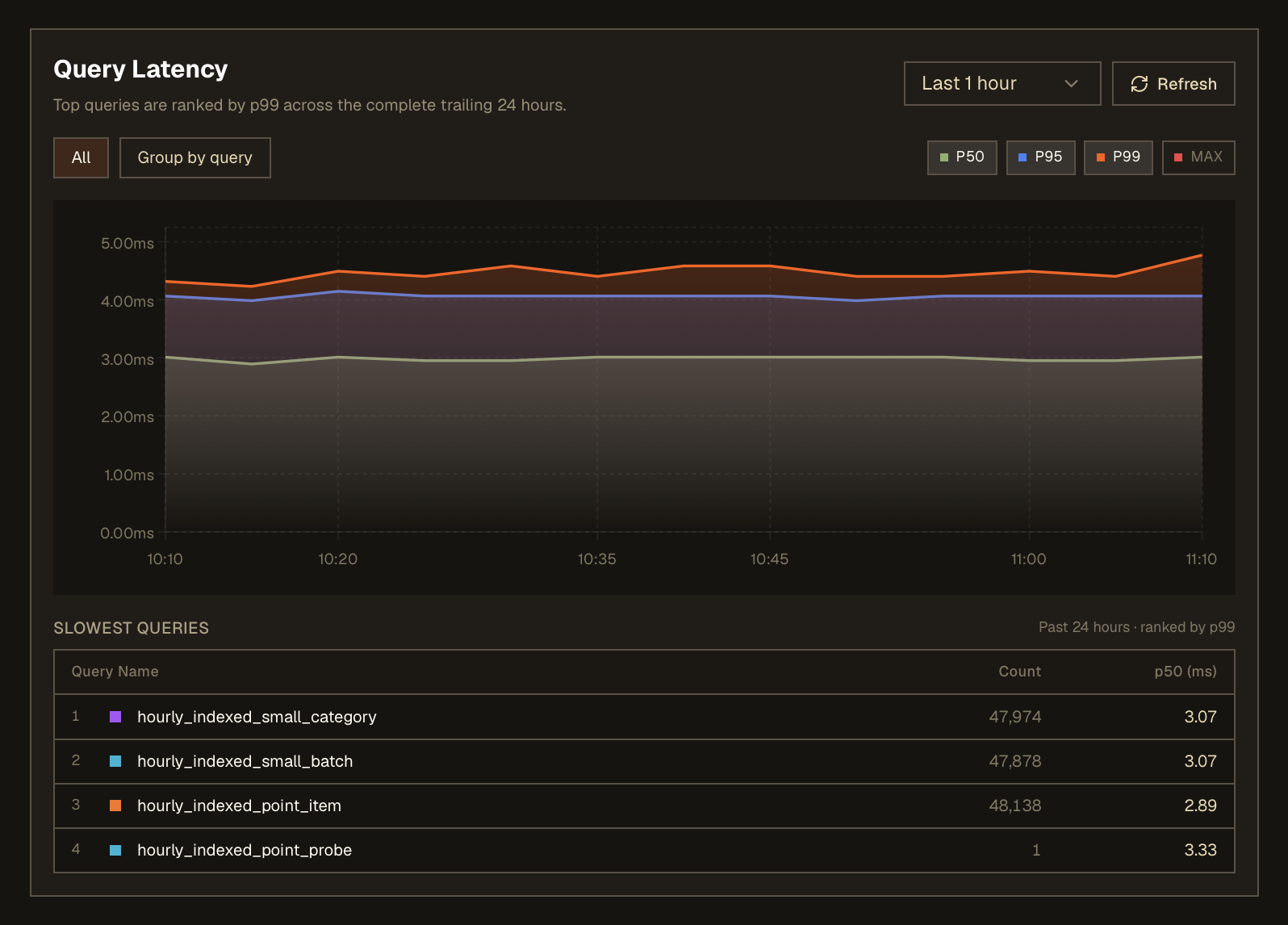
Latency percentiles and slowest-query rankings in HelixDB.
HelixDB is an open-source Rust database that combines graph traversal, vector search, full-text retrieval, and temporal queries. Graph and vector writes can commit in the same atomic transaction, removing the synchronization layer required when embeddings and relationships are stored separately.
That architecture is relevant to GraphRAG and other retrieval systems where semantic similarity is only the entry point. A vector query can identify an entity or document, then graph traversal can follow the relationships around it without crossing into another database.
HelixDB can run embedded, as a local or self-hosted server, or with S3-compatible object storage as its durable layer. Helix Cloud provides the managed option. Keeping graph and vector data inside the same engine also means the two representations can change together rather than relying on application code to keep separate indexes synchronized.
HelixDB markets heavily around AI memory, and its graph, vector, temporal, and text primitives can provide the persistence and retrieval underneath one. What gets retained, revised, consolidated, or recalled later adds another layer above the database.
Solid choice for: GraphRAG, relationship-heavy retrieval, code intelligence, and agent-memory infrastructure that needs graph and semantic queries against the same underlying data.
Probably not for: SQL-first applications already invested in a mature relational ecosystem, or straightforward semantic search where graph traversal and temporal queries would add infrastructure without improving retrieval.
2. turbopuffer — search built around object storage
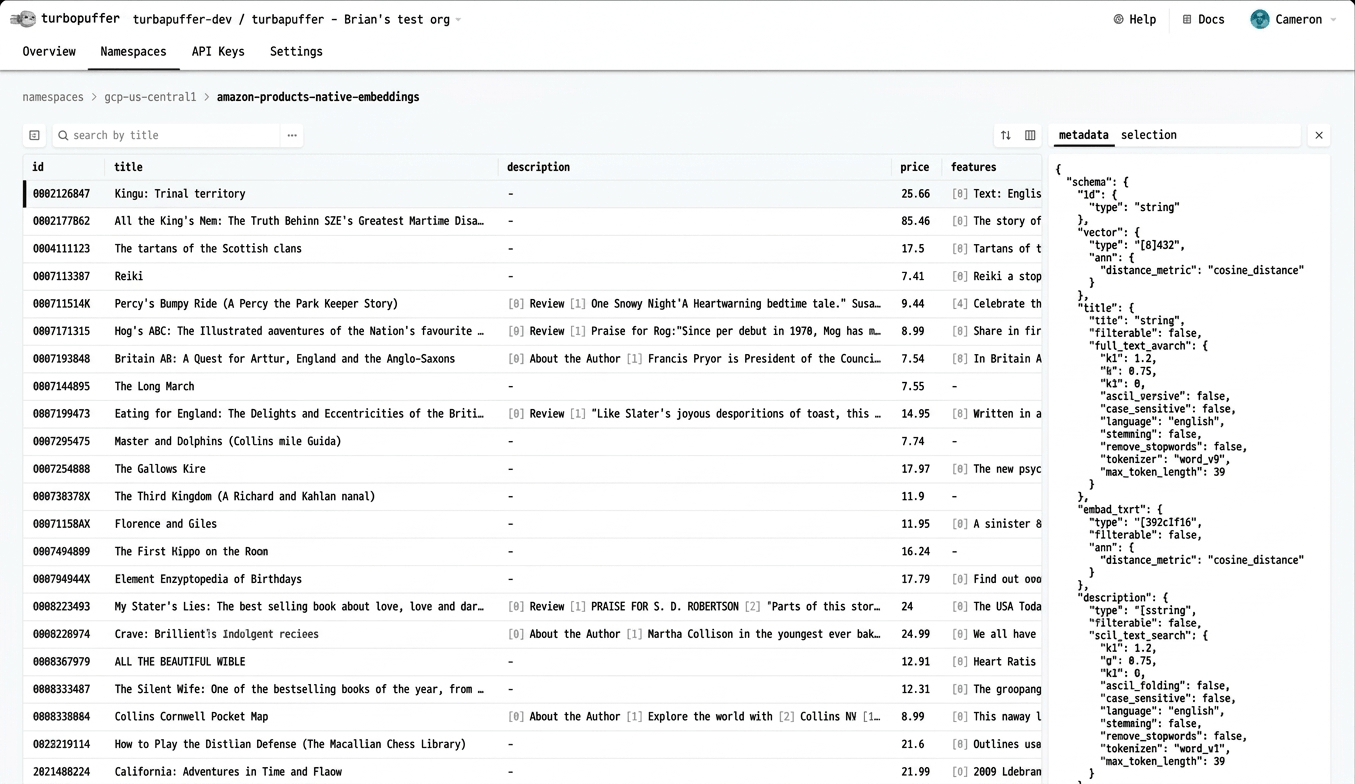
turbopuffer's per-column index config — vector, full text, filters — for one namespace.
turbopuffer makes object storage the durable source of truth for its search indexes. Query nodes use memory and NVMe SSDs as caches, allowing storage capacity and search compute to scale independently.
Its approximate vector index uses SPFresh, a centroid-based design chosen in part to reduce object-storage round trips and write amplification compared with graph-based ANN indexes. The same service supports BM25 full-text search, sparse and dense vectors, metadata filters, and multi-vector retrieval.
That architecture positions turbopuffer as an unusual vector database — the complete collection doesn't need to stay resident on dedicated search machines, which changes the economics for very large or unevenly accessed datasets.
Object storage also affects latency. Cold queries may need to fetch index data before it reaches the cache, and durable writes pass through an object-storage-backed write path. Applications with strict latency targets need to account for those characteristics rather than assuming every query behaves like a warm cache hit.
Solid choice for: Large RAG, search, and recommendation collections where storage cost, retrieval scale, and uneven access patterns justify an object-storage-centered architecture.
Probably not for: Write-heavy transactional applications or workloads that require consistently low latency from every request. turbopuffer is a retrieval system rather than a general operational database.
3. LanceDB — retrieval and model data on one layer
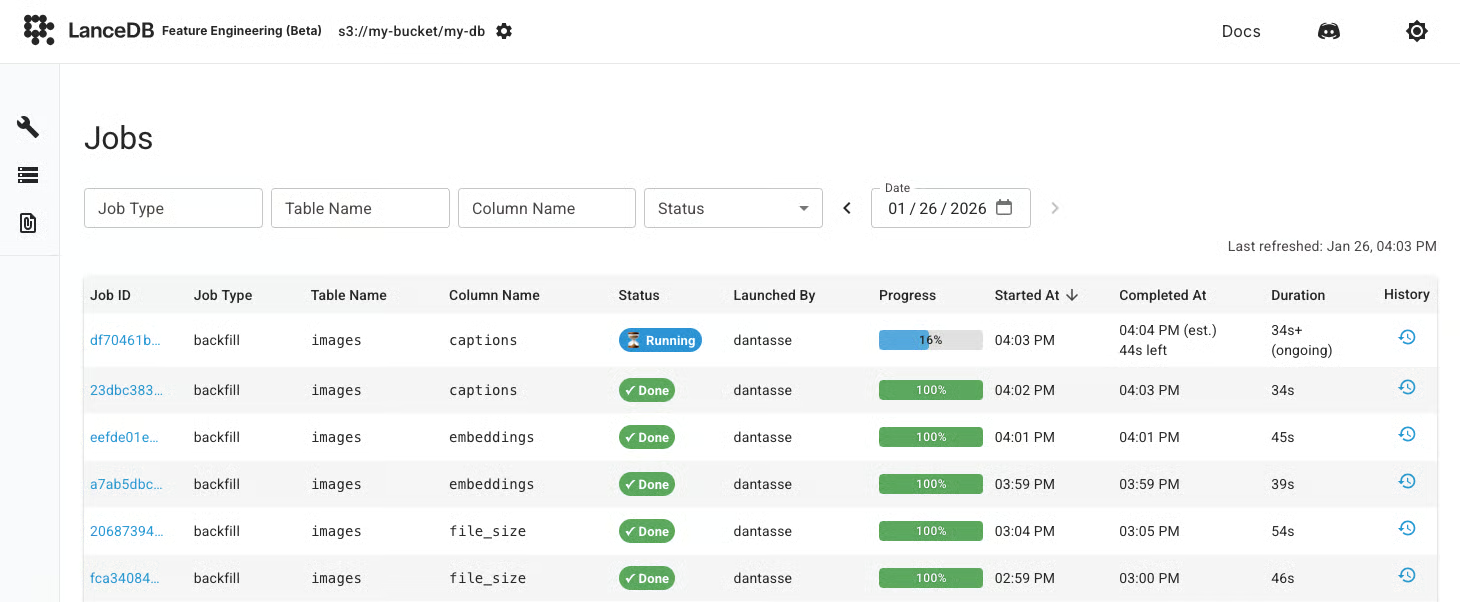
Backfill jobs computing embeddings and derived columns in LanceDB.
LanceDB began as a vector database and has since sprawled out into a multimodal lakehouse. Its versioned tables can store raw images, video, audio, documents, embeddings, metadata, and derived features on the same data foundation.
The Lance data format is optimized for random access to multimodal data, and Lance Blob V2 makes large binary objects such as images, audio, video, and PDFs native table values, reducing the need to coordinate raw files in one system with embeddings and metadata stored elsewhere.
LanceDB Enterprise extends the same foundation into dataset curation, feature engineering, retrieval, and model training. A dataset can be filtered or enriched, versioned, searched, and then passed into training without building a separate copy for each stage of model development.
This is the main reason LanceDB belongs here rather than appearing simply as another vector store. Retrieval becomes one operation on the same data used to build and refine the model.
Solid choice for: Multimodal retrieval, dataset curation, physical AI, and model-development pipelines where raw media, embeddings, metadata, derived features, and training inputs need a shared data foundation.
Probably not for: Applications centered on transactional business records, frequent row-level application updates, or conventional relational workflows. LanceDB is oriented toward AI and ML data rather than acting as the primary OLTP database for a typical application.
4. SurrealDB — several AI data models in one transactional engine
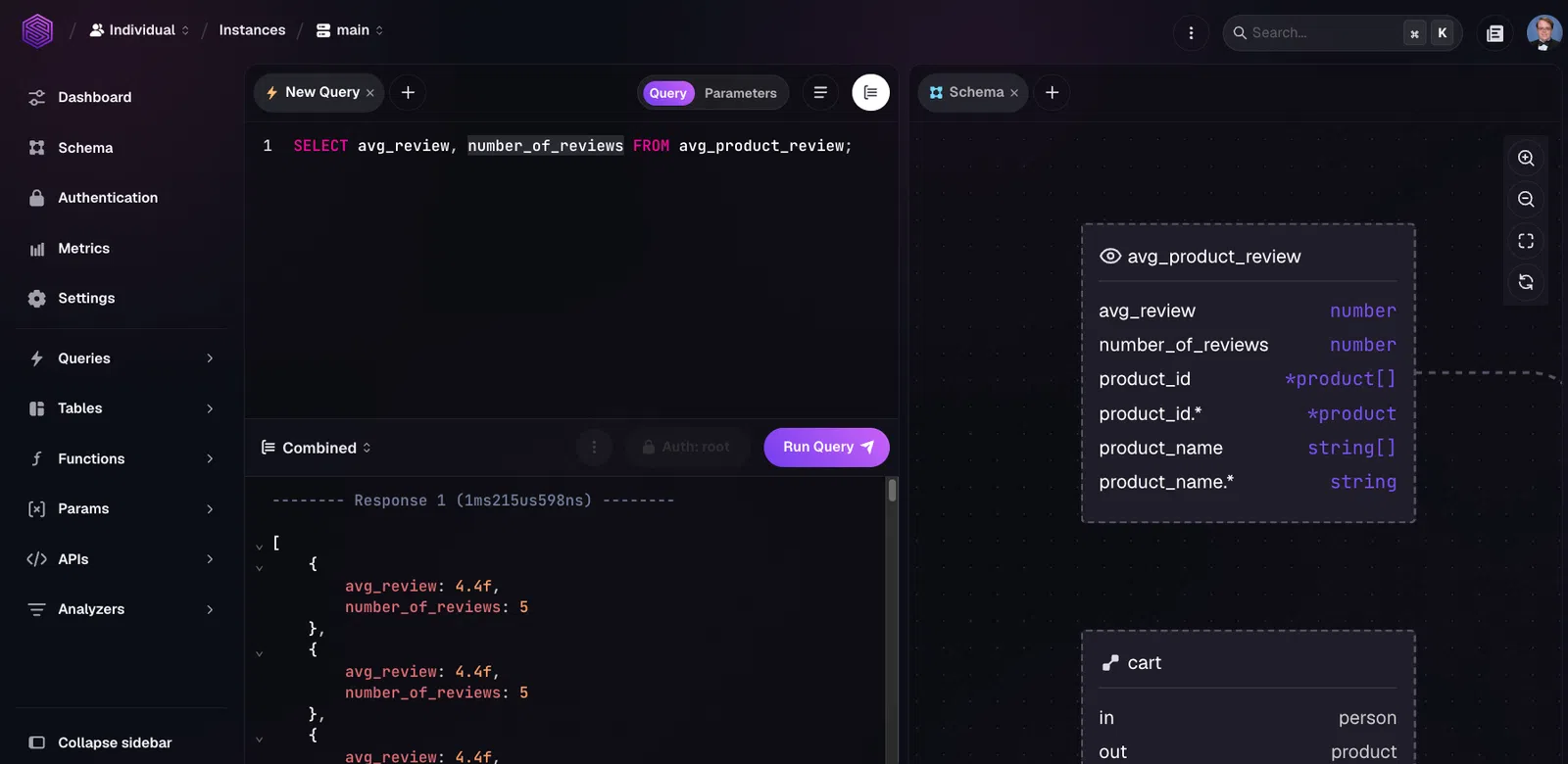
A SurrealQL query and schema in Surrealist, with graph-edge and vector fields.
SurrealDB combines relational records, documents, graph relationships, vectors, full-text indexes, time-series data, and geospatial values in a single Rust engine. SurrealQL can query these models together, with changes committed in a single ACID transaction.
Applications can keep user data, relationships, embeddings, documents, and other operational state in the same database without maintaining synchronized relational, graph, and vector stores.
The current 3.x line has continued expanding the retrieval layer, with v3.1 adding DiskANN alongside HNSW and a first-party MCP server, and v3.2 improving vector-index construction and concurrent index builds.
SurrealDB also offers a separate Agent Memory product that adds an application layer above the database, with graph, vector, document, and structured memory records persisted in SurrealDB.
Solid choice for: AI applications that need graph relationships, vectors, documents, full-text retrieval, and operational records inside the same transactional database.
Probably not for: Applications already standardized on PostgreSQL or another mature relational system that only need one additional retrieval capability. SurrealDB introduces a new query language and database ecosystem, which is harder to justify if most of its data models would go unused.
5. Turso — a database per agent
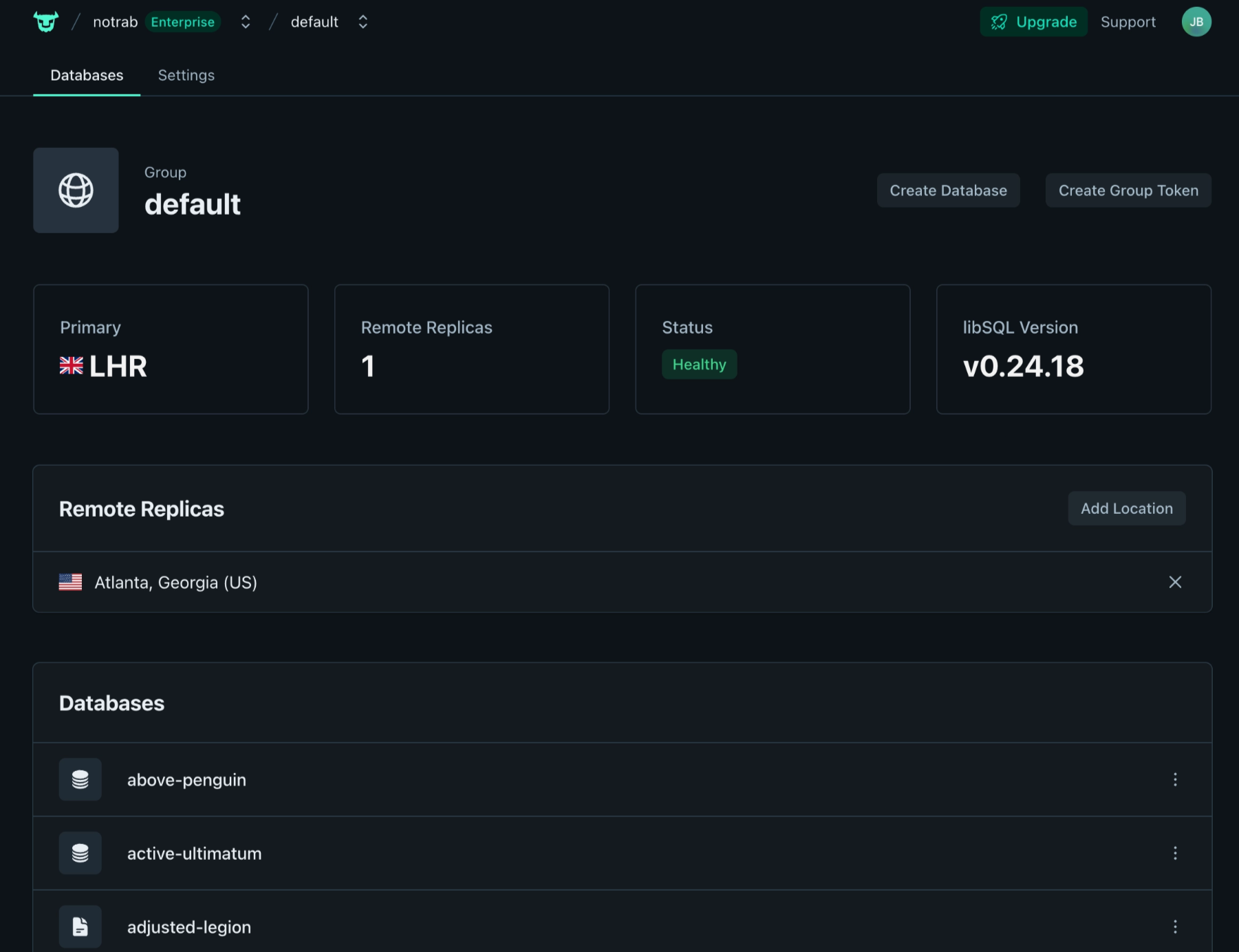
Individually provisioned databases listed within one Turso group.
Turso develops a SQLite-compatible database engine in Rust, adding capabilities that go beyond SQLite's original execution model, including native vector search, change data capture, concurrent-write support, and local-to-cloud operation.
Instead of putting every agent's state into shared tables distinguished by an agent_id, Turso can provision a dedicated lightweight database for each agent, user, project, or session. Those databases are created programmatically and can be removed with the entity that owns them.
Native vector types let embeddings be stored with messages, files, tool results, and other structured state in the same database. For edge agent memory, local agents can keep that database on the device under the same hardware and connectivity constraints as the rest of the system, with Turso Sync connecting embedded storage to Turso Cloud when needed.
The model changes how multi-agent systems can partition state — separation happens at the database level rather than through application-level tenant filtering.
Solid choice for: Local and edge agents, per-agent or per-user state, and applications that benefit from provisioning many small dedicated databases with structured data and native vector retrieval.
Probably not for: Centralized knowledge systems that depend on heavy graph traversal, huge shared retrieval indexes, or complex transactions across many agents. Turso's architecture is most compelling when small independent databases are an asset rather than an obstacle.
What's your bottleneck?
The database decision should be predicated on the part of the data path that's forcing extra infrastructure or synchronization. If the existing database already handles the required queries, scale, and deployment model, replacing it can just end up relocating complexity. A newer database is only warranted when it removes a constraint the current stack can't resolve without a mess.
For AI agents, solving storage and retrieval still leaves another problem: deciding what deserves persistence and what should return later. A database can commit records, index embeddings, traverse relationships, and retrieve context, but it doesn't inherently decide whether a tool result is temporary, whether new information supersedes an older fact, whether two observations refer to the same entity, or which memories belong in the next prompt.
Those decisions turn stored data into cross-session memory layered above the database itself, alongside retention, revision, provenance, consolidation, and recall.