How to Build Persistent Context for Coding Agents

Every mature repository contains decisions that make perfect sense if there's a record of what happened before. The implementation is preserved in source control, but the reasoning behind it is usually scattered across commits, tests, ADRs, issues, and pull requests.
Persistent context for coding agents turns those valuable findings into reusable project knowledge. It can preserve the reason behind a fix, a non-obvious dependency, an accepted design constraint, or the outcome of an earlier investigation, along with all the backing repository evidence.
A later agent should be able to retrieve the relevant finding, see where it came from, and check it against the current branch before using it. Even with larger context windows, coding agents need memory that survives the active model call when project knowledge has to persist temporally or be carried over across branches or runtimes.
The layer also needs to be selective. Routine tool traces and temporary hypotheses have a much shorter retention period than a validated architecture decision or a bug cause that took hours to uncover.
In this guide, we'll build that persistent context layer from repository ingestion through retrieval, verification, write-back, and maintenance, then apply it to bug fixing, feature delivery, and onboarding.
What Persistent Context for Coding Agents Needs to Include
Persistent context combines sources with different lifetimes, retrieval patterns, and levels of authority. Keeping them separate helps the agent distinguish stable guidance from unfinished work, reusable project knowledge, and the current implementation.
| Context source | What it contains | When it's loaded | How it should be handled |
|---|---|---|---|
| Standing instructions | Build commands, coding conventions, contribution rules, restricted paths, repository guidance | At session start or when the agent enters a relevant path | High-authority guidance, maintained explicitly |
| Repository truth | Source files, tests, configuration, schemas, git history, current branch state | Queried as the task develops | Primary evidence for current implementation behavior |
| Durable project memory | Verified bug causes, accepted decisions, code relationships, rejected approaches, compatibility constraints | Retrieved by task, repository, path, symbol, or other scope | Reusable when supported by evidence and clear scope |
| Active work state | Current objective, branch, changed files, completed checks, open questions, pending actions | Loaded for the current task or handoff | Temporary until an outcome has been validated |
Standing instructions → Stable repository guidance
Files such as CLAUDE.md, AGENTS.md, and repository-specific configuration provide consistent guidance on building and testing commands, coding conventions, restricted directories, contribution rules, and required validation steps. They should be compact enough to load predictably.
Current repository state → Implementation evidence
Before relying on retrieved project memory, the agent should check whether its supporting source still applies or whether refactoring, deletion, or other changes have altered the relevant files or flows. Source files, configuration, git history, and relevant tests provide the evidence needed to confirm how the current branch behaves.
Durable project memory → Expensive-to-reconstruct knowledge
Durable project memory preserves findings that are difficult to recover from source alone, such as rejected design paths, cross-module bug causes, compatibility constraints, and architecture decisions. Each record should retain its scope and evidence, including relevant repositories, branches, commits, files, symbols, tests, issues, ADRs, or pull requests, so a later agent can verify or revise it.
Active state → Unfinished work snapshot
Active work state captures task-specific context such as current hypotheses, changed files, completed investigation steps, unresolved questions, and pending checks. It stays task-scoped until a validated outcome deserves longer-term retention. In agent workflow memory, task state preserves continuity while selected outcomes carry into later work.
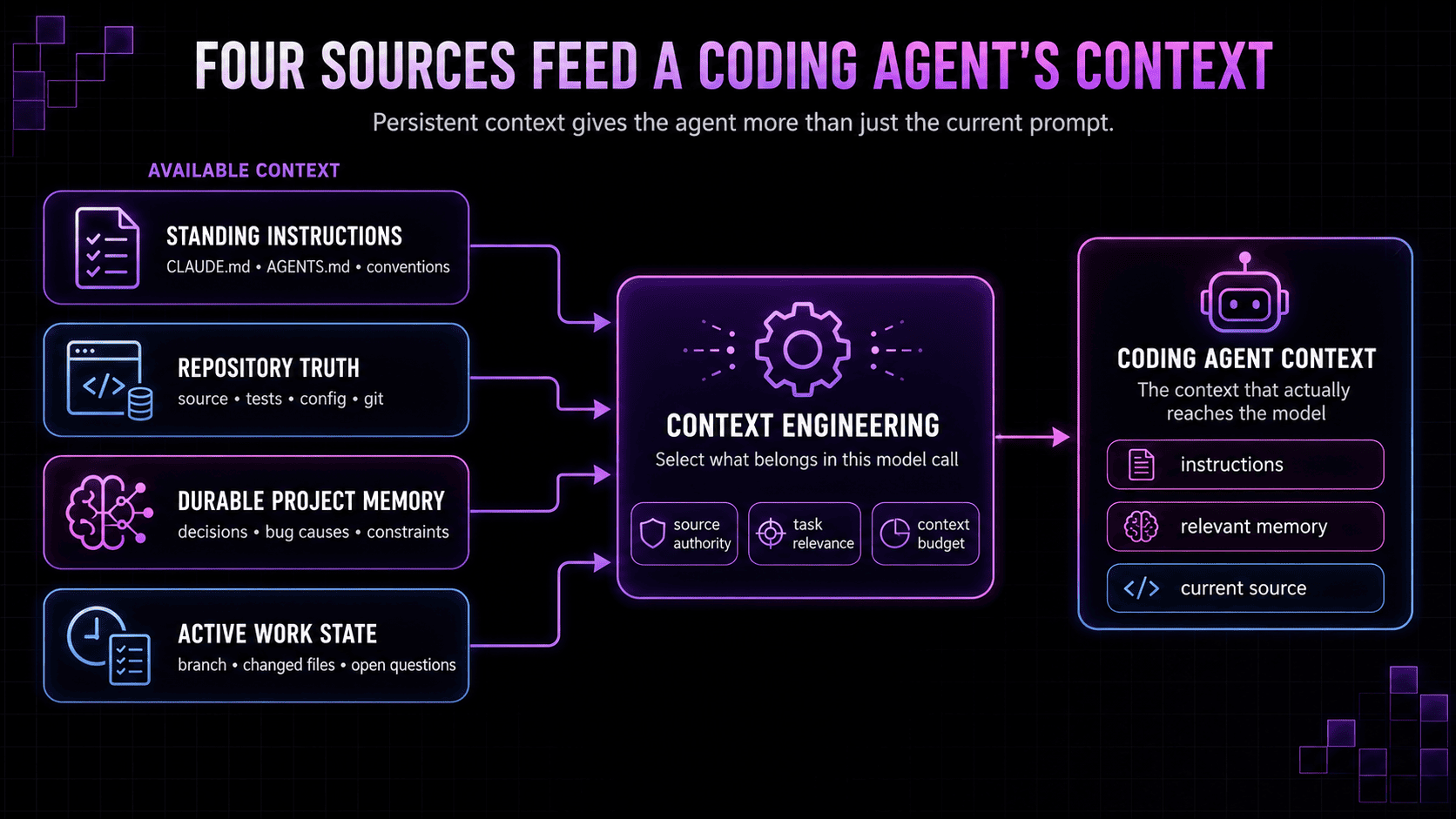
Context engineering → What reaches the model
Persistent storage determines what knowledge is available, and context engineering determines which instructions, task state, project memories, source files, and tool results enter the model context. Retrieved memory should keep enough metadata to show its source and type, with any conflict against current repository evidence left visible for verification.
Causes of Coding Context Collapse
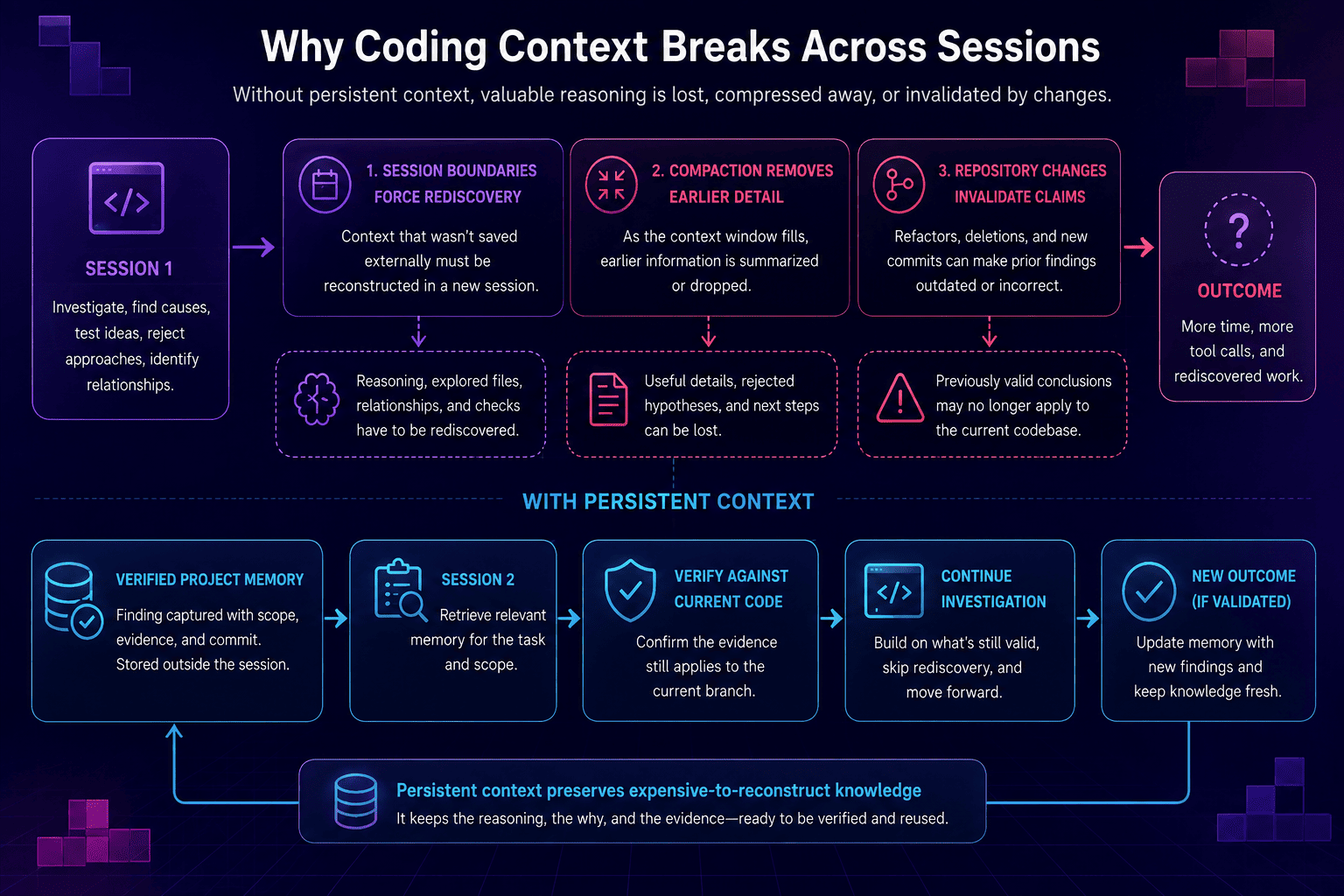
Persistent context becomes indispensable when work needs to continue into another session, the active conversation is compressed, or repository changes make earlier findings unreliable.
Session boundaries can force rediscovery
In a fresh session, any investigation that wasn't preserved externally may need to be reconstructed. This includes files already inspected, relationships discovered between modules, explanations that were ruled out, tests that exposed relevant behavior, and checks that still need to run.
The same problem applies to structural repository knowledge. Rediscovering it burns tool calls and tokens without producing anything new.
Active task state can preserve an unfinished investigation, while durable codebase memory can retain valuable findings, which the next session can use to narrow its search before inspecting the current files.
Compaction can remove earlier detail
As a long-running session fills its context window, the agent or runtime may summarize earlier interactions or discard lower-priority output. This process can remove pieces of information that later become relevant.
A persistent task record, on the other hand, can preserve things like confirmed observations, rejected hypotheses, and the next unresolved question without actually storing the full interaction history.
Repository changes can invalidate remembered claims
A retrieved memory can still look relevant even after the code behind it has changed. Consequential memories should therefore retain provenance such as repository, branch, commit, source file or symbol, and supporting tests or documentation. The agent can then verify the claim against the current repository before relying on it.
Building the Persistent Context Workflow
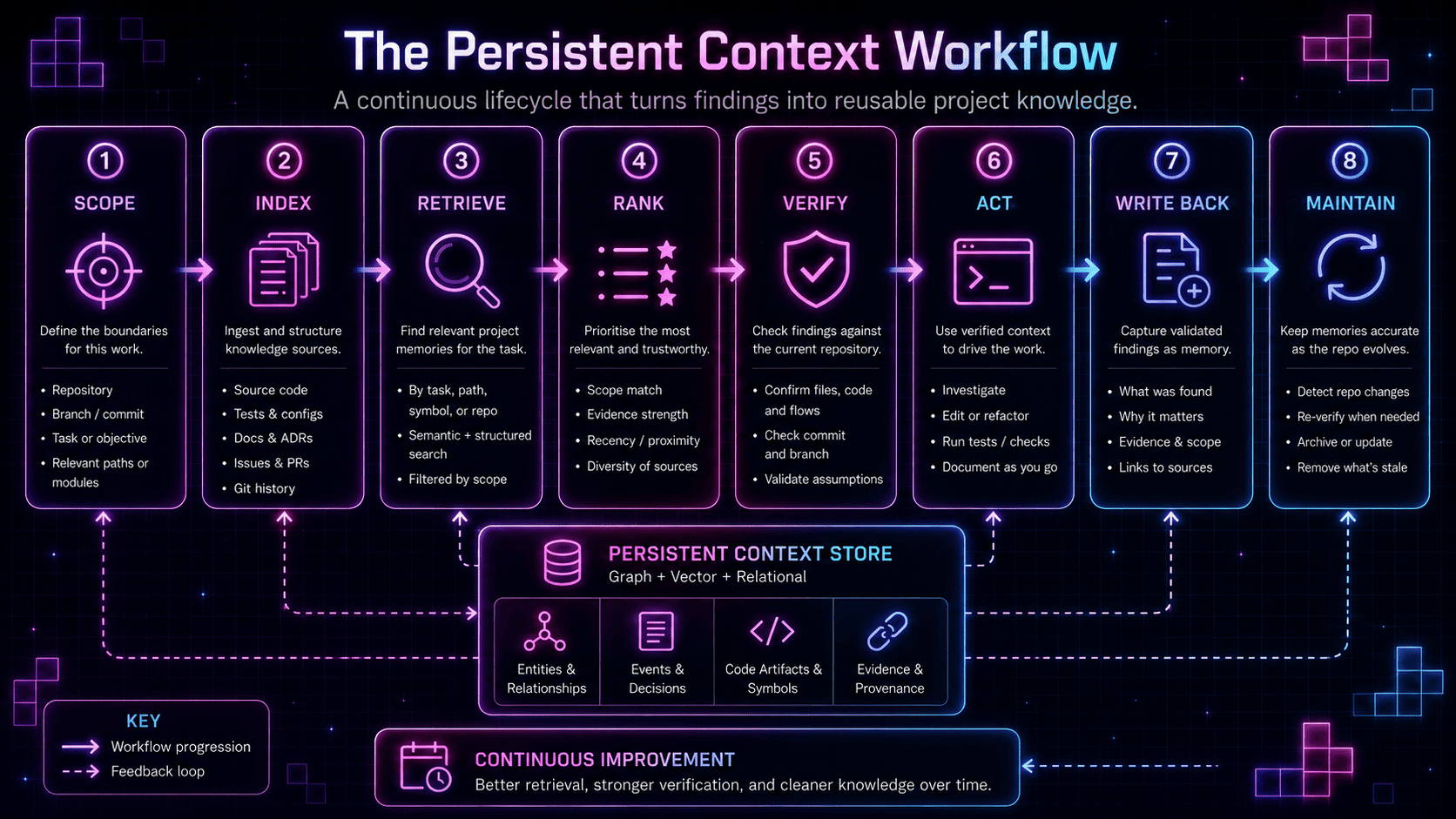
Persistent context depends on a clear lifecycle for how repository knowledge is scoped, indexed, retrieved, verified, written back, and maintained as the codebase changes. The steps below turn that lifecycle into an implementation workflow for coding agents.
Step 1: Define the context scopes
Every persistent record needs enough metadata to keep repository, branch, task, and user context from bleeding into each other. At minimum, include a repository identifier and memory type, then add narrower scope fields wherever reuse depends on them:
- organization or user;
- repository;
- default branch, feature branch, or commit;
- task, ticket, or pull request;
- file path;
- class, function, endpoint, or other symbol;
- source type;
- creation and verification timestamps.
Filtering on exact scope before broader retrieval also improves precision. A semantically similar record from another repository should never outrank a record tied directly to the current project simply because its embedding score is higher.
Here's what that looks like on payments-service — three records written at different scopes, each carrying its scope metadata from the moment it's created:
A retrieval scoped to main then enforces the boundaries instead of just recording them:
The branch-scoped workaround never reaches ranking, no matter how semantically similar it is to the query. In cognee, datasets provide hard isolation while node sets provide tag-level filtering.
Branch-local records can stay isolated until a later validation or merge step determines whether they belong in wider repository context. We cover that promotion process in Step 7.
Step 2: Index existing repository knowledge
The coding agent already has access to the repository, and the context layer should make relevant knowledge easier to locate.
Inputs can include:
- repository instructions such as
CLAUDE.mdandAGENTS.md; - architecture decision records;
- API and schema documentation;
- module, import, dependency, and call relationships;
- build, test, migration, and deployment procedures;
- selected issue and pull-request discussions;
- compatibility constraints;
- ownership and domain boundaries.
Source code can also be indexed for semantic and structural retrieval, helping the agent locate relevant files, symbols, dependencies, and relationships before inspecting the current implementation directly.
cognee's deterministic code graph supports dependency, path, and resolved-caller queries, giving coding agents a structural basis for impact analysis alongside semantic retrieval over project documentation.
Our guides on repository knowledge graphs and vector and graph retrieval cover those retrieval methods in more detail.
On payments-service, indexing the instructions, two ADRs, and the source tree produces a graph where documentation and structure meet at the module level:
The two retrieval modes then answer different questions from the same graph.
-
Structural — exact and cheap:
-
Blended — when the question doesn't name a symbol:
The structural query returns stored graph facts without an LLM generation step; the blended query adds semantic retrieval to find the relevant entry point before following those relationships.
Security note: Exclude secrets and restricted material before ingestion, including
.envfiles, private keys, credentials, production exports, customer data, restricted infrastructure configuration, and generated artifacts that may contain secrets. Apply path exclusions, content filters, and access controls before indexing, and preserve source permissions in any derived summaries or memories.
Step 3: Retain validated findings from agent work
A coding session produces plenty of temporary information. Persistent context should retain only findings that are likely to save substantial reconstruction effort and cost.
That can include:
- confirmed root causes;
- accepted architecture decisions;
- successful fix patterns;
- rejected approaches with their reasons;
- non-obvious repository conventions;
- compatibility requirements;
- non-obvious relationships confirmed during investigation;
- validated procedures or constraints.
The write call happens at a validation point, and scope, evidence, and the verifying test travel inside the same call — they're part of the record (the full record structure is shown below), not annotations added later.
That write could look like this (illustrative pseudocode):
Reading it back shows what survives the round trip:
Most memory layers reshape prose on ingestion — entity extraction, chunking, summarization — so check what your retrieval returns, not what you wrote. The metadata fields are the part that must come back intact, because the verification step later depends on them.
A durable record should capture them together with scope and evidence, giving a later agent a route back to the source:
(illustrative — field names vary by system)
What should stay out of durable memory: Keep temporary hypotheses, routine tool traces, copied source, secrets, and short-lived task details out of durable memory. Failed approaches should be retained only when they could prevent repeated work; preserve the reason and evidence, not the full investigation trace.
Step 4: Retrieve context in layers
Loading the complete history at the beginning of every task consumes tokens and makes relevant evidence harder to identify.
An optimal retrieval sequence looks like this:
- Load standing instructions relevant to the repository or current path.
- Restore active task state for the current branch, ticket, or handoff.
- Retrieve durable project memory related to the task.
- Retrieve structural repository context around relevant files and symbols.
- Inspect current source and tests as the investigation narrows.
This should provide enough orientation before the agent opens source for exact implementation detail, while also keeping each context type identifiable. A remembered decision should arrive with different metadata and authority from a current source excerpt or temporary task note.
Here's one BUG-1842 prompt with all five layers injected, each visibly labeled and separately bounded:
Two properties make this workable. Each layer is capped independently (per-item truncation times a per-layer top-k), so trimming the budget shrinks layers rather than dropping one. And each entry carries its origin label — a remembered decision arrives as [decision · ADR-042], never disguised as live source.
When several coding clients need access to the same persistent context, exposing it through MCP or another shared interface keeps repository knowledge available across tools. Here's an example of how cognee can be used to give Claude Code persistent memory.
Step 5: Rank candidate context before prompt assembly
Retrieval produces candidate context, then ranking determines which records receive prompt space.
These are the salient types of signals for repository work:
- scope match: repository, branch, task, path, or symbol;
- task proximity: relationship to the current bug, feature, file, or test;
- evidence quality: source authority, verification status, supporting tests;
- retrieval relevance: semantic, lexical, or graph-based relevance;
- context cost: token length and duplication with other selected records.
A conceptual score can stay simple:
Ranking should weigh semantic relevance alongside scope, evidence, and structural proximity, prioritizing branch-specific records or directly linked tests over broader context. After ranking, reserve enough prompt space for standing instructions, active task state, current source, tests, and tool output.
Two candidates legitimately overlap on src/auth/logout.ts, and a third is semantically similar but useless. Scored against the five signals:
| Signal | Branch fix (BUG-1842) | Architecture note (ADR-042) | Similar note, other repo |
|---|---|---|---|
| Scope match | high — repo + branch + task | medium — repository-wide | none — different repository |
| Task proximity | high — same file and test | medium — same module | low |
| Evidence quality | high — verifying test + commit | medium — ADR reference | none |
| Retrieval relevance | high | high | high — embeddings alone love it |
| Context cost | low — ~320 tokens | medium — ~700 tokens | high — ~1,900 tokens |
| Outcome | ranked first | ranked second | excluded by the scope filter |
The last column is the case that breaks pure vector retrieval: on semantic relevance alone it ranks near the top. Scope filtering and evidence weighting are what keep it out of the prompt.
Step 6: Verify consequential memories against the current repository
Use persistent memory to accelerate investigation while checking consequential claims against current repository evidence.
Before relying on a retrieved memory that could affect the implementation:
- confirm the cited file or symbol still exists;
- check whether the claim applies to the current branch;
- inspect changes since the recorded commit;
- look for a later decision that replaced it;
- run a related test or check when appropriate.
GitHub has described a similar citation-based design for Copilot's cross-agent memory: stored observations retain references to specific code locations, and those references are checked before the memory is applied.
Verification can leave a record in four pertinent states:
- confirmed — the evidence still supports the claim;
- partially valid — part of the record is still relevant and needs narrower or revised scope;
- superseded — newer code or a later decision has replaced it;
- unsupported — the cited evidence no longer supports the claim.
The verification status can feed directly into later filtering and ranking, and any branch mismatches should be handled through scope filtering before the record reaches this stage.
Verification depth can then follow risk: low-impact guidance may only need rechecking after its source changes, while authentication, migrations, permissions, and deployment behavior warrant stronger verification when retrieved.
A concrete drift case, caught at retrieval time:
And one line for each verification state:
- confirmed —
logout()still callsSessionStore.revoke; the verifying test passes unchanged. - partially valid — the claim holds but the cited line moved in a refactor; evidence updated, scope kept.
- superseded — ADR-051 replaced the Redis store with a JWT denylist; the record stays as history, out of current guidance.
- unsupported — the cited helper was deleted with no equivalent; the record is flagged and excluded until revised.
Step 7: Write back after validation
Write durable records only after the task reaches a validation point, such as passing tests or review. Use the Step 3 structure for scope, evidence, verification, and applicability, and keep unconfirmed conclusions out of persistent memory.
Review can happen at existing checkpoints such as pull requests, merges, releases, or handoffs, with low-risk records handled automatically and repository-wide decisions requiring explicit approval.
A natural gate is the pull request. The proposed memory rides in the same diff as the fix, so the reviewer approves the finding together with the code that proves it:
On merge, the record enters repository-wide retrieval. The two authority levels look like this:
| Path | Example | Gate |
|---|---|---|
| Automated, low risk | Task handoff saved at session end (branch, open questions, pending checks) | None — task-scoped, expires with the task |
| Reviewed, high authority | Repository-wide decision or bug cause, like the record above | Explicit approval at the PR / merge checkpoint |
Step 8: Update affected context as the repository changes
Use incremental maintenance triggered by commits, merges, changed files, or other repository events.
When code changes, revisit:
- changed files and symbols;
- graph relationships connected to them;
- memories citing the affected evidence;
- linked tests;
- summaries describing the modified subsystem;
- branch-local records affected by the merge.
cognee uses content hashes to identify changed inputs during re-indexing, allowing affected repository context to be updated incrementally instead of rebuilding unchanged records.
If a symbol disappears, related graph records and persistent memories should be revised or removed. If a decision is reversed, an older record can be retained as historical context while being excluded from current guidance.
Before and after, on one commit:
The reversed-decision case is different from deletion — the record survives with its history, but stops steering the agent:
Include indexing, retrieval, verification, background processing, and review in the operating-cost calculation — check out our guide to token cost of persistent AI memory for more detail.
Three Persistent-Context Workflows
The same persistent-context setup can look quite different depending on the work in front of the agent. Bug fixes, feature development, and repository onboarding show those differences clearly.
Bug fixing across sessions
Context from an earlier related fix can help trace an authentication failure: the previous root cause, affected files and symbols, relevant tests, recent changes, and rejected approaches. The agent can use that history to narrow the investigation, then verify it against the current branch.
During the work, temporary findings stay in active task state. Once the cause is confirmed, the durable record can preserve the verified cause, accepted fix, evidence, affected code, and applicable conditions for future retrieval.
End to end, the authentication bug spans two sessions:
Session 2 starts from a narrowed search space instead of rediscovery — and because the restored records carry evidence, the drift is caught before an outdated file path can mislead the investigation.
Feature delivery across several sessions
Feature work across several sessions needs to preserve both unfinished implementation state and decisions that may become durable project knowledge. For an organization-level API key feature, retrieval can produce relevant interfaces, architecture decisions, migration conventions, compatibility constraints, tests, and the active specification.
Session handoffs can capture the branch, changed files, completed work, open questions, pending migrations, and rejected design paths. After review and merge, approved decisions can move into durable memory, while branch-local or abandoned approaches are either retired or retained with their rejection rationale.
The organization-level API keys feature, across three passes:
Pass 2 restores the handoff and resumes at the open question instead of re-reading the diff. After review and merge, pass 3 promotes only what deserved repository-wide authority:
Ruled-out paths are kept, not deleted: the rejected-approach record with its reason is what prevents a later session from proposing per-key JWTs all over again.
Repository onboarding
Onboarding context should give a developer or coding agent a compact entry point into an unfamiliar repository, with routes to deeper retrieval when the task reaches a specific area.
A first context bundle can cover:
- the repository's purpose;
- primary modules and responsibilities;
- architecture entry points;
- build and test commands;
- important interfaces and schemas;
- recent architecture decisions;
- contribution rules;
- known constraints;
- ownership or domain boundaries.
A concise bundle could look like this:
As the work narrows, the agent can retrieve deeper context, such as settlement decisions and tests for src/settlement/, or callers and compatibility constraints for a public interface.
Verified onboarding findings can also update repository guidance: an outdated build command may belong in AGENTS.md or CLAUDE.md, while an undocumented dependency may become documentation or durable project memory after review.
The deeper-query hooks fire when the work narrows. An agent whose task enters src/settlement/ pulls the scoped layer for that area:
And when onboarding reveals something wrong — the outdated build command — the correction routes through the same review gate as any repository-wide memory (Step 7):
An onboarding bundle that can propose its own corrections stays trustworthy; one that can't decays into the documentation it was supposed to replace.
Measure Whether Persistent Context Improves Coding Work
Evaluate persistent context by what changes in the coding workflow: task quality, investigation effort, context quality, and operating cost.
Test cases can include known bugs, interface changes, schema changes, interrupted work, or previously diagnosed failures, with results validated through tests, static analysis, expected file changes, known root causes, or reviewer acceptance.
Compare against realistic baselines
Run the same task under three conditions to isolate the contribution of cross-session context from the value already provided by repository instructions:
| Condition | Context available |
|---|---|
| Repository only | Current source, tests, git history, and ordinary search tools |
| Standing instructions | Repository access plus CLAUDE.md, AGENTS.md, or equivalent guidance |
| Persistent context | Standing instructions plus retrieved decisions, previous findings, structural context, and task history |
Keep the model, tools, instructions, and repository revision consistent across runs.
Measure task quality alongside investigation cost
The first group of metrics should show whether the agent completed the work correctly, and the second one should show how much repository exploration was required to get there.
| Metric | What it shows |
|---|---|
| Task completion rate | Whether the agent reaches an accepted result |
| Test pass rate | Whether the implementation satisfies executable checks |
| Patch acceptance rate | Whether the final change survives review without major correction |
| Root-cause accuracy | Whether the agent identifies the real cause of a bug |
| Cross-session completion rate | Whether interrupted work can be resumed successfully |
| Repeated-error rate | Whether previous findings prevent already-rejected approaches from recurring |
| Repository exploration calls | How much navigation is required before substantive work begins |
| Time to first relevant edit | How quickly the agent reaches the affected area |
| Exploration tokens | How much context is spent rediscovering the repository |
| Time to validated result | Total effort required to reach a confirmed outcome |
Faster retrieval counts as an efficiency improvement. Better coding performance requires an improvement in the resulting patch, diagnosis, or task completion as well.
The Codebase-Memory preprint provides a strong example of why these dimensions should be measured separately. Across 31 real-world repositories, its Tree-Sitter knowledge graph achieved 83% answer quality compared with 92% for a file-exploration agent, while using roughly one-tenth the tokens and 2.1 times fewer tool calls.
In that evaluation, structural retrieval reduced search cost while direct file exploration retained higher overall answer quality. A coding workflow can therefore use persistent structure to locate the relevant area and current source to resolve implementation detail.
Evaluate the context that reaches the agent
A retrieval result can be relevant to the query and still be poor context for the task.
Inspect whether selected records:
- belong to the correct repository and branch;
- point to relevant files, symbols, tests, or decisions;
- retain usable source evidence;
- duplicate information already present;
- conflict with current repository evidence;
- improve the investigation or narrow the next step.
| Metric | Definition |
|---|---|
| Context precision | Share of injected records that contribute relevant information |
| Context coverage | Share of required repository knowledge present in the assembled context |
| Verification success rate | Share of consequential retrieved claims confirmed against current evidence |
| Contradiction rate | Share of retrieved records that conflict with current repository evidence |
| Incorrect-memory usage | Frequency with which an unsupported record influences an edit or conclusion |
Count any unsupported record that influences the final edit as a reliability error, even when retrieval itself succeeded.
Compare cold-start and accumulated-context runs
A newly indexed repository and one with months of validated findings provide different evaluation conditions. Comparing the two shows whether write-back improves later tasks:
- Cold-start runs use standing instructions, indexed source structure, and existing documentation.
- Accumulated-context runs add accepted bug causes, implementation decisions, rejected approaches, and other knowledge created through previous work.
In Snowflake's 2026 ArcticMem evaluation, persistent memory improved five of seven internal benchmark tasks, left one unchanged, and reduced performance on one. These mixed results reinforce that more stored memory doesn't automatically yield better performance.
Inspect retrieval traces alongside final scores
Final scores can't show whether a failure came from missing knowledge, poor retrieval, weak ranking, failed verification, or agent behavior.
For representative runs, retain enough trace information to reconstruct the context path:
- query and scope filters;
- retrieved records and ranking scores;
- source references;
- verification results;
- records passed to the model;
- agent actions that followed;
- proposed write-backs and review decisions.
Trace review should show whether a retrieval improved the agent's next coding decision.
A results sheet worth copying — same task, same repository revision, three conditions:
| Metric | Repository only | Standing instructions | Persistent context |
|---|---|---|---|
| Task completed | record per run | · | · |
| Tests pass | · | · | · |
| Exploration tool calls | · | · | · |
| Exploration tokens | · | · | · |
| Time to validated result | · | · | · |
The numbers belong to your repository — publish your own rather than inheriting anyone else's. What makes the comparison auditable is the retrieval trace kept for the persistent-context run:
If a run fails, the trace says whether the knowledge was missing, retrieved but ranked out, or retrieved and ignored — the three failures a bare score can't distinguish.
Factor in the context maintenance budget
Persistent context adds upkeep through re-indexing changed files, updating structural relationships, running retrieval and verification calls, reviewing proposed memories, and correcting records after repository changes.
The Codified Context paper tracked a context system maintained alongside a 108,000-line C# project across 283 development sessions. Updating an affected specification reportedly added about five minutes to a session, alongside a 30-to-45-minute review every two weeks. The author estimated total context maintenance at roughly one to two hours per week.
The report also identifies outdated specifications as its main failure mode, showing why maintenance cost and reliability should be evaluated together.
The PR-riding lifecycle from Step 7, including the path where the gate says no:
The decline is the point: a proposed memory is a claim about the repository, and it deserves the same scrutiny as a code claim. A store that accepts everything eventually teaches the agent things nobody agreed to.
Persistent Context Implementation Checklist
Before putting persistent context into day-to-day repository work, it helps to check that the core safeguards and operating requirements are in place. This checklist should cover all the main aspects of implementation, retrieval, verification, maintenance, and evaluation:
Scope and source hierarchy:
- Give every persistent record a repository scope.
- Add branch, commit, task, path, and symbol scope where reuse depends on them.
- Keep standing instructions, active task state, and durable project memory distinct.
- Define how conflicts between remembered knowledge and current repository evidence are handled.
- Preserve source permissions in derived memory.
Ingestion and storage:
- Index documentation, decisions, and structural code relationships that are expensive to reconstruct.
- Exclude secrets, credentials, restricted paths, and sensitive artifacts before ingestion.
- Keep exact implementation details in the repository when direct source access is available.
- Store validated findings with scope, evidence, and applicability conditions.
- Keep temporary hypotheses and routine tool traces in task state.
Retrieval and ranking:
- Filter by repository and applicable branch scope before broader retrieval.
- Keep standing guidance, task state, durable memory, and structural context identifiable during retrieval.
- Rank candidates using scope, task proximity, evidence quality, retrieval relevance, and context cost.
- Deduplicate selected records before prompt assembly.
- Reserve context space for current source, tests, and tool output.
- Let the agent request deeper context when the initial retrieval is insufficient.
Verification and write-back:
- Check consequential claims against the current branch before the agent relies on them.
- Preserve relevant file, symbol, commit, test, issue, ADR, or pull-request references.
- Record whether a memory is confirmed, partially valid, superseded, or unsupported.
- Persist durable findings after an appropriate validation point.
- Require review before promoting high-authority branch-local knowledge to repository-wide context.
Maintenance:
- Trigger incremental updates from commits, merges, file changes, or comparable repository events.
- Revisit memories and structural relationships connected to changed source.
- Remove or archive records whose evidence no longer supports current guidance.
- Attach context review to existing development checkpoints where possible.
- Track indexing, retrieval, verification, storage, and review overhead.
Evaluation:
- Build repository-specific tasks with objective or reviewable outcomes.
- Compare repository-only, standing-instruction, and persistent-context conditions.
- Measure task quality alongside repository-exploration cost.
- Track context precision, coverage, verification failures, and unsupported-memory use.
- Compare cold-start performance with performance after validated project knowledge has accumulated.
- Inspect retrieval traces for representative successes and failures.
Let Each Investigation Improve the Next
Every difficult bug leaves two things behind: the fix, and the reasoning that led to it. Git keeps the former and, unless there is a place to store the latter, it usually disappears with the session.
Persistent context gives that reasoning a longer shelf life. A verified record can preserve what was learned, where it applies, which evidence supports it, and the commit it was checked against, so a future agent has what it needs to verify the finding against the repository as it exists now.
Over time, that changes how much previous work the codebase can carry forward, with the real value coming from retaining hard-won knowledge in a form that stays connected to the code behind it.
With cognee, that memory can stay outside any single coding client and be available to Claude Code, Cursor, and other compatible tools through MCP or programmatic integrations. Graph-backed repository context can persist across sessions while retaining the source evidence a future agent needs to verify what it inherits.
FAQ
Answers to the most common questions from this guide.
Is persistent context the same as RAG?
RAG is a retrieval pattern in which external information is fetched and added to the model context for the current request.
Persistent context refers to how project knowledge survives and changes across coding sessions. It can use RAG techniques internally while adding repository scope, write-back, verification, task handoffs, and lifecycle rules around retrieval.
Does persistent context require fine-tuning the coding model?
No. Persistent context can be stored outside the model and reach the coding agent through prompts, tools, an API, an SDK, MCP, or another integration layer.
Because the project knowledge is stored outside the model weights, changing the memory workflow does not require retraining the coding model.
Can several coding agents use the same persistent context?
Yes, if they connect to a shared context layer rather than keeping all project knowledge inside individual sessions.
Repository, branch, task, user, and permission scopes then become important because a record written by one agent may later be retrieved by another. Shared access should preserve where the record came from and who is allowed to use it.
Can persistent context span several repositories?
Yes. This can help when work crosses services, shared libraries, API consumers, or infrastructure stored separately.
Repository identity should stay explicit so retrieved records preserve their source, version, access rules, and relationship to the current task. Cross-repository retrieval can then connect related project knowledge without blending separate codebases into one undifferentiated context store.
How long should coding-agent context be retained?
Retention depends on the type of record.
Active task state may only need to survive until the task is completed. A validated architecture decision or compatibility constraint can stay relevant much longer. Branch-specific records can be reviewed after merge, while temporary workarounds can be removed once the code no longer depends on them.
The retention policy should follow how long the information retains value and whether its supporting evidence still applies.
What happens when two coding agents write conflicting project memory?
The conflict should stay visible until the system or a reviewer can resolve it.
Relevant metadata includes the source, branch, commit, verification status, authoring agent, and supporting evidence for each record. Retrieval can prefer a more recent or better-supported record where policy allows, while higher-impact conflicts can be routed for review rather than silently choosing one version.