Deep Dives
Explore advanced AI techniques and methodologies, including Retrieval-Augmented Generation (RAG), Graph-RAG, knowledge graphs, embeddings, and context management. Dive into the graph-based retrieval systems, large language models (LLMs) and innovative ways to enhance AI performance.
Latest
Latest
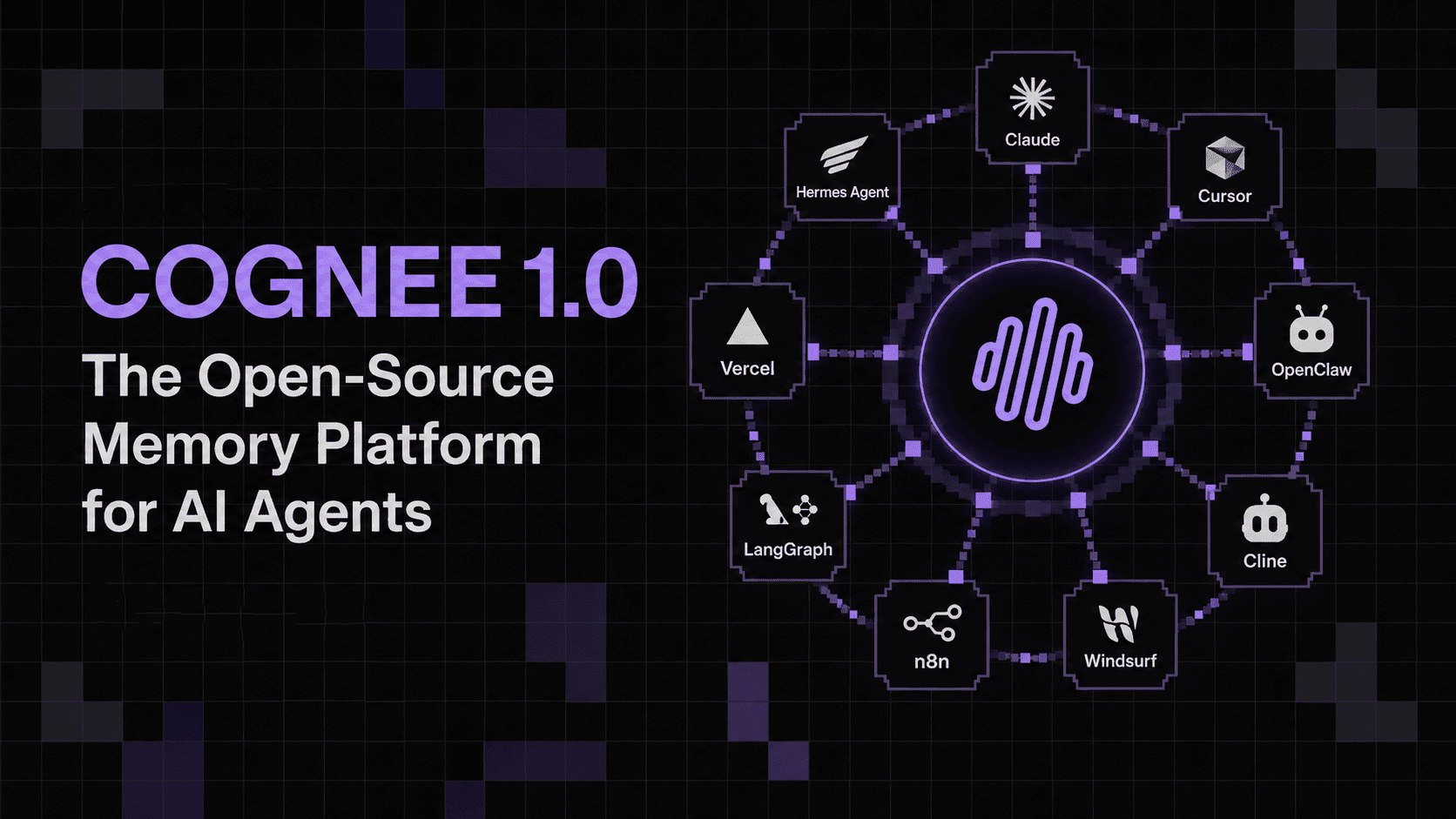
Just Postgres: Drop the Graph Database. Keep the Graph.
cognee 1.0 runs the full agent memory layer — graph, vectors, sessions, and metadata — on a single Postgres instance, eliminating the need for separate graph database, vector store, and Redis deployments.
Technical Note: Understanding the Token Cost of Persistent AI Memory
Persistent memory trades an upfront ingestion cost for cheaper queries. We measure where the tokens go in cognee, model the trade-off, and find break-even at roughly 23–26 repeated queries — after which the gap keeps widening.
Behind the Viral Numbers: How We Got 7x Cheaper and 145% Better
Our LinkedIn and X videos put two numbers on screen — 7x cheaper than chat and 145% better than the best alternative. Here's exactly where each one came from, linked to our BEAM report.
cognee on-device: Bringing Agent Memory to the Edge
The cognee core rebuilt in Rust, bringing the full agent memory pipeline — graph construction, embeddings, and retrieval — to phones, robots, and offline environments without a server-side stack.
Inside cognee 1.0: Memory-Native APIs for Production Agents
cognee 1.0 ships four memory verbs — remember, recall, improve, forget — with a self-improving feedback loop, hybrid retrieval with evidence references, a TypeScript SDK, and migration tools for Mem0, Zep, and Letta.
Separate memories for organization, agent and user: Support AI Agent Use-Case
Most support teams don't have a support problem — they have a context problem. Here's how we built a support agent on top of cognee using user, agent, and organization memory.
Memory as a Decorator
Adding memory to agentic workflows used to mean restructuring your stack. One decorator changes that. We ran 198 simulated sales conversations — and the results make a strong case for structured memory.
Cognee's CLI Replaces MCP OAuth in 100 Lines
MCP has real auth built in. CLI doesn't — or so the claim goes. The Claude Code plugin that wraps cognee-cli runs a full register-login-token handshake before the first command fires.
Agents Don't Need Another Protocol. They Need a Good CLI.
Your agent forgets everything between sessions. The fix isn't a bigger context window — it's persistent memory via a CLI. Four commands give your agent cross-session, graph-structured memory.
Just Postgres: Drop the Graph Database. Keep the Graph.
cognee 1.0 runs the full agent memory layer — graph, vectors, sessions, and metadata — on a single Postgres instance, eliminating the need for separate graph database, vector store, and Redis deployments.
Technical Note: Understanding the Token Cost of Persistent AI Memory
Persistent memory trades an upfront ingestion cost for cheaper queries. We measure where the tokens go in cognee, model the trade-off, and find break-even at roughly 23–26 repeated queries — after which the gap keeps widening.
Behind the Viral Numbers: How We Got 7x Cheaper and 145% Better
Our LinkedIn and X videos put two numbers on screen — 7x cheaper than chat and 145% better than the best alternative. Here's exactly where each one came from, linked to our BEAM report.
cognee on-device: Bringing Agent Memory to the Edge
The cognee core rebuilt in Rust, bringing the full agent memory pipeline — graph construction, embeddings, and retrieval — to phones, robots, and offline environments without a server-side stack.
Inside cognee 1.0: Memory-Native APIs for Production Agents
cognee 1.0 ships four memory verbs — remember, recall, improve, forget — with a self-improving feedback loop, hybrid retrieval with evidence references, a TypeScript SDK, and migration tools for Mem0, Zep, and Letta.
Separate memories for organization, agent and user: Support AI Agent Use-Case
Most support teams don't have a support problem — they have a context problem. Here's how we built a support agent on top of cognee using user, agent, and organization memory.
Memory as a Decorator
Adding memory to agentic workflows used to mean restructuring your stack. One decorator changes that. We ran 198 simulated sales conversations — and the results make a strong case for structured memory.
Cognee's CLI Replaces MCP OAuth in 100 Lines
MCP has real auth built in. CLI doesn't — or so the claim goes. The Claude Code plugin that wraps cognee-cli runs a full register-login-token handshake before the first command fires.
Agents Don't Need Another Protocol. They Need a Good CLI.
Your agent forgets everything between sessions. The fix isn't a bigger context window — it's persistent memory via a CLI. Four commands give your agent cross-session, graph-structured memory.
Keenable × cognee: Giving Web Retrieval Persistent Memory
Cut Cognee's Vector Memory by 8x with Qdrant's TurboQuant