AI Knowledge Base: Building a Retrieval-Ready Knowledge Layer for Agents and RAG

While a traditional knowledge base helps people find answers, an AI knowledge base has a harder job: to give AI memory systems the right information, with enough context, at the right moment, reliably, at scale, often without human oversight.
When a person reads a knowledge base article, they can notice when something looks outdated, cross-reference with another source, skip guidance that clearly doesn't apply, or ask a colleague when the answer feels "off." But AI retrieval pulls whatever appears relevant and packages it into a confident response even if the underlying source is stale, duplicated, incomplete, or written for an entirely different audience.
That's why an AI knowledge base needs structure that's usable for retrieval systems: source links, entity relationships, timestamps, permissions, content type labels, and signals about whether the information is current and authoritative. Without that structure, the system just gets a mess of documents without a clue which ones to trust.
It's clear that this structure is imperative for a range of AI workflows. Customer support agents need accurate product and policy context, internal assistants need access-controlled company knowledge, agentic RAG pipelines need source-grounded retrieval, and enterprise AI systems need auditability and provenance.
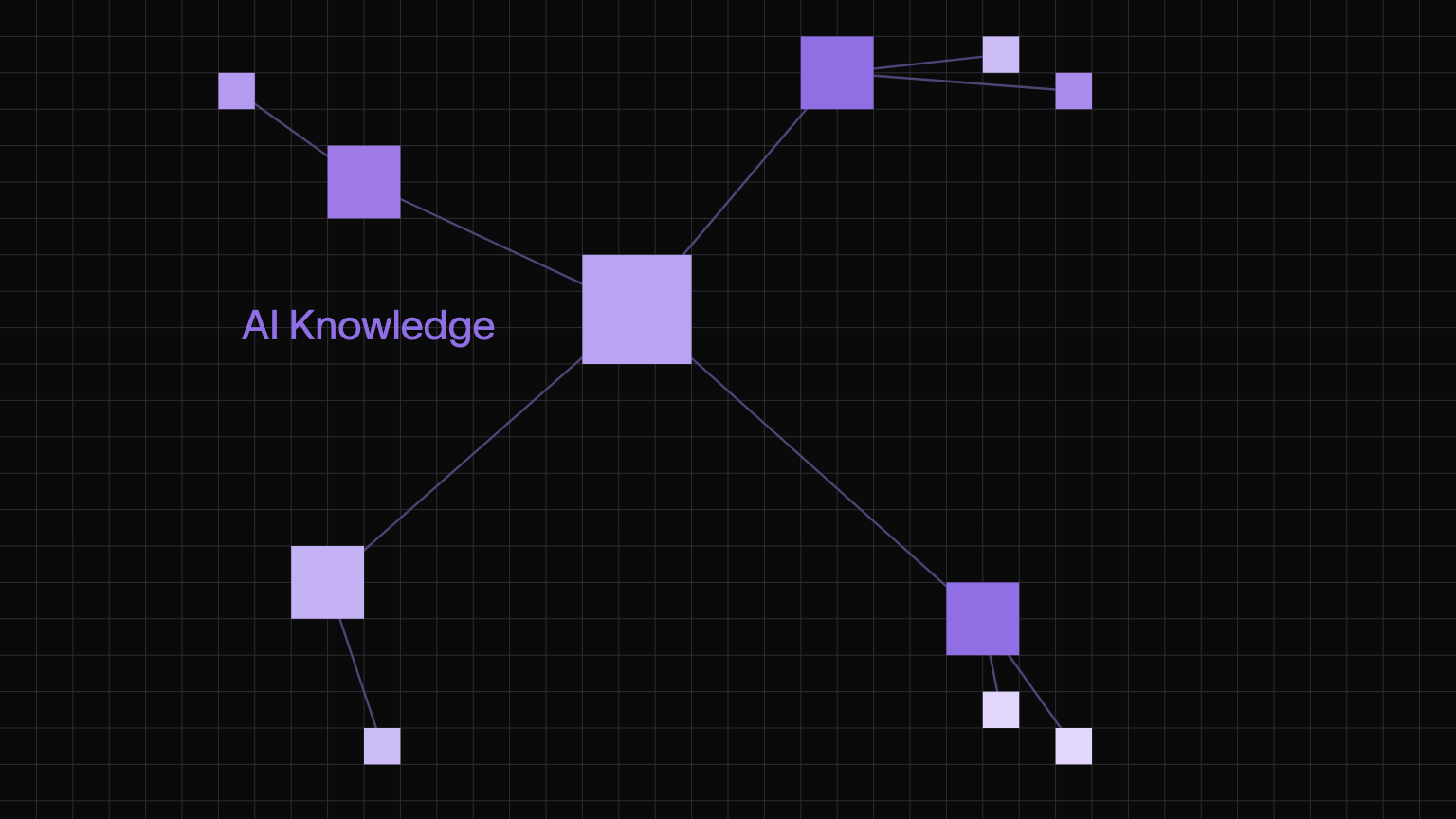
The solution is a knowledge layer — a connected structure that links documents, records, decisions, entities, relationships, and feedback so that AI systems can retrieve information with context rather than just finding text that sounds similar to the query.
This makes the difference between static stored information and genuinely relevant retrievable knowledge, and it's what this guide is about.
What Makes a Knowledge Base AI-Ready?
An AI knowledge base is a structured information repository designed to be retrieved and used by generative AI systems, not just read by people.
It can include articles, documentation, policies, tickets, product data, customer records, research notes, technical runbooks, decision logs, previous task outcomes, and user feedback. What makes it an AI knowledge base is not the content type itself, but how the information is prepared for retrieval, reasoning, and reuse by AI systems.
The content of a traditional knowledge base structured for human consumption — with categories, article titles, FAQs, update dates, search, etc. — still matters, but it's not enough for AI workflows.
An AI-powered knowledge base needs to answer questions that a human reader would normally resolve using their judgment:
- Where did this information come from?
- Is it current, and who's accountable for it?
- What entity, product, customer, policy, or process does it describe?
- What other information is connected to it?
- Is it suitable for a certain audience or workflow?
- Has a newer source replaced it, and what should be cited if the answer is challenged?
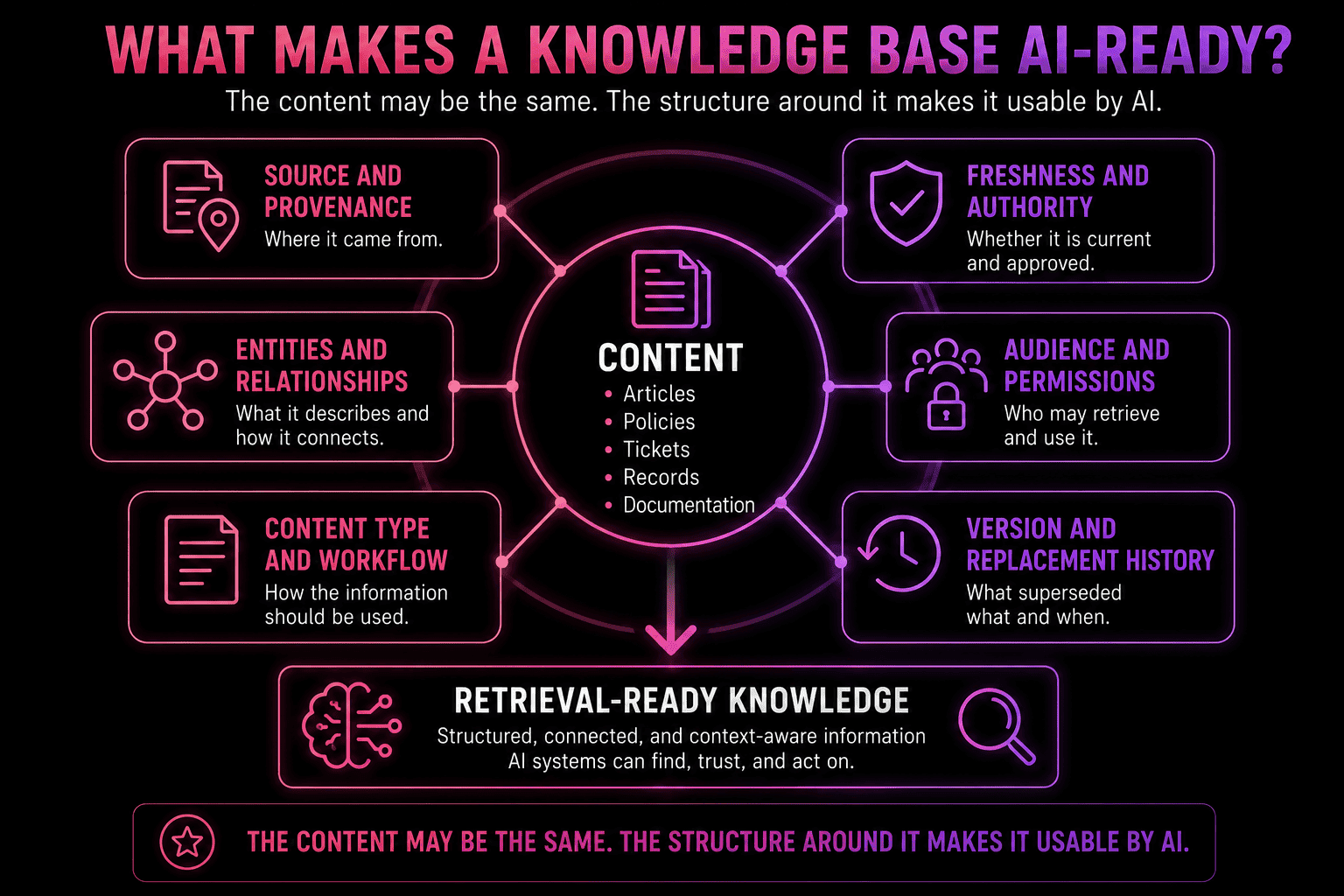
An AI knowledge base has to make all of this visible to the retrieval system, through a combination of structured metadata, vector search, knowledge graphs, permissions, source tracking, and retrieval pipelines, the goal being to retrieve relevant information that's also trustworthy, current, connected, and appropriate to use.
In that sense, a knowledge base in artificial intelligence functions as the memory and retrieval layer that grounds AI systems in usable, source-aware context.
What Goes South When AI Reads Your Existing Knowledge Base
Plugging AI into a human-oriented knowledge base makes its inadequacies easy to scale and harder to catch. Here's why:
Human-readable isn't the same as AI-retrievable
Vector search, which AI engines use to surface semantically similar content rather than what just matches the query keywords, is a genuinely useful improvement over traditional search. But a page can be both semantically close to a question and wrong.
It may apply to an old product version, or be written for internal support agents rather than customers, or describe an exception rather than the general rule. It may be a draft, a duplicate, or a page that should have been retired six months ago.
So, retrieval quality depends on signals about source authority, freshness, ownership, permissions, and how information relates to other knowledge in the system.
Maintenance problems become retrieval problems
Outdated content can be frustrating for human users, but in an AI workflow, any errors get delivered as truth, repeatedly and at scale.
If the AI system has no way to distinguish what's actually true, the wrong source can mean real consequences.
Disconnected articles produce incomplete answers
Traditional knowledge bases are organized as separate articles, where each page answers one question, covers one process, or explains one policy. When an AI system needs to assemble a complete answer from multiple connected facts, disconnects are a dealbreaker.
If pieces of information are stored as isolated pages with weak relationships between them, the system may retrieve one correct fragment and miss everything around it, resulting in a technically accurate but operationally wrong answer.
Retrievable context makes content usable
More than just what an article says, an AI knowledge base also has to describe what the information is, where it came from, and how it should be used — content types, sources, owner, review status, audience, permissions, timestamps, linked entities, and connected records.
Without that structure, AI systems are forced to infer too much from text alone. They may retrieve the nearest answer instead of the right one, use internal notes in customer-facing contexts, or miss updates that only exist in connected sources. Better retrieval comes from a knowledge layer that makes context retrievable alongside content.
Stored Data → Connected Knowledge
While a static collection of articles can answer "how do I solve this issue," a knowledge layer is built to answer something harder: "what is true about this situation, based on the connected sources available?"
A traditional knowledge base is organized around content objects such as pages, folders, categories, and articles, each of which has a title, body text, some tags, maybe a review date. For AI retrieval, that structure is often a low ceiling.
Complex questions frequently depend on several sources that never got consolidated into a single document, like two records describing the same customer, a policy that replaced an older guideline, a product limitation that only applies to a specific version, a decision record that supersedes a meeting note on the same topic. A traditional knowledge base may contain all of that but it just doesn't expose the relationships clearly enough for an AI system to use reliably.
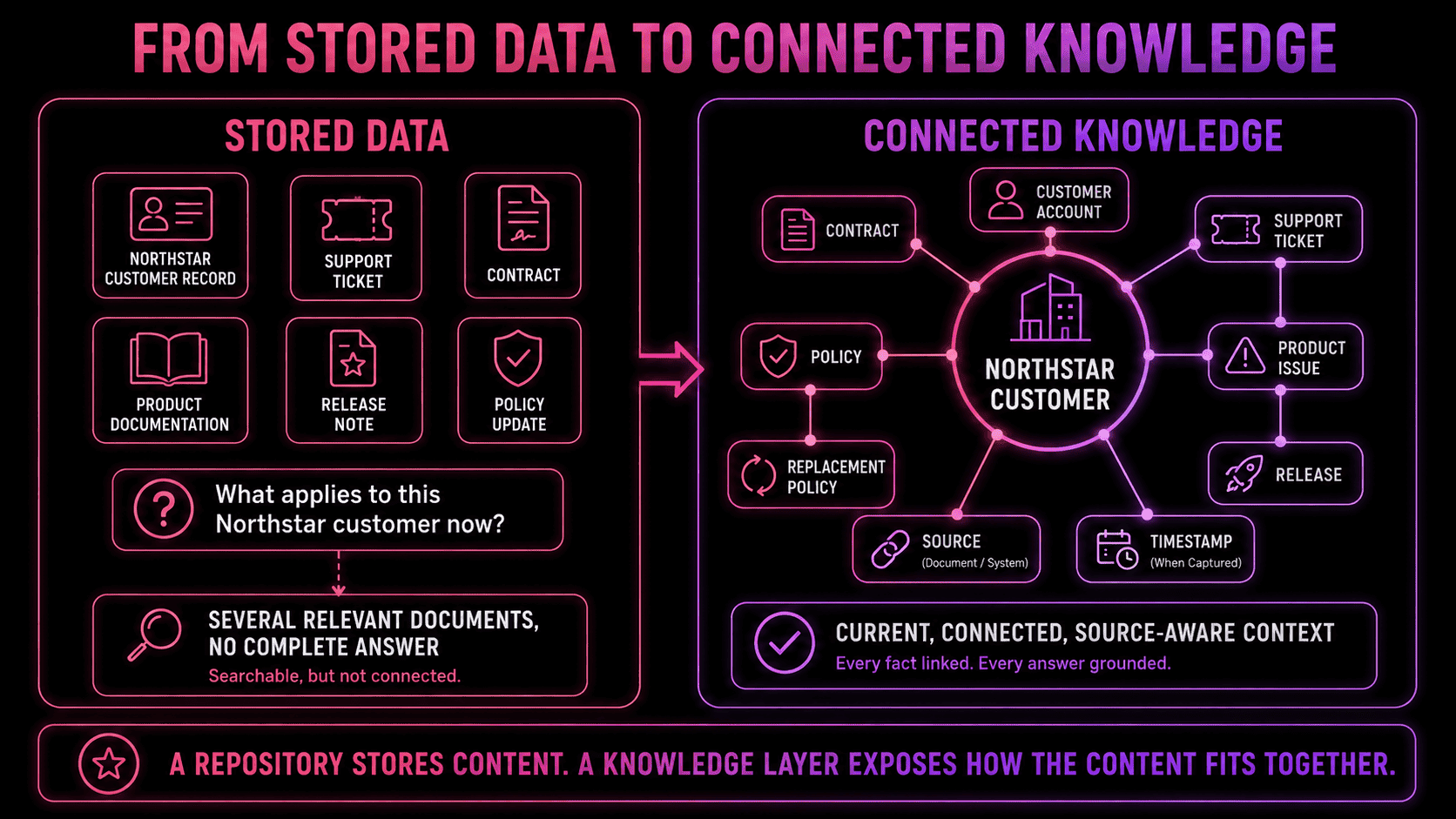
A knowledge layer treats information as connected rather than collected. Instead of storing text alone, it identifies entities, relationships, sources, timestamps, and context — linking a customer to accounts, tickets, contracts, support history, and product usage; a feature to documentation, release notes, known issues, and customer-facing explanations; a decision to the source documents, the people involved, and later revisions. That connected structure gives retrieval systems a richer and more honest surface to work from.
Depending on the task, it also supports multiple retrieval paths over the same underlying knowledge: vector search to find semantically related material, keyword search to match exact terms, graph traversal to follow entity relationships, temporal lookup to check what changed, and/or RAG to generate a response grounded by external sources. More about this in the next section.
This changes how AI agents actually query a knowledge base. Rather than searching once and deciding whether a result answers the question, an agent breaks the task into smaller, precise questions: What is this entity? What is its current status? What relationships does it have? What changed recently? Is there a newer or more authoritative version? While a human might answer some of those through intuition, an agent needs the knowledge layer to make them retrievable.
AI retrieval is also often continuous rather than one-and-done. An agent may retrieve on a schedule, during a workflow, after a deployment, or every time a monitoring process runs. The knowledge base audience is no longer only a reader — it may be a service with a heartbeat. That's why the structure supporting repeated, automated retrieval matters as much as the content itself.
Retrieval Is Plural
Most artificial intelligence knowledge base discussions frame retrieval as a choice between keyword search and semantic search. That's a myopic perspective: in reality, both are useful, but neither is sufficient on its own. A mature AI knowledge base needs multiple retrieval strategies running over the same underlying knowledge, selected based on what the task actually requires.
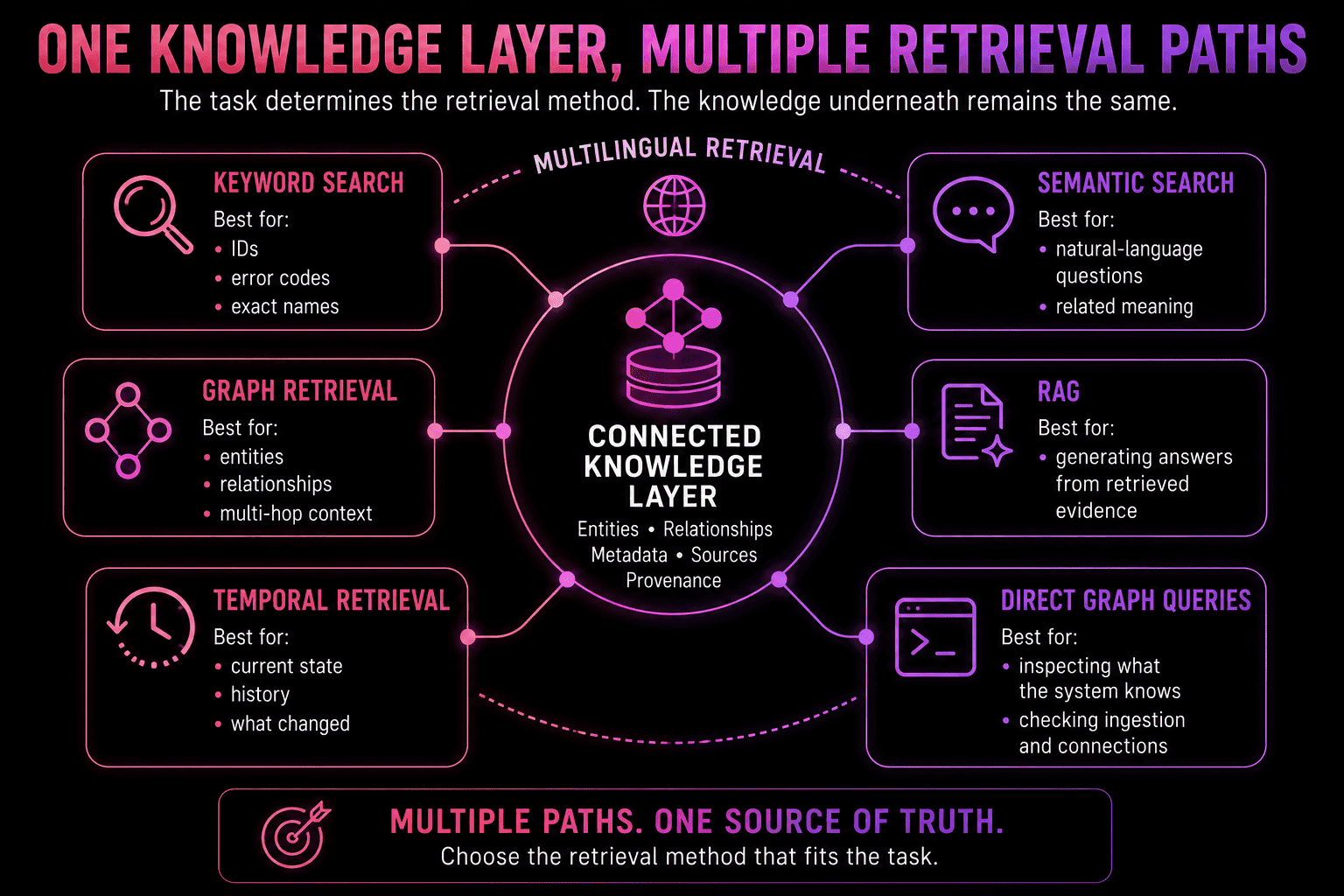
Here are the most dominant mechanisms:
- Keyword and lexical search is still needed for exact terms — product names, error codes, regulation numbers, customer IDs, API endpoints, ticket numbers, internal acronyms. Semantic similarity fudges over those details rather than sharpening them.
- Semantic search is essential for users asking questions in natural language without knowing the right terminology. "Why can't I get into my account?" may surface articles about authentication, login failure, or identity providers — none of which use the customer's exact words. However, semantic search uses embeddings and other natural language processing and machine learning techniques to retrieve by conceptual closeness, not by authority. The nearest source may still be outdated, incomplete, or wrong for the asker.
- Graph retrieval follows relationships between entities rather than finding text that resembles the query. It's used when the relevant answer depends on connections rather than isolated passages.
- RAG — retrieval-augmented generation — retrieves relevant external sources and uses them to generate a grounded response, expanding the AI systems' knowledge beyond their training data. But RAG quality is a direct function of retrieval quality. If the wrong source gets retrieved, the generated answer inherits that problem regardless of how capable the underlying model is.
- Temporal retrieval handles time-dependent queries: recent changes, historical states, sequence of events, duration, version history, and what the system knew at a specific point. A regular knowledge base treats dates as maintenance metadata, but for a knowledge layer, time is a part of the answer.
- Direct graph queries let users and agents inspect the knowledge layer itself — retrieve all entities of a certain type, check how many chunks were created from a source, verify whether a specific document was ingested and connected. It's not a replacement for natural language retrieval; it's how the people responsible for the system see what it actually knows.
- Multilingual retrieval requires a knowledge layer to retrieve by meaning across languages, including queries asked in one language over documents written in another — a requirement that breaks exact-wording retrieval quickly in global teams, multilingual support workflows, and mixed-language research environments.
No single method covers every AI workflow, and the strongest setups are those that make the same knowledge available through multiple retrieval paths.
Knowledge Layer Malfunctions
As we've covered, poor content maintenance is detrimental to AI knowledge base success. However, there are also two earlier failure modes that are just as damaging and harder to catch: content that never made it in, and knowledge that can't be traced back to an auditable source.
Incomplete Memory
Errors happen during file ingestion. A document fails to parse properly, a source gets added but never connects to the right entities, or a pipeline processes the text but loses tables, metadata, attachments, or source links along the way.
In an AI workflow, these kinds of failures can stay invisible indefinitely, resulting in the model answering from incomplete knowledge with no way to signal that something important is absent. Similar to hallucinations, the output looks plausible, but here it's grounded in real (although lacking) sources.
Weak Provenance
When a generative AI system gives a wrong answer, the model is usually the first to take the blame. But quite often, the real failure is upstream — in outdated documentation, a duplicated/missing file, a draft note treated like an approved policy, or content that was never meant to be authoritative.
While these are certainly problems resulting from inadequate data structuring and contextualization, provenance is the mechanism of finding the actual failure point.
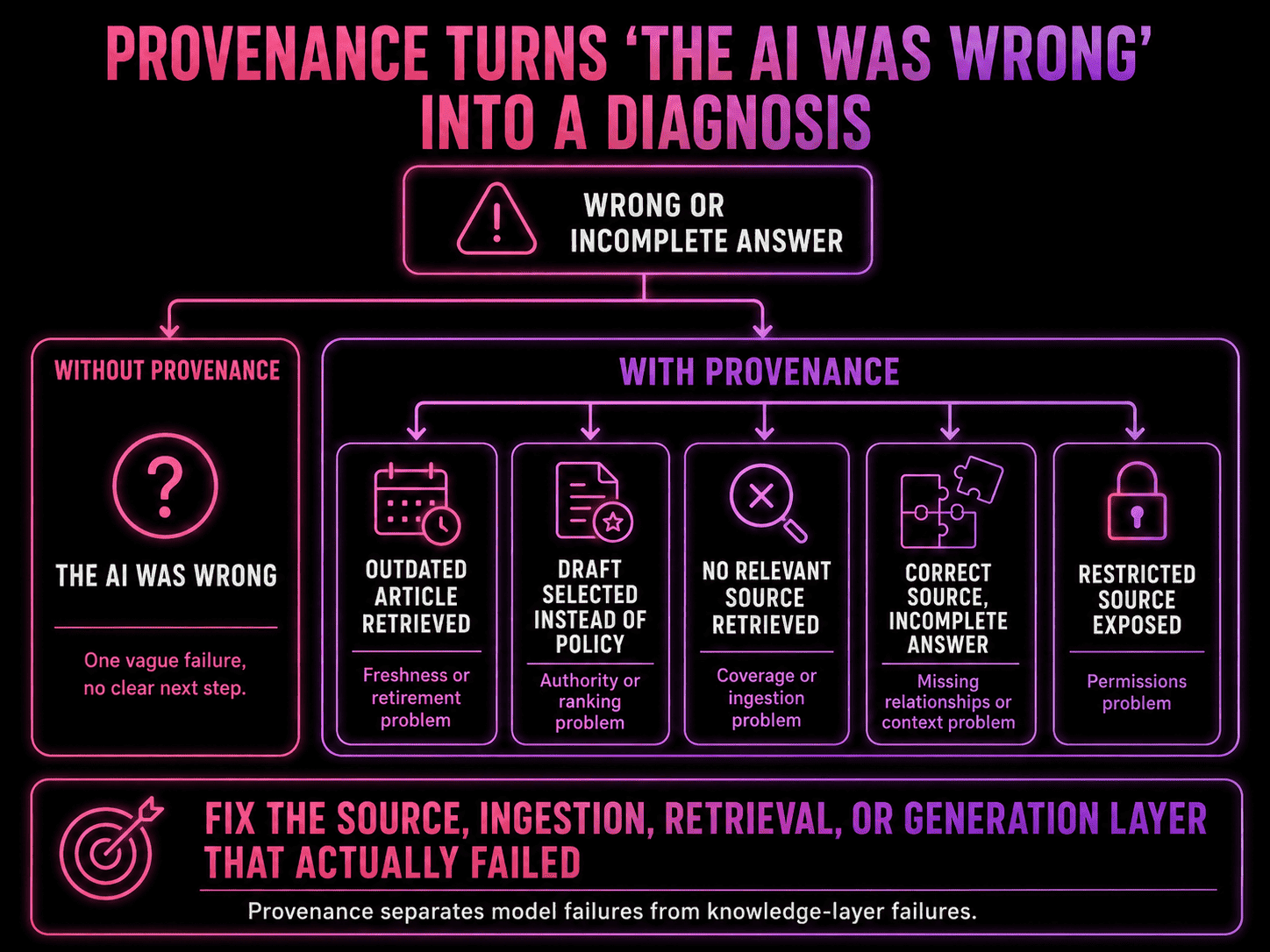
- Outdated article? The problem is lack of content retirement and temporality.
- Draft chosen instead of an approved policy? The problem is source authority and retrieval ranking.
- No relevant source at all? The problem may be coverage.
- Correct source retrieved but incomplete answer produced? The problem may be missing relationships or insufficient context.
Without provenance, all of those problems collapse into one vague complaint — the AI was wrong. Conversely, if the knowledge layer is queryable about itself, fixes can go where they belong.
The Right Build Order for an AI Knowledge Base
To build an AI knowledge base properly, you should start with the same foundation as any good knowledge base needs: useful content, clear ownership, current information, and structure that reflects real needs. The difference is that AI systems need more context than human readers — and that context must be built in from the start.
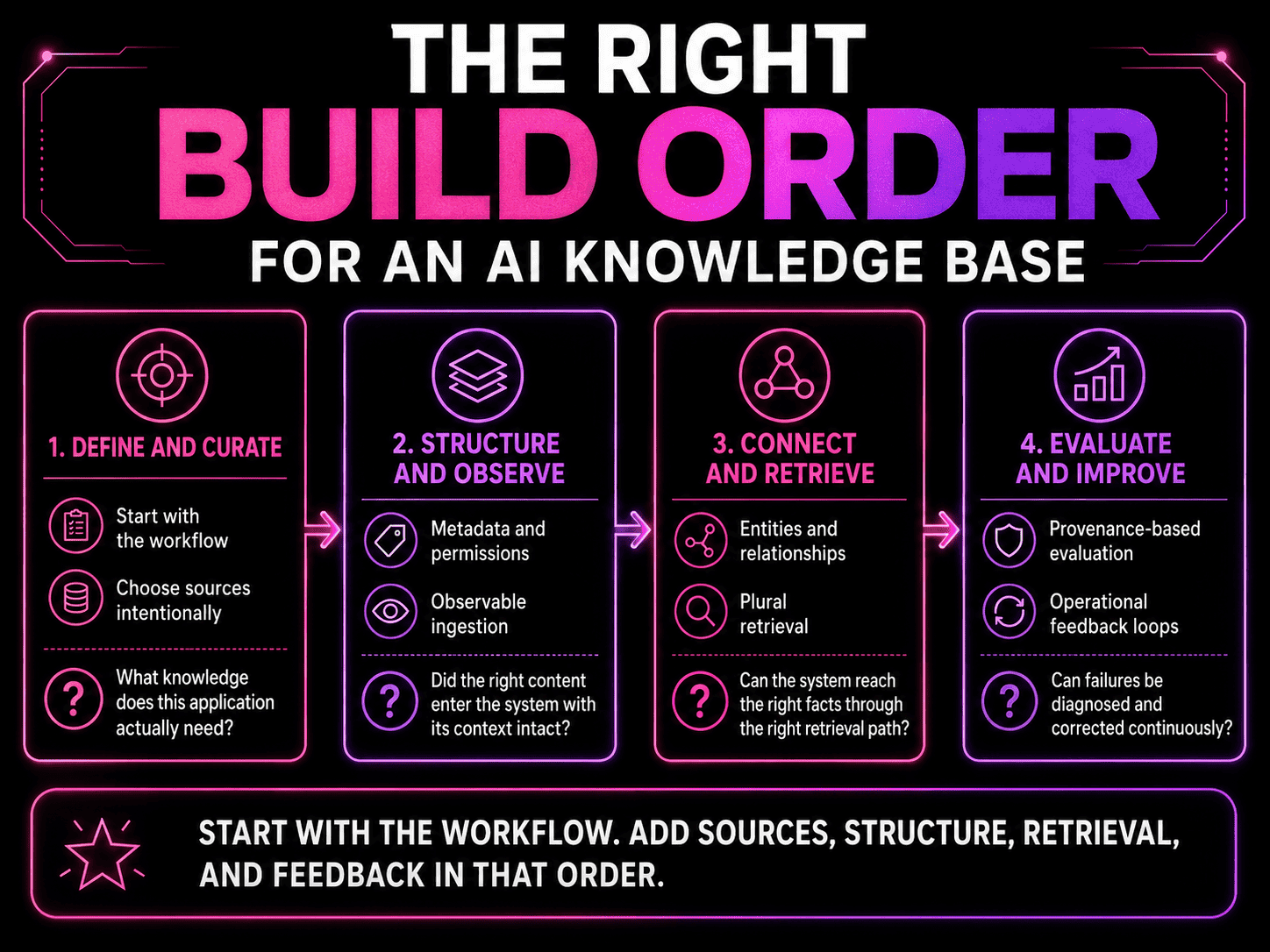
1. Start with the workflow, not the data
Don't begin by connecting every source available, but with the specific AI workflow the knowledge base needs to support. Customer support teams, internal copilots, engineering agents, and compliance all need different sources, permissions, metadata standards, and retrieval strategies. Defining the use case first determines what knowledge actually matters, and what can (and should) be left out.
2. Choose sources intentionally
Each source should have a clear reason for being included: currency, relevance, reusability, and workflow suitability. If a source is outdated, duplicated, unowned, or not meant to be authoritative, fix it, exclude it, or label it clearly before retrieval depends on it. Source quality becomes answer quality, and no retrieval step can remedy bad inputs upstream.
3. Bake in metadata and permissions
Useful metadata includes source type, owner, audience, creation date, last update, review status, product version, and content authority. Permissions matter just as much — customer-facing answers shouldn't expose internal notes, and internal assistants shouldn't retrieve restricted content for users who aren't cleared to see it. This structure is significantly harder to apply post hoc.
4. Make ingestion observable
Treat ingestion as a pipeline with checkpoints. For every source, the system should be able to confirm whether ingestion succeeded, whether parsing failed, how much usable content was produced, what metadata was preserved, and which entities and relationships were built — this is how invisible gaps get caught before they become retrieval failures.
5. Connect entities and relationships
Documents shouldn't exist in isolation. They should connect to the products, customers, policies, people, projects, incidents, and decisions they describe. Ask about a customer and the knowledge layer should surface related tickets, contracts, support history, and any recent changes.
6. Support plural retrieval
Keyword search, semantic search, graph retrieval, temporal retrieval, RAG... A usable artificial intelligence knowledge base gives the retrieval layer several ways to reach the right context.
7. Use provenance for retrieval evaluation
If the system produces a poor response, inspect the retrieval path before blaming the model. Provenance lets you evaluate retrieval separately from generation and implement fixes rather than workarounds.
8. Build feedback loops, not just feedback forms
User feedback, failed searches, low-confidence answers, support escalations, and retrieval misses should all feed back into maintenance. Some issues need better content, others need metadata changes, source pruning, permission fixes, or ingestion improvements. A knowledge layer must continuously improve, because the workflows depending on it get more demanding in real time.
Knowledge Base + cognee = Knowledge Layer
An AI knowledge base is only as useful as its surrounding structure. Documents alone aren't enough. Chunks alone aren't enough. Even semantic search underperforms if the system can't tell which source is current, authoritative, and appropriate to use.
The stronger pattern is a knowledge layer: a retrieval-ready structure that connects documents, entities, relationships, timestamps, metadata, and provenance across sources.
That's what cognee brings to the table. Rather than treating a knowledge base as a flat chunk store, our engine turns messy documents and data sources into structured AI memory by extracting entities, mapping their relationships, preserving source context, and making knowledge retrievable across AI systems — slotted right over existing help centers, wikis, databases, and support platforms without replacing them.
The limiting factor in most AI workflows isn't the model, it's whether the model can retrieve the right knowledge, from the right source, with the right context.
That's what long-term memory for AI agents actually requires — and what a well-structured knowledge layer makes possible.
FAQ
Does an AI knowledge base need to be built from scratch?
No. Most organizations start with existing documentation — help articles, internal wikis, product docs, support tickets. The work is in preparing that content for AI retrieval: cleaning up ownership, adding metadata, connecting entities, removing outdated sources, and making ingestion observable. A well-maintained traditional knowledge base is a better starting point than a large unreviewed archive, even if the archive is bigger.
What's the difference between RAG and a knowledge layer?
RAG — retrieval-augmented generation — is a technique for generating answers from retrieved sources rather than model training data alone. A knowledge layer is the infrastructure that makes retrieval reliable enough for RAG to work well. RAG handles the generation step; a knowledge layer handles the structure, relationships, provenance, and source quality that determine what gets retrieved before generation begins. One without the other produces inconsistent results.
How do you know if your AI knowledge base has coverage gaps?
You can't know from the outputs alone — an AI system will retrieve around missing sources and still produce confident-sounding answers. Coverage gaps require ingestion observability: the ability to see which documents were successfully processed, which failed, which produced no usable content, and which were never connected to the right entities. If the system can't answer those questions, you're trusting retrieval you can't verify.
How often should an AI knowledge base be updated?
High-change sources should update when the underlying thing changes, not only on a fixed review cycle. Product behavior, pricing, policies, and known issues often need event-driven updates or automated syncs. Stable sources can still use scheduled review, but the ingestion pipeline should make source changes visible rather than relying only on manual re-uploads.
When does a knowledge base need graph-based retrieval?
When the answer depends on relationships rather than isolated passages. If a question requires connecting a customer to their account history, a product feature to its known issues, a decision to its source documents, or a policy to its replacement history, keyword and semantic search alone won't reliably surface the full picture.
Can a single knowledge base serve both human users and AI systems?
Yes, and that's increasingly the goal. The structural requirements for AI retrieval — clear ownership, source metadata, entity relationships, permissions, review signals — are also what make a knowledge base more reliable for human readers. Building for AI readiness generally means building a better knowledge base overall, with ingestion observability, provenance tracking, and relationship modeling added on top.