OpenClaw Agents: 3 Viral Use Case Ideas Powered by Cognee
OpenClaw, the open-source personal AI assistant framework created by Peter Steinberger, has taken the developer world by storm in the last month. We wrote about it’s incredibly fast growth in our previous blog post (What OpenClaw is and how we give it memory with cognee) and even tested our plugin for the first time with the community on Feb 7th, in our AI-Memory Hackathon we hosted in SF together with our partners.
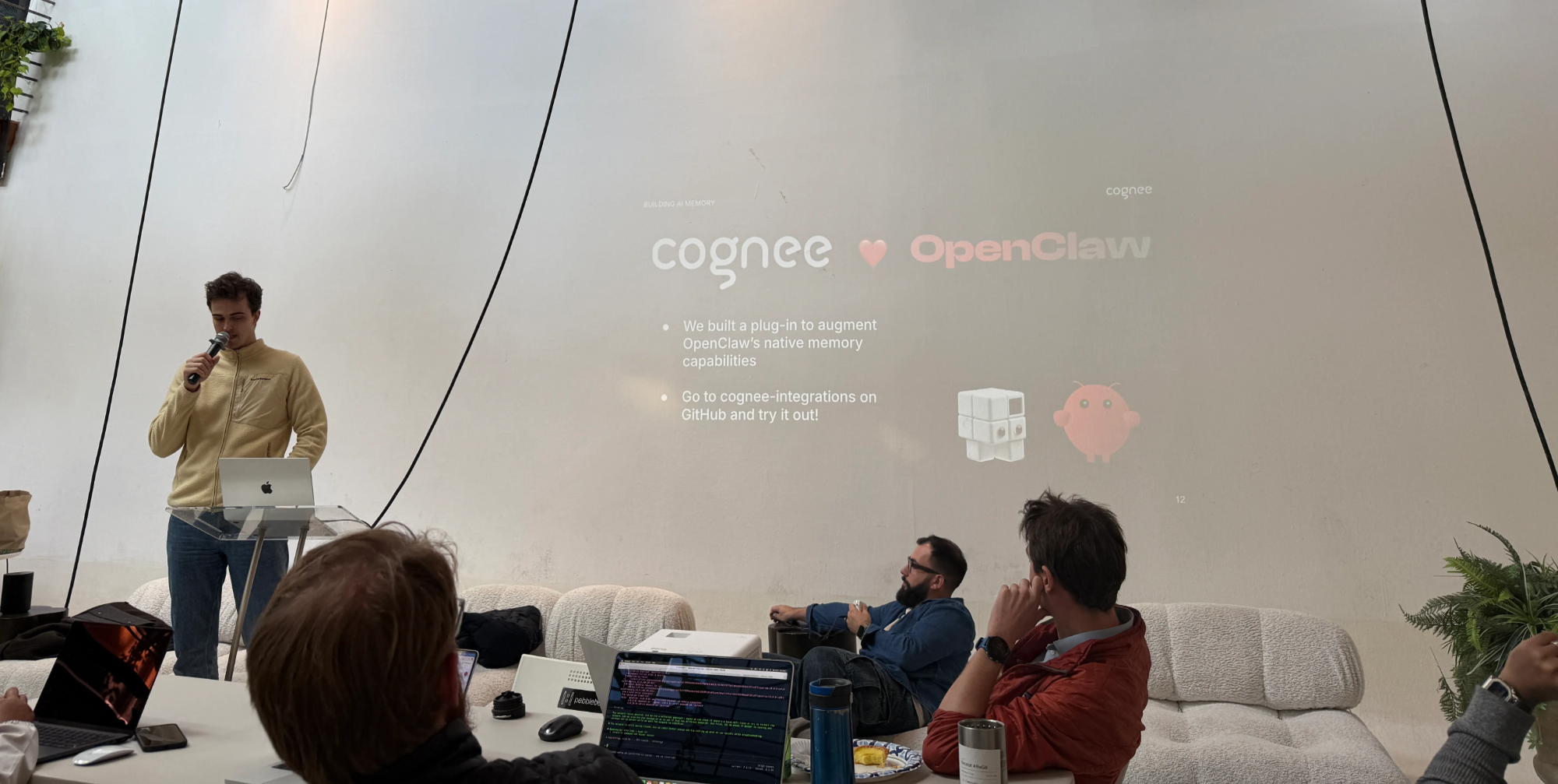
Today we will look into 3 popular OpenClaw Agents and how Cognee rocks (with my personal Claw as a bonus). But first, for those who haven't had a chance to run OpenClaw yet, here is a quick recap: Unlike traditional chatbots, a Claw lives in your messaging apps (Telegram, WhatsApp, Discord, SMS), operates 24/7, remembers your conversations, and (here's the wild part) writes its own code to extend its own capabilities. Need it to check your email every morning? It builds the integration. Want it to call a restaurant or start browsing the web for research? It sets up the tools. The Every.to Claw School guide captures it perfectly: "It has a personality, it operates 24/7, and it has the ability to change itself."
But here's the thing: memory is where hit their ceiling.
OpenClaw stores memories as flat markdown files. That works fine when you have a dozen notes. But as your Claw accumulates hundreds of interactions, projects, preferences, and context — searching those flat files becomes a game of keyword roulette. Your Claw might "remember" something exists but fail to connect it to what matters right now.
Cognee: The Memory Engine Your Claw Deserves
Cognee is an open-source AI memory that turns your data into a knowledge engine. It builds layers of entities, relationships, embeddings from any data so that an AI can reason over and improve over time. Where standard RAG (retrieval-augmented generation) gives you ~60% accuracy on complex queries, Cognee's graph-enhanced retrieval pushes that to ~93%.
Read more: How Cognee Builds AI Memory
The @cognee/cognee-openclaw plugin drops right into your Claw and does two things automatically:
- Auto-indexes your memory files into Cognee's knowledge engine after every agent run
- Auto-recalls relevant memories before each run, injecting rich, graph-traversed context into your Claw's prompt
The result? Your Claw doesn't just search its memory. It actually understands how things connect. This is what you need from a close-to-real intelligence.
Let's look at three popular OpenClaw agents from the community and how Cognee transforms each of them.
1. The Second Brain
"Text anything to your bot to remember it, then search through all your memories."
The Second Brain is one of the most beloved OpenClaw patterns. You fire off thoughts, links, article snippets, ideas, and meeting notes to your Claw throughout the day. It stores everything and lets you search it later through a dashboard or natural language queries.
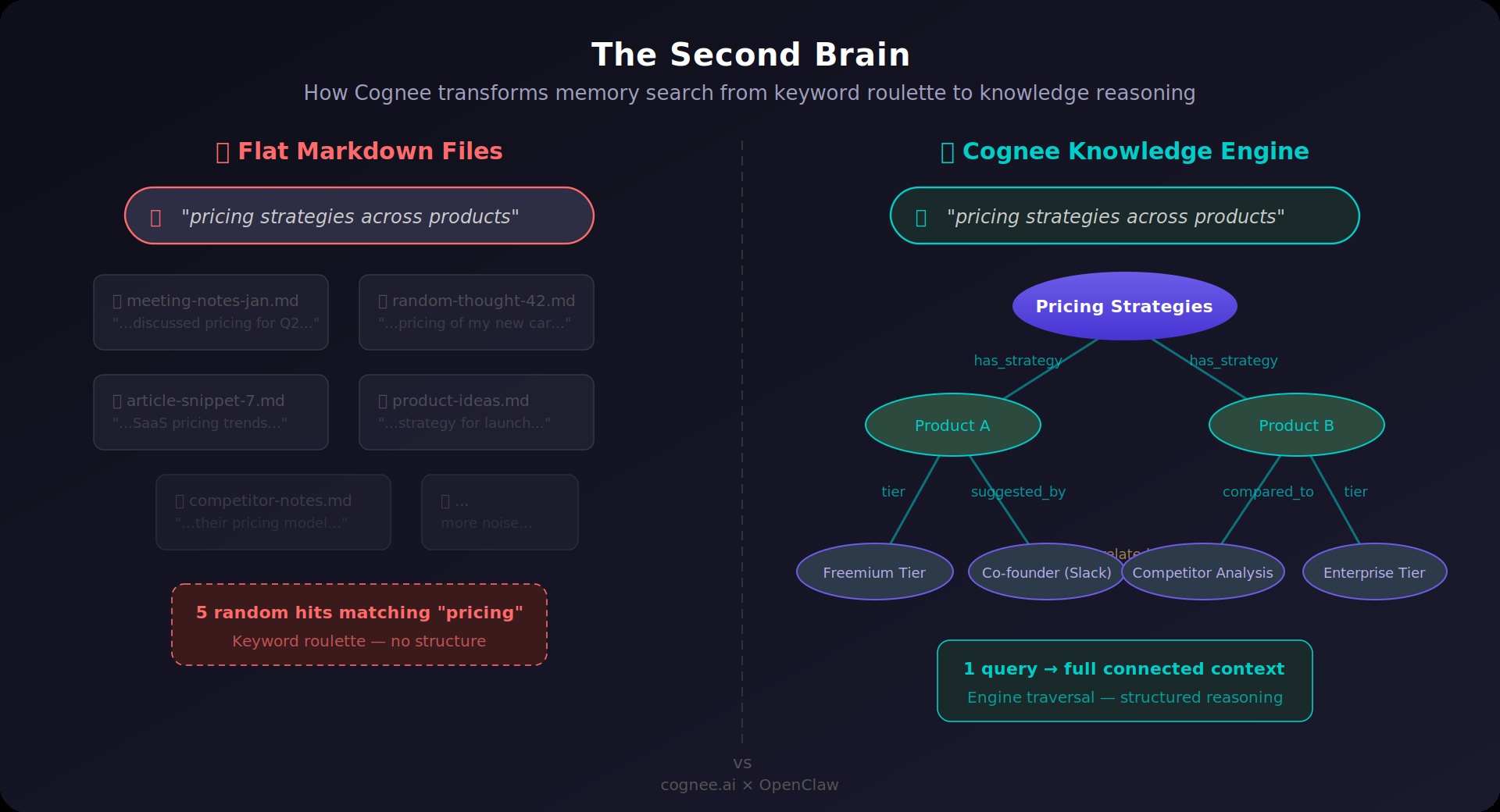
Where it breaks down: As your second brain grows past a few hundred entries, flat-file search starts returning noise. You ask "What did I save about that pricing strategies across our products" and might get back five unrelated notes that happen to mention "pricing" but very low chance that it identifies each product pricing strategy note across scattered files.
How Cognee rocks it: Cognee doesn't just index your notes as text — it extracts entities (people, projects, concepts) and relationships (who said what, which idea connects to which project). When you search for that pricing strategy, Cognee traverses the graph: it finds the node about pricing, follows the edges to the nodes of each product, pulls in the related competitor analysis you saved few weeks ago (plus any other data you ingested in Cognee - not just OpenClaw memory files), and surfaces the Slack message where your co-founder suggested a freemium tier. One query, full context - not five random hits.
2. The Multi-Agent Specialized Team
"4 agents, each with their own job... shared memory for the big stuff, but each agent also has their own context."
This is the power-user pattern. Instead of one Claw doing everything, you run multiple specialized AI agents — a strategist, a developer, a marketer, a business analyst — coordinated through a single Telegram chat or Discord server.
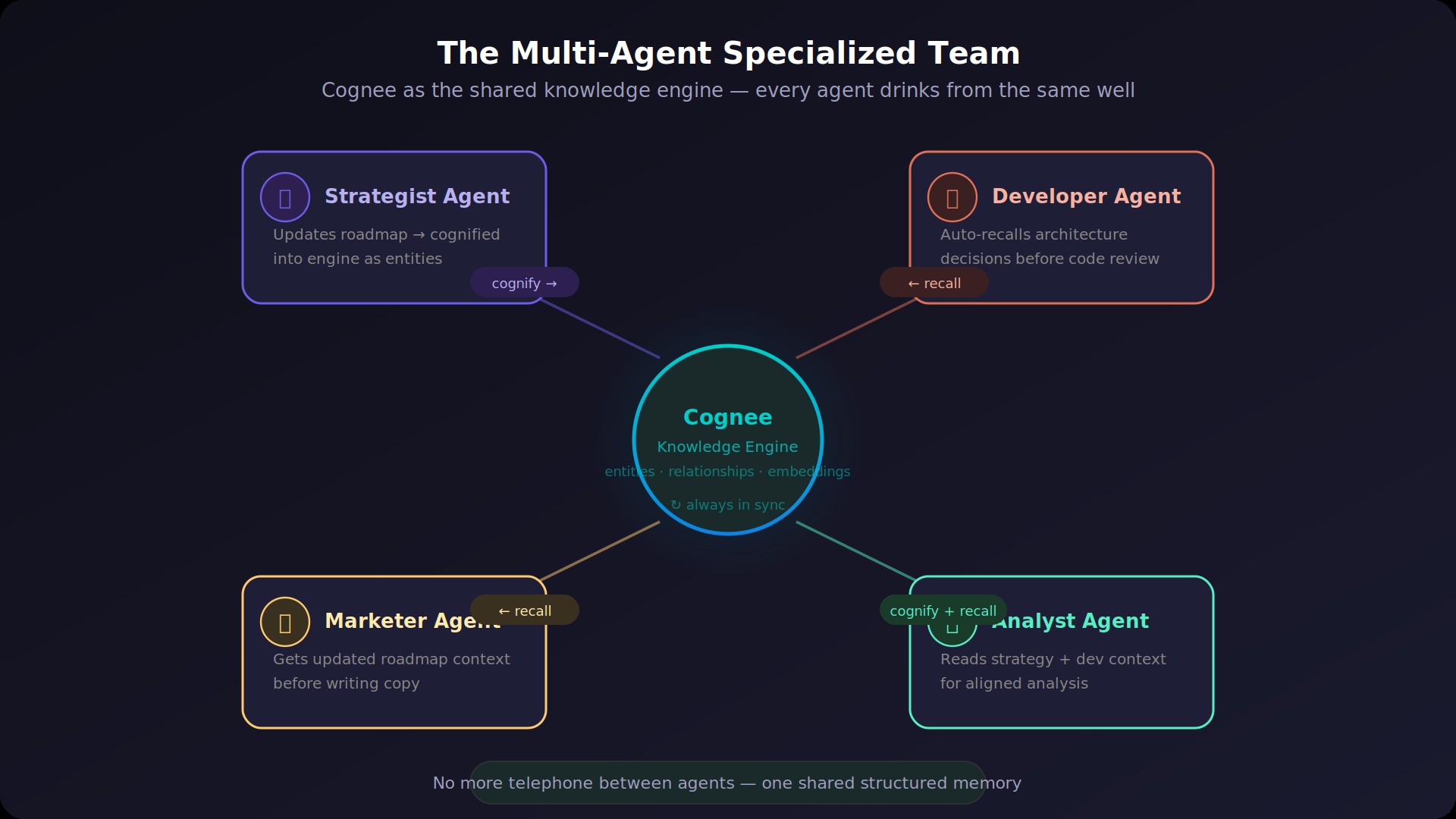
Where it breaks down: The hardest problem in multi-agent systems is shared context. Agent A decides to pivot the product roadmap. Agent B, working on marketing copy, doesn't know. Agent C reviews a PR based on the old architecture. You end up playing telephone between your own robots.
How Cognee rocks it: Cognee acts as the shared knowledge graph across all agents. When your strategy agent updates the roadmap, that change gets cognify-ed into the graph as entities and relationships. When the marketing agent runs next, Cognee's auto-recall pulls in the updated roadmap context before the agent even starts writing. The dev agent sees the new architecture decisions when it searches for relevant context before a code review.
No more telephone. No more stale context. Every agent drinks from the same well of structured knowledge — and Cognee ensures they get the relevant parts, not a dump of everything.
3. The Health & Symptom Tracker
"Track food intake and symptoms to identify triggers, with scheduled check-in reminders."
Health tracking is a sleeper hit in the OpenClaw community. From the showcase, @bangkokbuild connected Garmin watch data and has the Claw log sleep, health, and exercise data — even telling him when he stays up too late. @danpeguine had his Claw organize all his bloodwork lab results into a structured Notion database. The Health & Symptom Tracker use case takes this further: log what you eat, how you feel, and let the Claw find correlations.
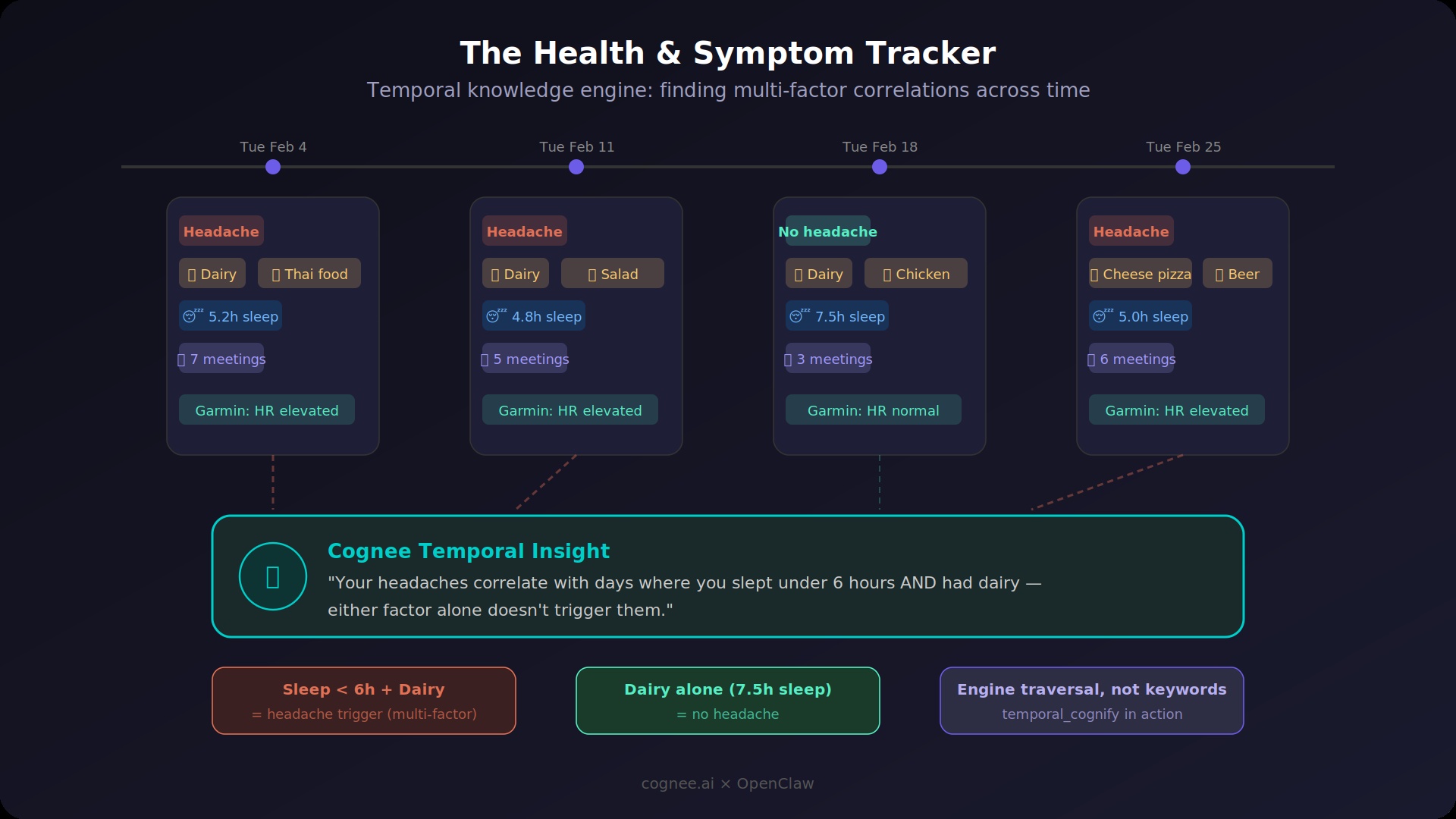
Where it breaks down: Pattern recognition over time is hard with flat memory. "I had a headache three Tuesdays ago after eating Thai food" is buried in conversational logs. Correlating that with your sleep data from Garmin, your stress levels from the week's calendar, and the weather that day? Forget it.
How Cognee rocks it: This is where Cognee's knowledge graph shines brightest. Every food log, symptom report, sleep score, and exercise session becomes a node in the graph with temporal edges (when enabled). Cognee's temporal_cognify adds time-aware relationships, so queries like "What did I eat in the 24 hours before my last three headaches?" become graph traversals, not keyword searches. The Claw can surface patterns you'd never spot manually: "Your headaches correlate with days where you slept under 6 hours AND had dairy — either factor alone doesn't trigger them." That's not a prompt trick. That's structured knowledge reasoning.
Bonus: Two From My Own Claw — The Social Glue
The above examples from a great awesome-openclaw-usecases repo and OpenClaw showcase. I built my own Claw for a deeply personal reason. Lately, I'm terrible at staying in touch with the people I love. My life moves fast with back-to-back work, traveling, constant paper-work (living in Germany), deadlines - and the relationships that matter most are the ones that quietly erode when you're not paying attention. So I built a Claw that acts as my social relationship manager.
The Relationship Reminder Engine
My Claw is getting to know my circle: family birthdays, wedding anniversaries, the fact that my college friend Deniz just had a baby, that my cousin moved to Berlin last year. It tracks when I last reached out to each person and nudges me with context:
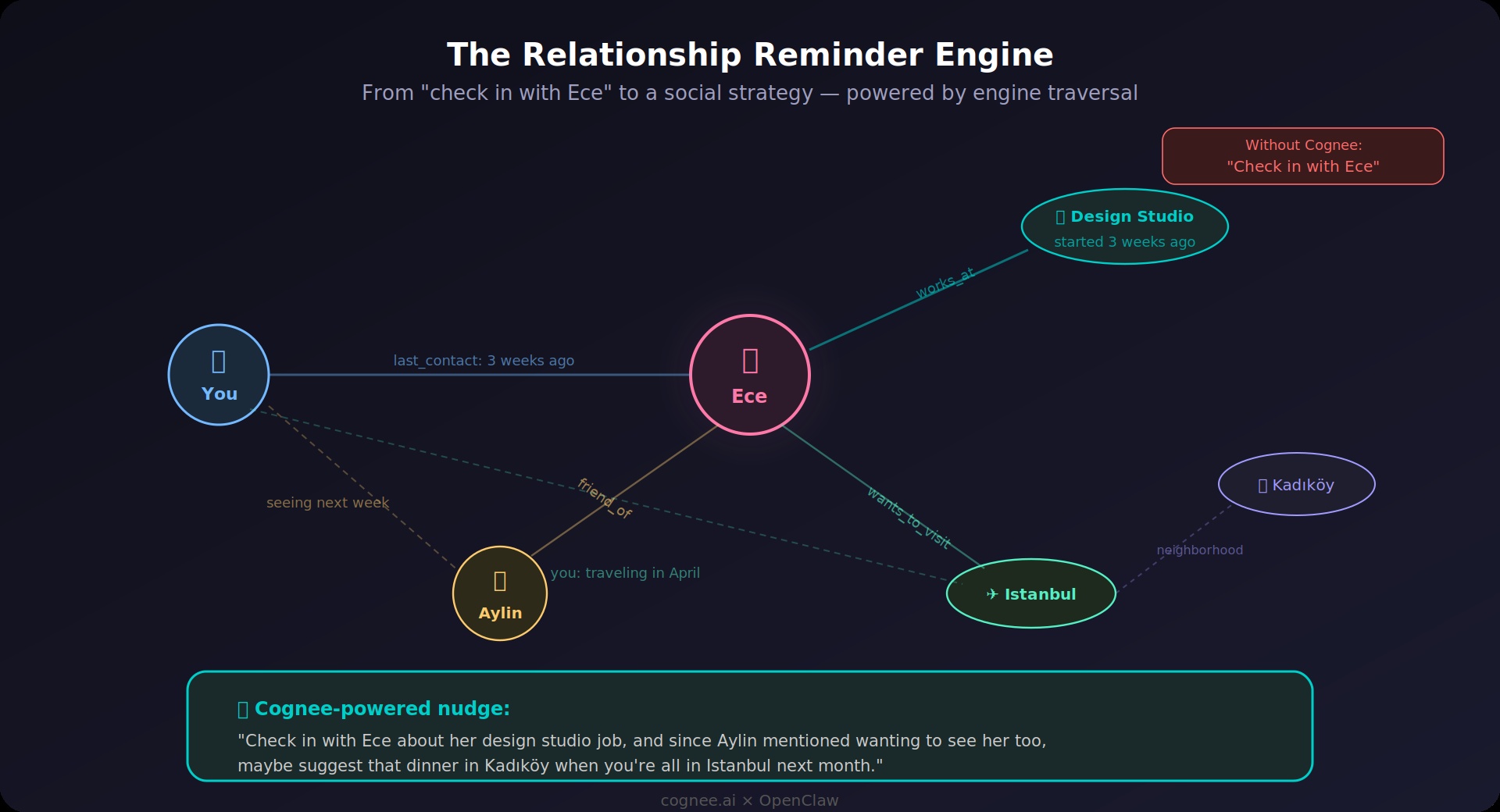
"You haven't talked to Ece in 3 weeks. Last time you chatted about her new job at the design studio. Maybe check in and ask how the first month went?"
It even drafts messages for me. Not generic "hey how are you" but context-aware messages that reference our last conversation. I review, of course add my personal touch, and send. What used to be a guilt-ridden "I should really call someone" feeling is now a gentle, actionable system.
How Cognee makes this radically better: Without Cognee, my Claw searches flat markdown files to find "last interaction with Ece." With Cognee, it traverses a relationship graph: Ece → works at → design studio → started → 3 weeks ago. Ece → friend of → Aylin → who you're seeing next week (so you could coordinate a group dinner). Ece → mentioned → wanting to visit Istanbul → where you'll be in April. The nudge goes from "check in with Ece" to "check in with Ece about her design studio job, and since Aylin mentioned wanting to see her too, maybe suggest that dinner in Kadıköy when you're all in Istanbul next month." That's not a reminder — that's a social strategist.
The Social Event Planner
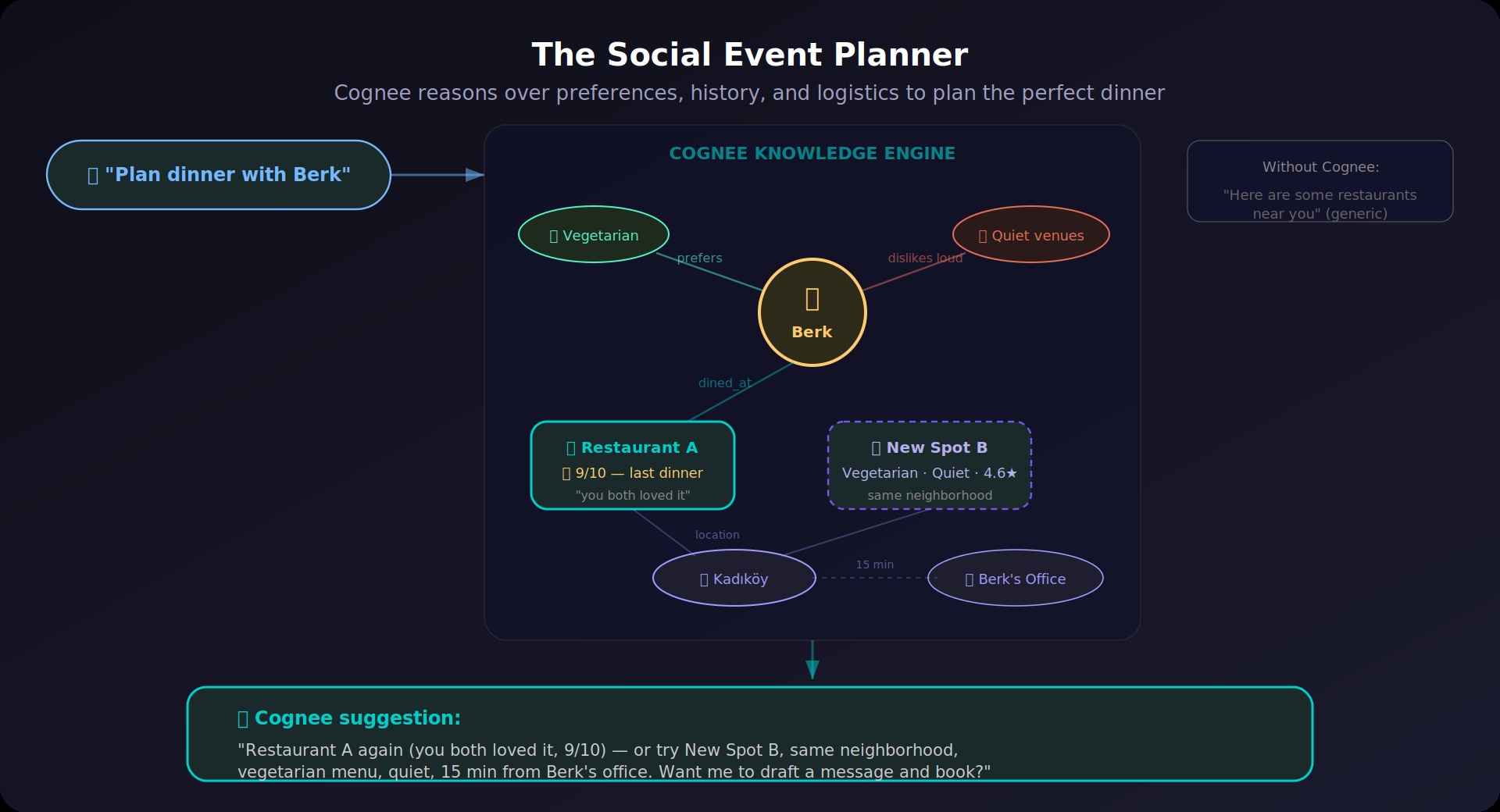
The other side of my Claw handles the logistics of actually doing things with people. When it's time to catch up with someone, I tell my Claw and it handles the rest: finds restaurant options based on what we both like (it remembers my friend Berk is vegetarian and hates loud places), drafts a message proposing a time, and if I approve, sends the booking. For bigger events like birthdays or holiday gatherings, it manages guest lists, coordinates schedules, and follows up with people who haven't responded.
How Cognee makes this radically better: Every dinner, every restaurant review, every "that place was amazing" or "too loud, never again" gets cognified. The knowledge graph builds a rich map: Berk → prefers → vegetarian restaurants. Berk → dislikes → loud venues. Last dinner with Berk → at RestaurantA → rated → 9/10. Restaurant → neighborhood → Kadıköy → 15 min from → Berk's office. When I say "plan dinner with Berk," it reasons over the graph and suggests RestaurantA again (you both loved it) or a new spot in the same neighborhood that matches his preferences. Cognee turns my Claw from a logistics bot into something that genuinely understands the social network and the fabric of my life.
I will share the details about my Claw soon.
The Bottom Line
OpenClaw gives your AI assistant agency. Cognee gives it memory that actually works. Both can work 100% local, without any data leaving your machine.
Flat markdown files are fine for getting started. But the Claws doing the most impressive work — managing multi-agent teams, tracking health patterns over months, building genuine project intelligence, or keeping your relationship alive — need memory that understands relationships between things, not just things.
If you're building on OpenClaw, installing the Cognee plugin is one openclaw plugins install @cognee/cognee-openclaw away from giving your Claw a brain upgrade. Your Claw already writes its own code and operates 24/7. Imagine what it does when it actually remembers.
Ready to give your Claw a memory?
Check out the Cognee OpenClaw integration: Github & Docs
Share your use cases with us on our Discord community.