Graph Knowledge: How Knowledge Graphs Represent Connected Information

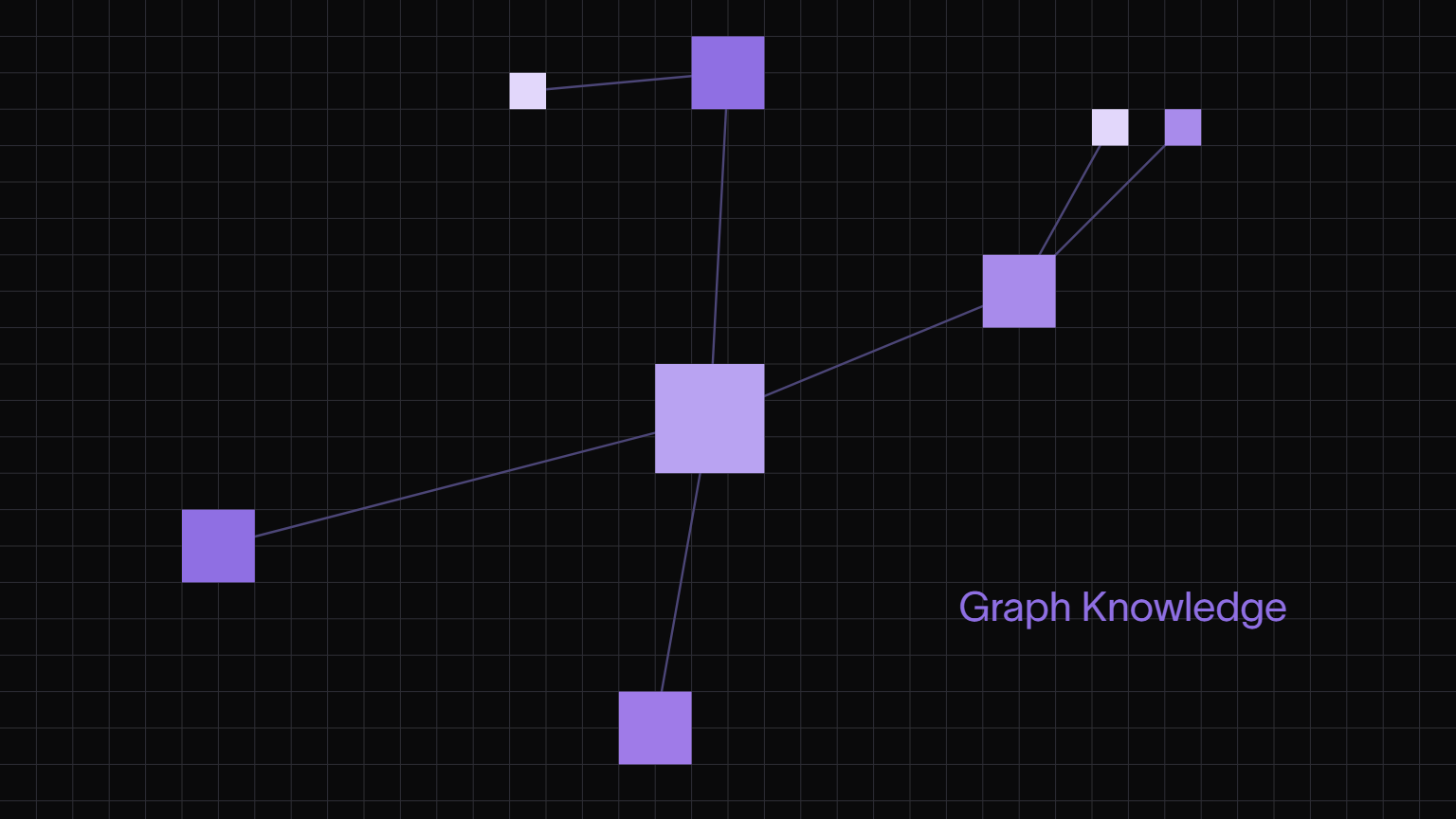
Graph knowledge is information extracted from source data, represented through entities, their features, and the explicit relationships among them. It's organized into a knowledge graph so the connections between entities can be queried consistently.
Knowledge graphs can use RDF or labeled property graphs, with semantics defined through formal ontologies, shared vocabularies, domain schemas, or application rules. In either implementation, their core tenet is the representation of entities and their relationships with interpretable meaning.
That semantic structure makes graph knowledge distinct from a simple information repository. Relationships such as AUTHORED, DESIGNED, or CITES encode how entities are connected, and properties, identifiers, and source context add the details needed to interpret those connections.
In this guide, we'll explain how knowledge graphs represent information, how their architecture is organized, and how schemas, ontologies, RDF, property graphs, graph queries, and provenance contribute to that representation. We'll also go over how graph knowledge can support AI retrieval and persistent agent memory.
What Is Graph Knowledge?
The defining feature of graph knowledge is that the connections themselves are imbued with information. A relationship can specify that one person AUTHORED a document, FOUNDED an organization, or WORKS_FOR a company, giving each connection an explicit meaning that can be queried.
In a knowledge graph, nodes represent entities while edges are a record of these defined relationships. Properties and semantic rules add further context, allowing the graph to distinguish connections that involve the same entity types but represent different facts.
This structure lets applications interpret an entity alongside its attributes and surrounding connections, then traverse, query, validate, or combine those facts according to their defined semantics.
How a Knowledge Graph Represents Knowledge
Now that we know that knowledge graphs represent connected information through entities, relationships, properties, and supporting evidence, let's take a closer look at each of these elements.
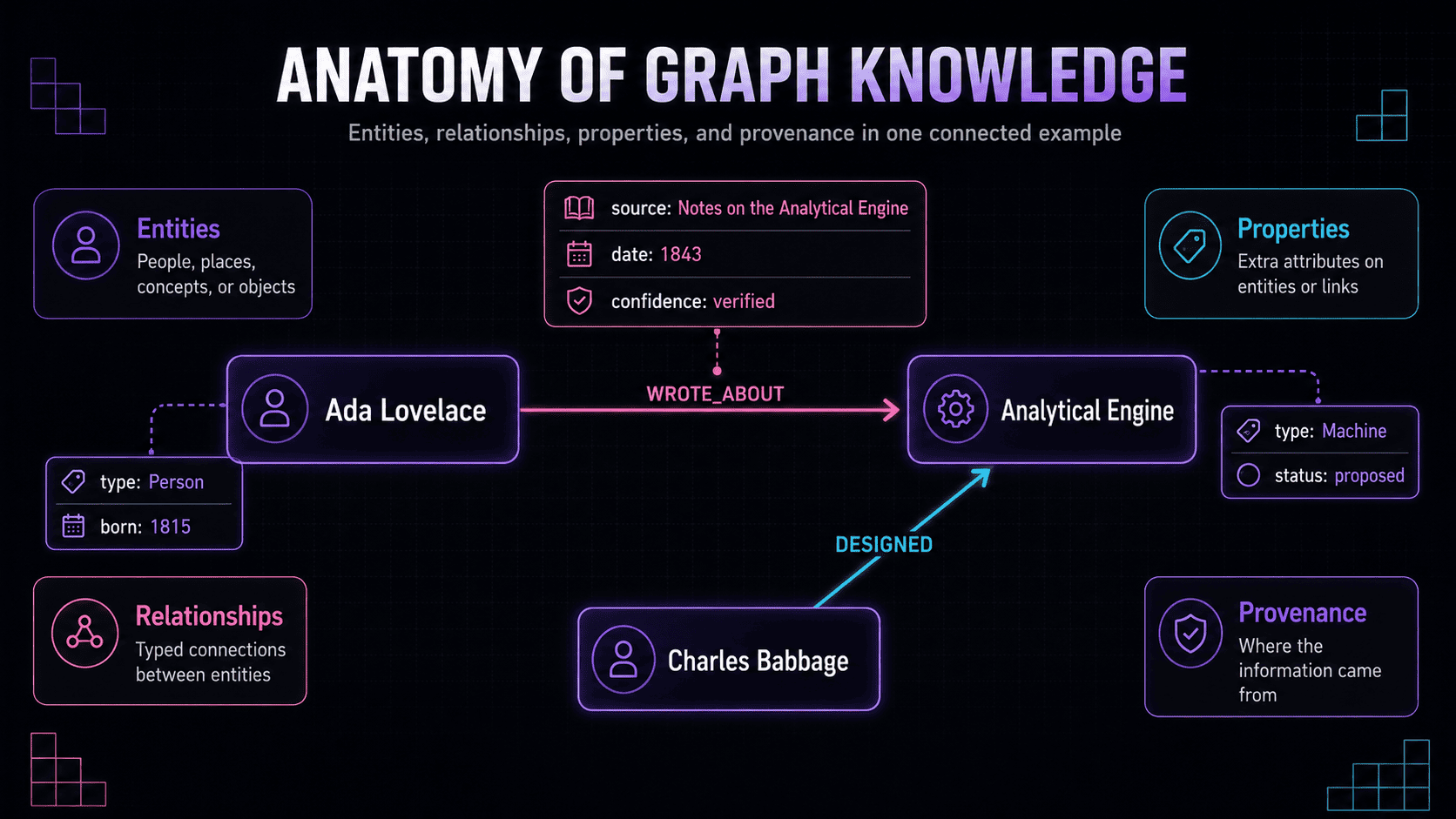
Entities
An entity is a distinct person, place, organization, event, object, concept, document, or other item represented in the graph.
Entities are represented as nodes, which can carry a type such as Person, Organization, Technology, or Document, along with properties describing the entity.
For example:
Ada Lovelace
can be represented as a Person entity with attributes such as a name, birth date, and identifier.
Relationships
Relationships connect entities and define what the connection represents.
For example, the statements:
Ada Lovelace → WROTE_ABOUT → Analytical Engine and Charles Babbage → DESIGNED → Analytical Engine
associate two people with the same machine through different facts.
Because the Analytical Engine entity is shared between the statements, a graph query can follow the connection between Lovelace and Babbage through that common entity.
Properties
Properties add descriptive information to graph records.
A Document entity might have a publication date, title, and source URL attached. A relationship can also carry properties when the graph model supports them, such as the date when a person joined an organization or a confidence score attached to an extracted connection.
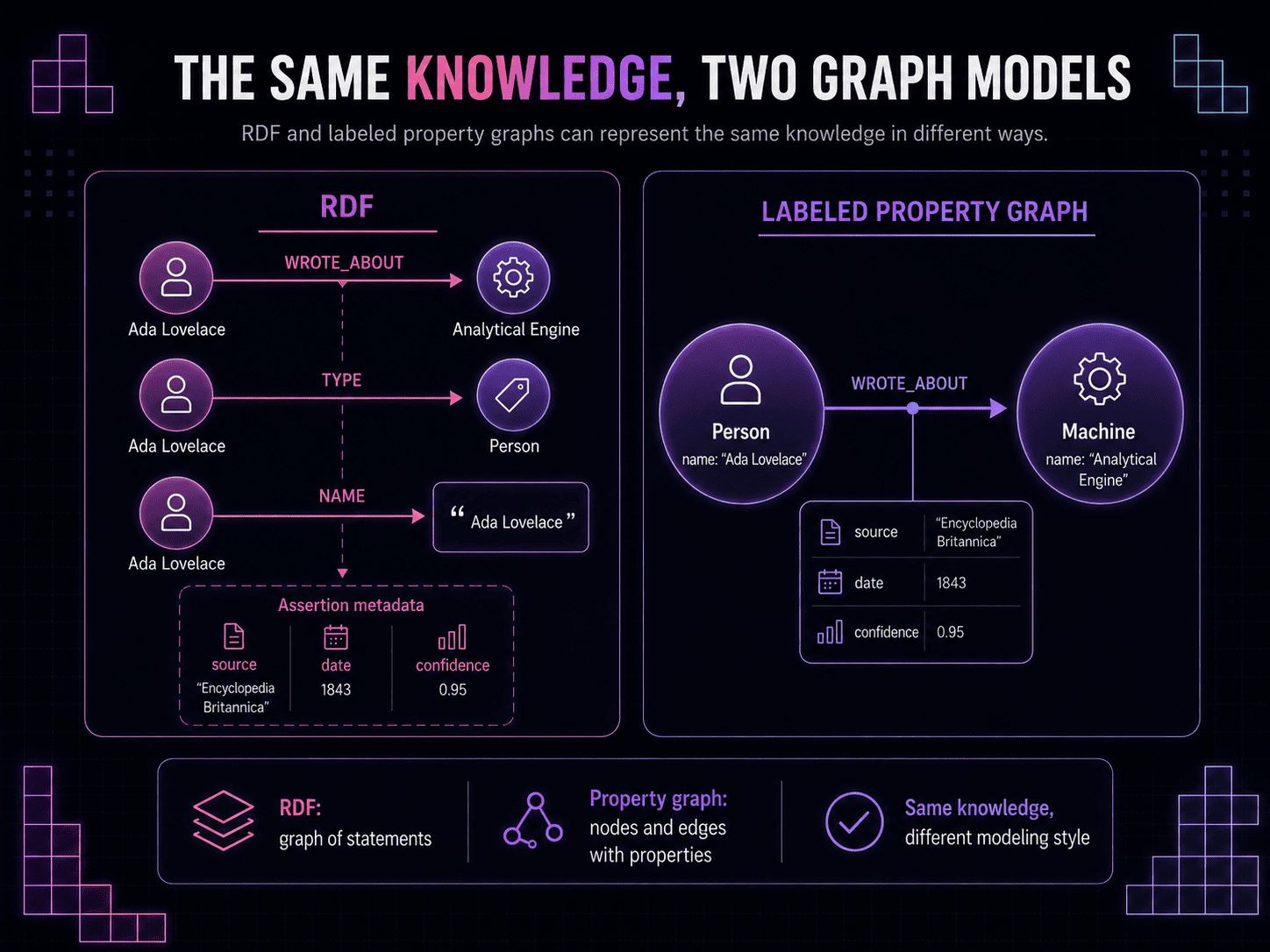
How this information is represented depends on the graph model. Labeled property graphs can attach properties directly to nodes and relationships, while RDF graphs primarily represent information through subject → predicate → object triples and related semantic mechanisms.
Provenance
Provenance records the evidence behind a graph assertion.
If a system extracts:
Charles Babbage → DESIGNED → Analytical Engine
the graph can associate that assertion with the document, passage, database record, API response, or other source that supports it. When information changes or sources conflict, that provenance gives the application evidence it can use to evaluate which assertion is better supported or relevant to the query.
Schema, Taxonomy, and Ontology
Consistent definitions of entity types, relationship meanings, and domain concepts make facts interpretable across a knowledge graph. Schemas, taxonomies, and ontologies all contribute to that consistency, so let's examine each of these structures in more depth.
Schema
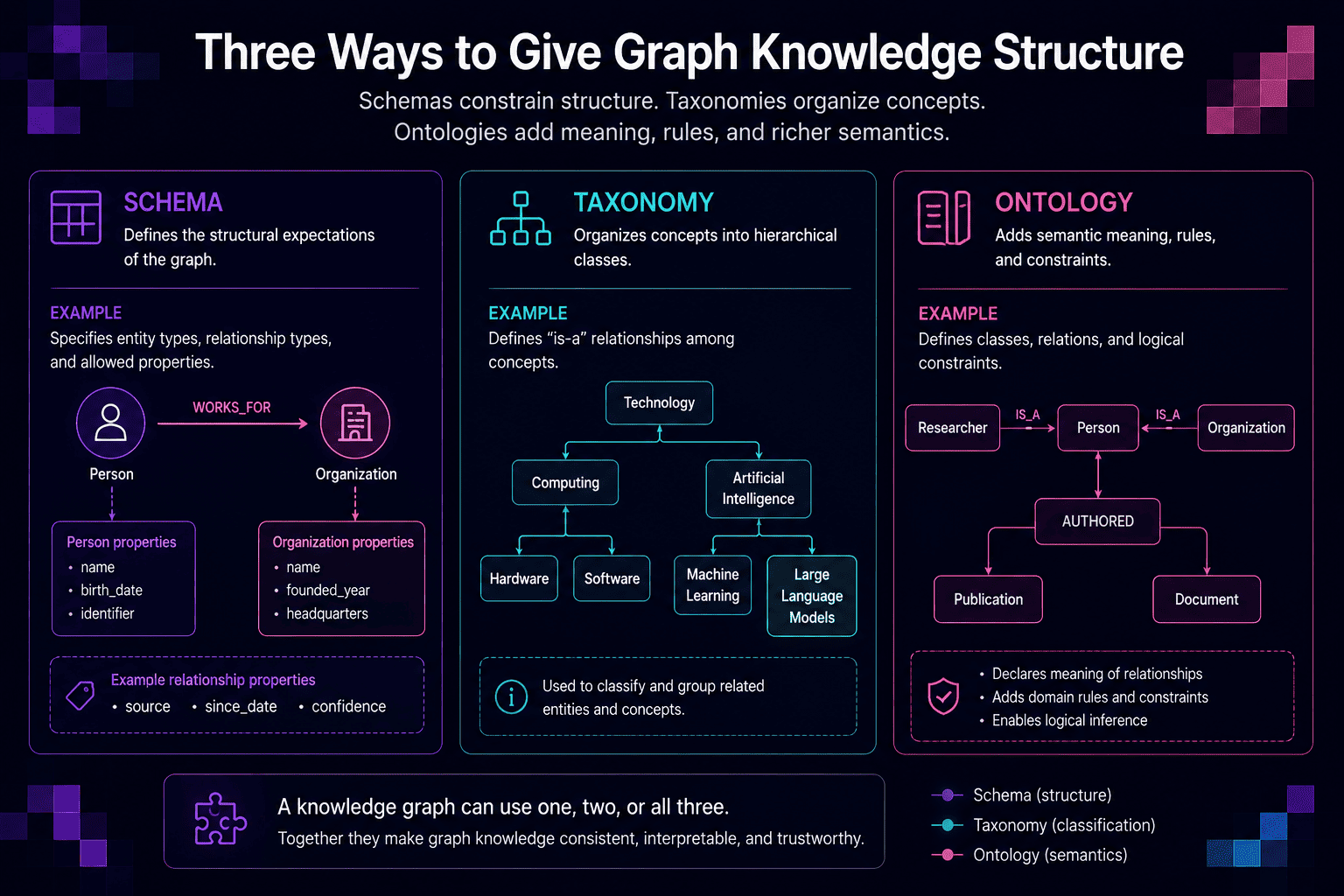
A schema defines the structural expectations of the graph. It can specify which entity and relationship types are available, which properties they can carry, and which connections are valid.
For example, a schema could define:
PersonandOrganizationas entity types.WORKS_FORas a relationship between aPersonand anOrganization.founded_yearas a property of anOrganization.sourceas metadata attached to a relationship.
Schemas can be strict or flexible depending on the graph technology and application. Their role is to keep graph records structurally consistent enough for querying, validation, and maintenance.
Taxonomy
A taxonomy organizes concepts into categories and subcategories, usually through hierarchical relationships.
A publishing taxonomy might contain:
Technology → Artificial Intelligence → Large Language Models
Taxonomies primarily organize classification hierarchies. They can help group entities under broader concepts, but they usually encode a narrower range of semantics than an ontology.
Ontology
An ontology defines concepts within a domain together with their relationships and semantic constraints, providing a formal vocabulary that can support validation and inference.
An ontology might define Researcher as a type of Person and restrict AUTHORED to relationships between a person and a publication. It can also encode equivalence, identity, class hierarchies, and other rules that support more formal interpretation.
In RDF-based systems, standards such as RDF Schema and OWL can make these semantics machine-readable and support inference in compatible reasoning systems.
Many knowledge graphs don't need a formal ontology and instead use lighter domain schemas or controlled vocabularies when formal reasoning and interoperability aren't necessary. Likewise, a graph can use a schema alongside a taxonomy or a formal ontology, or some combination of them.
RDF vs Labeled Property Graphs
RDF and labeled property graphs can both support knowledge graphs. They organize statements, attributes, and semantics differently:
| RDF | Labeled property graph | |
|---|---|---|
| Basic representation | Subject–predicate–object triples | Nodes connected by typed relationships |
| Entity attributes | Expressed through additional statements | Properties attached directly to nodes |
| Relationship metadata | Usually modeled through additional RDF statements; RDF 1.2 introduces triple terms and statement-level reification and annotation | Properties can be attached directly to relationships |
| Semantic modeling | RDF Schema, OWL, shared vocabularies, ontologies | Labels, relationship types, properties, constraints, and domain schemas |
| Common query language | SPARQL | Cypher, GQL, and related property-graph query languages |
| Typical use | Semantic interoperability and standards-based data integration | Traversal and application-oriented graph modeling |
RDF
RDF commonly uses Internationalized Resource Identifiers (IRIs) to identify resources (entities, objects, or concepts) and predicates, while literals represent values such as strings, numbers, and dates. Blank nodes can represent resources that don't require a global identifier. RDF datasets can organize statements into named graphs, too.
When the same resource appears across multiple subject → predicate → object triples, those statements become part of the same connected RDF graph.
RDF also has semantic standards built around it. RDF Schema defines classes and properties, while OWL supports richer ontology constructs and inference semantics.
The current RDF 1.2 Candidate Recommendation introduces triple terms and rdf:reifies, providing a more direct way to identify a statement and attach metadata or commentary to its reifier.
Labeled property graphs
A labeled property graph represents entities as nodes and connections as typed, directed relationships. Nodes can carry labels and properties, and relationships can carry their own properties as well.
For example:
(:Person {name: "Ada Lovelace"})-[:WROTE_ABOUT]->(:Machine {name: "Analytical Engine"})
A relationship can carry its own properties as well:
(:Person)-[:WORKS_FOR {start_date: "2025-01-01"}]->(:Organization)
Here, the employment start date belongs to the WORKS_FOR relationship rather than either entity.
Knowledge Graph Architecture
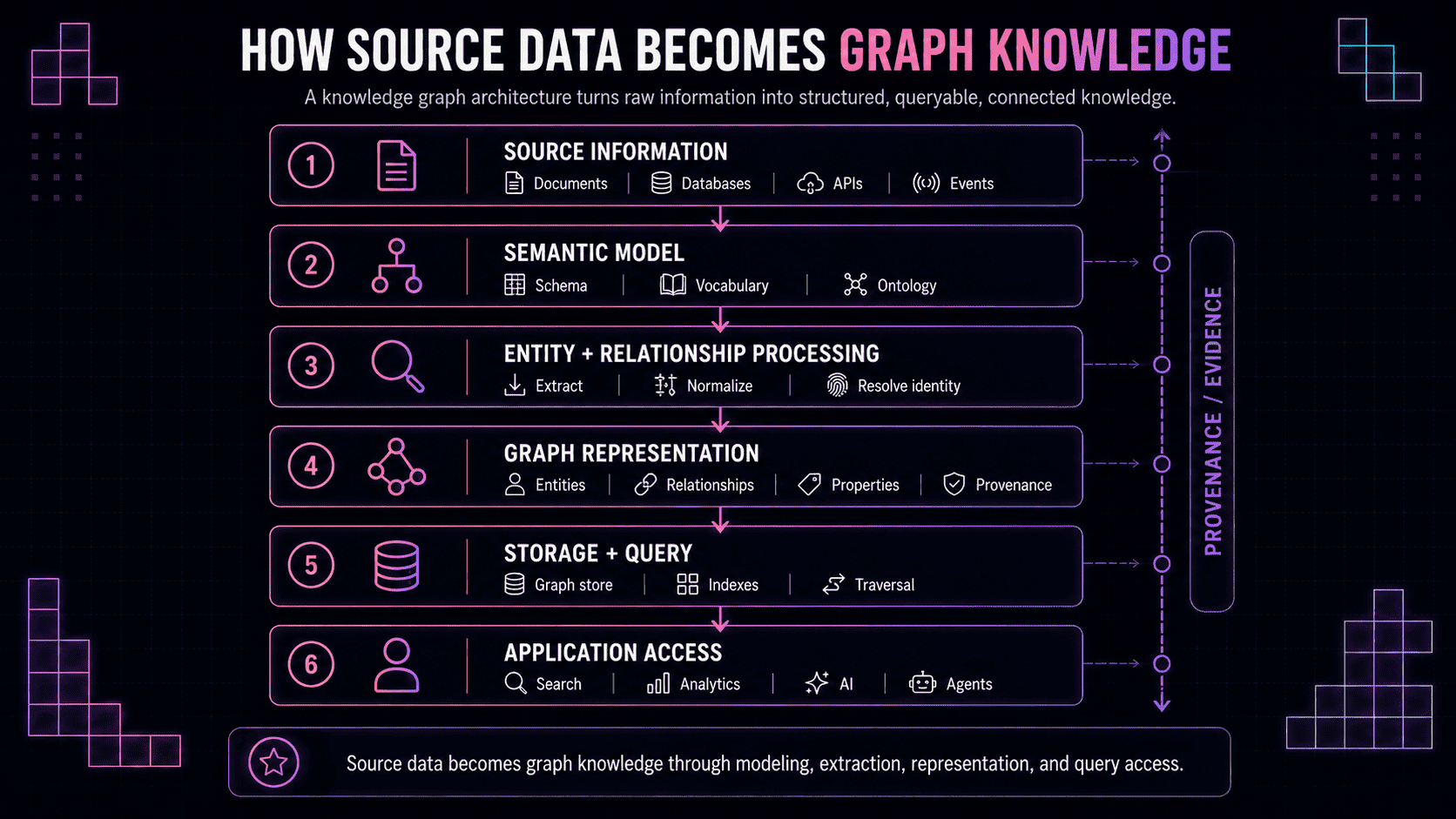
Knowledge graph architecture describes how source information is modeled, resolved into entities and relationships, stored as connected knowledge, and made available for querying and application use.
These are the logical layers of a typical architecture:
| Layer | Role |
|---|---|
| Source information | Documents, databases, APIs, event streams, and other inputs |
| Semantic model | Defines entity types, relationship types, properties, schemas, and ontologies |
| Entity and relationship processing | Identifies entities, resolves identities, extracts relationships, and normalizes them to the semantic model |
| Graph representation | Encodes entities, relationships, properties, and source evidence |
| Storage and query | Persists the graph and supports lookup, pattern matching, traversal, and inference where available |
| Application access | Makes graph knowledge available to search, analytics, AI systems, and other applications |
These layers are conceptual — a smaller implementation can combine several in the same application or database, and larger systems can distribute processing, storage, and retrieval across dedicated infrastructure.
Source information and semantic modeling
Knowledge graphs can combine structured and unstructured sources: relational tables, JSON records, documents, research papers, application events, and external APIs can all contribute.
The semantic model establishes how that information should be represented. It can define concepts such as Person, Organization, and Publication, together with relationships such as AUTHORED, WORKS_FOR, or CITES.
Two datasets might use different names for the same concept, or apply the same label to concepts that need to stay distinct. The shared vocabulary of the model gives later processing a consistent set of entity and relationship definitions.
Entity and relationship processing
Source records have to be associated with the correct entities and connections before they can become dependable graph knowledge.
For unstructured text, extraction can identify candidate entities and relationships. Structured data, on the other hand, can provide them more directly through fields, foreign keys, IDs, or existing records. Those candidates can then be normalized against the graph's schema so that equivalent relationships don't enter under inconsistent labels.
For example, source material might express the same employment relationship as:
works atemployed byemployee of
A graph schema can normalize those variants to a shared WORKS_FOR relationship, with the same principle applying to entity types and properties.
Entity resolution
Entity resolution determines whether records from different sources refer to the same underlying entity.
One source might identify:
Augusta Ada King
while another uses:
Ada Lovelace
If both records refer to the same person, storing them as unrelated nodes fragments the connections associated with that identity.
The opposite error is merging two distinct entities that happen to share a name. Text matching alone isn't enough to justify a merge; identifiers, attributes, source context, and other evidence can help establish identity.
Ontology-based entity validation can also help canonicalize extracted names against a shared vocabulary, reducing graph fragmentation across documents.
Identity errors propagate into the relationships attached to the affected node, which makes canonical identifiers and reversible merge decisions important as the graph expands.
Graph representation and storage
Once identities and relationship semantics have been established, the information can be encoded as RDF, a labeled property graph, or another kind of graph representation.
The logical knowledge model can be implemented across different storage backends. RDF graphs are commonly persisted in RDF stores or triplestores, while labeled property graphs are commonly stored in property-graph databases. Other architectures can combine graph representations with relational storage, vector indexes, or additional retrieval infrastructure.
The storage layer needs to retain the information required to interpret and query the graph later. That can include identifiers, relationship types, properties, source references, temporal metadata, ontology definitions, and indexes used to locate graph records efficiently.
Query and application access
The final layer makes graph knowledge available to consuming systems — retrieving known entities, locating relationship patterns, or traversing connected records and multi-hop paths. The quality and interpretability of those results depend on the identities, semantics, and source context established in the earlier layers.
How Knowledge Graphs Are Queried
Knowledge graphs can be queried through entities, properties, relationship patterns, and paths.
Using the earlier example:
Ada Lovelace → WROTE_ABOUT → Analytical Engine ← DESIGNED ← Charles Babbage
a query could retrieve the Analytical Engine directly, ask who designed it, or follow several relationships to connect the two individuals through the same machine.
Direct lookup and pattern matching
Some queries begin with a known identifier, property, or entity type and then expand to other directly connected entities.
Pattern matching specifies the structure the database should locate. A pattern such as:
Person → AUTHORED → Publication
can retrieve every person connected to a publication through an AUTHORED relationship, with additional conditions applied to properties such as publication date or subject.
Graph traversal and multi-hop queries
Graph traversal follows relationships across connected entities. Each relationship crossed adds another hop.
An example of a direct query is:
Who designed the Analytical Engine?
And a multi-hop query would be:
Who wrote about a machine designed by Charles Babbage?
The latter question combines several stored relationships into the evidence needed for the answer. It begins with Charles Babbage, follows DESIGNED to a machine, and then follows WROTE_ABOUT to the connected person or people.
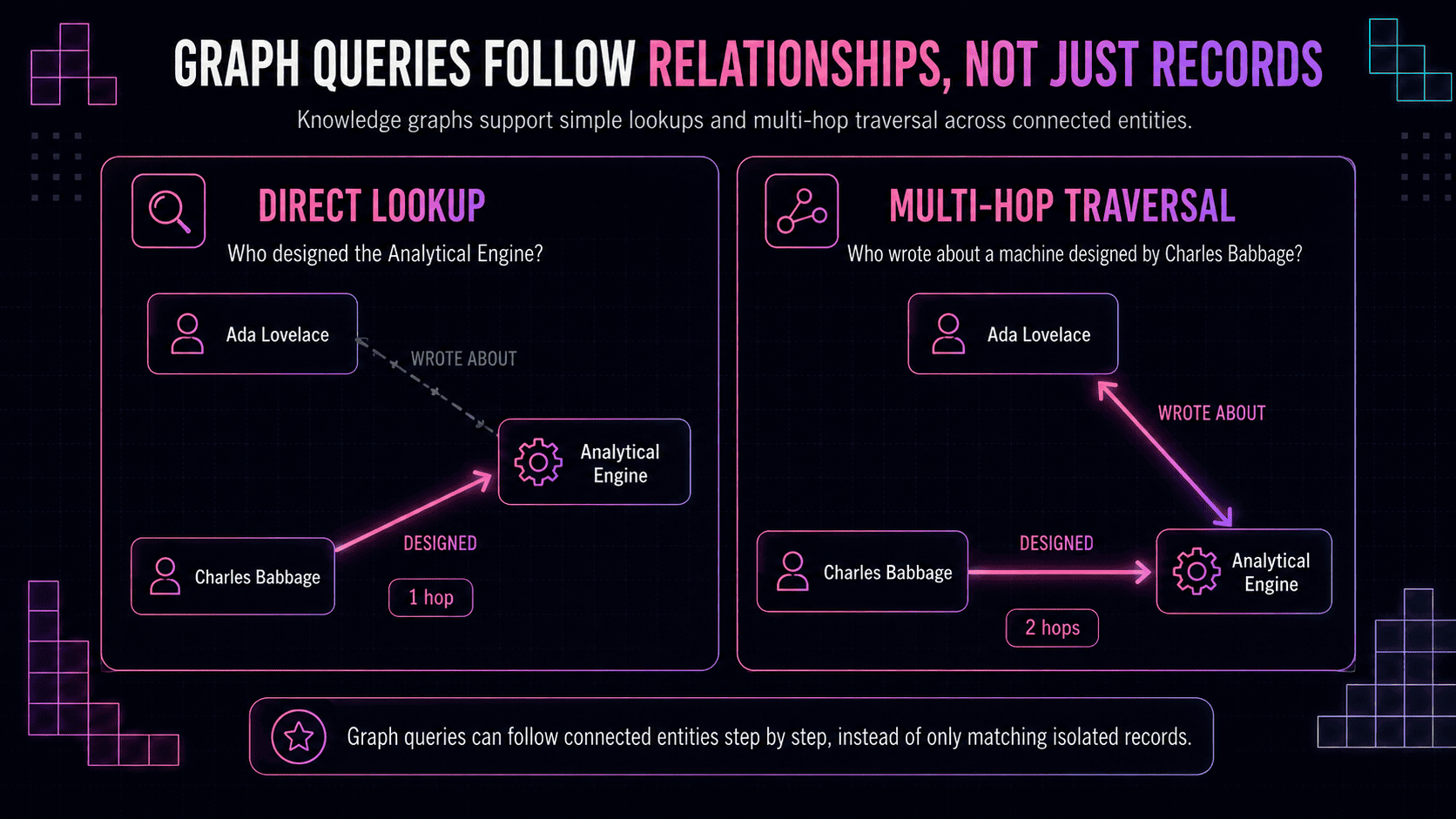
When a natural-language question is translated into graph retrieval and the resulting paths support an answer, the same pattern becomes knowledge graph query answering.
SPARQL, Cypher, and GQL
SPARQL, Cypher, and GQL all express graph patterns, but their syntax and capabilities reflect the graph models and database implementations they target.
- SPARQL is the W3C query language family for RDF. SPARQL 1.1 is the established Recommendation, while SPARQL 1.2 is under development. SPARQL queries describe patterns involving subjects, predicates, and objects and can filter, combine, aggregate, or construct results from matching RDF statements.
- Cypher is a declarative query language widely used with labeled property graphs. Its syntax represents nodes, relationships, and paths directly, making graph patterns central to the query.
- GQL, standardized as ISO/IEC 39075, provides an international standard query language for property graphs. Neo4j's Cypher implementation supports the majority of mandatory GQL features and tracks the gaps still open as GQL compatibility continues to develop.
Querying and inference
Some knowledge graphs can also support inference, where semantic definitions or application rules allow additional facts to be derived from the stored graph.
If an ontology states that every Researcher is a Person, and the graph contains:
Ada Lovelace → type → Researcher
a compatible reasoning system can infer:
Ada Lovelace → type → Person
without requiring that second statement to be stored separately.
Inference isn't an automatic capability and depends on the semantic model, reasoning engine, database features, or application logic available to the system. RDF and OWL environments can use formal entailment semantics, while other graph implementations can derive relationships through rules, algorithms, or application code.
Knowledge Graph vs Graph Database
A knowledge graph represents connected knowledge through entities, relationships, semantics, and source context. A graph database is infrastructure designed to store and query graph-structured data.
| Knowledge graph | Graph database | |
|---|---|---|
| Primary role | Represents connected knowledge and its meaning | Stores and queries graph-structured records |
| Core data model | Entities, relationships, semantic definitions, and provenance | RDF triples or nodes, relationships, and properties, depending on the database |
| Semantic layer | Can use schemas, ontologies, vocabularies, and defined relationship types | Depends on the model and semantics implemented by the application |
| Storage | Can use several underlying storage technologies | Provides the storage technology itself |
| Main concern | What the entities and relationships mean | How graph records are persisted and queried |
A graph database can provide the persistence and traversal layer for a knowledge graph, while the knowledge graph adds the identity, semantics, provenance, and domain structure that give those records meaning.
How Graph Knowledge Supports AI
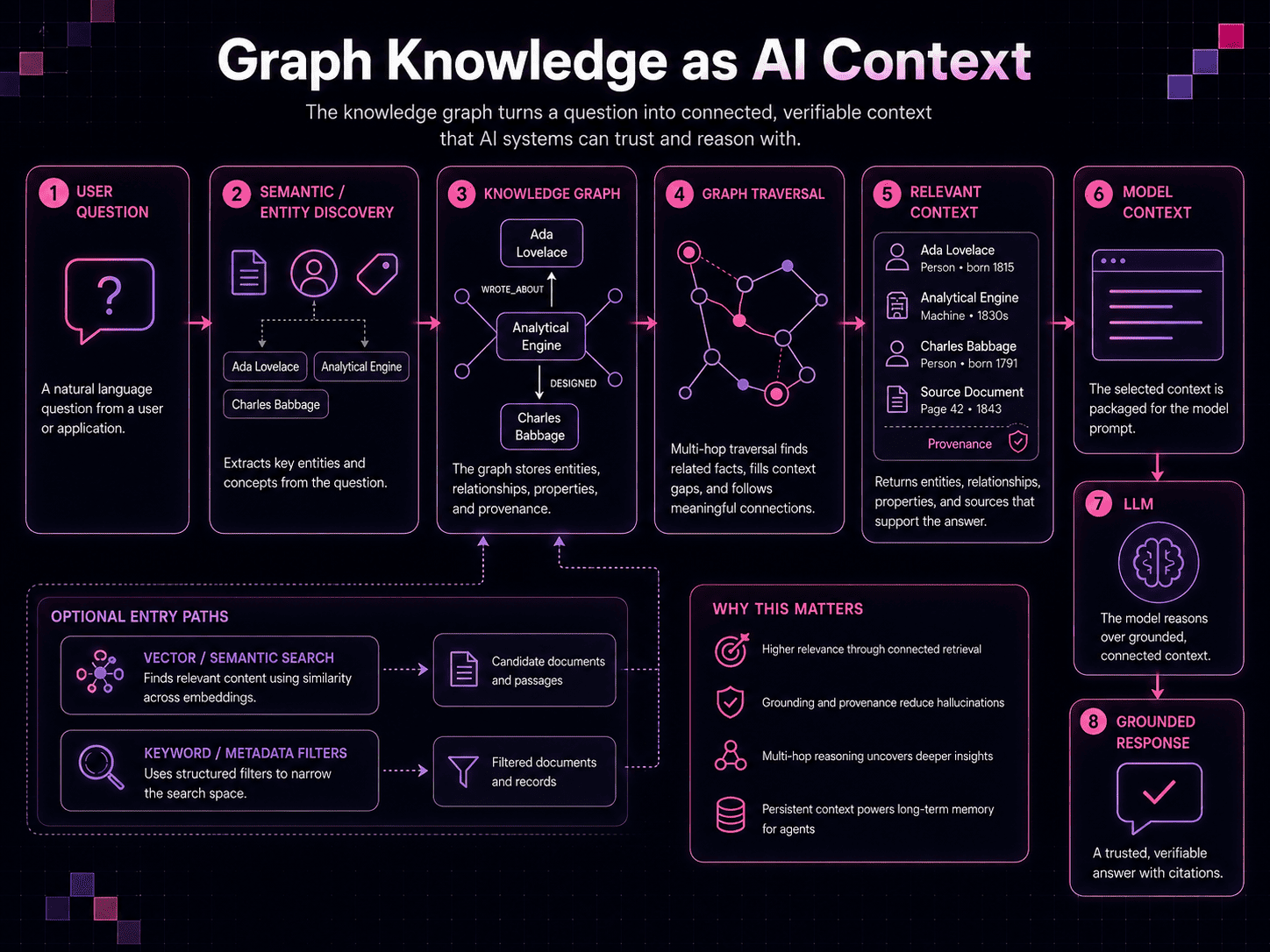
In AI systems, a knowledge graph can act as a structured external knowledge source that applications query for entities, relationships, and connected context.
A graph query can return the specific entities and relationship paths relevant to a question, along with properties and source information attached to those records. The application can then provide that connected subset of the graph to an LLM as context.
When an answer depends on relationships already encoded in the graph — such as dependencies, hierarchies, ownership, citations, or organizational connections — the application can retrieve those connections directly rather than reconstructing them from separate source passages.
Grounding with source context
Provenance recorded during construction can support inference-time grounding when source information is retrieved alongside the graph assertion.
If the graph records:
Company A → ACQUIRED → Company B
an AI application can retrieve the supporting document, database record, or event together with that relationship and provide both to the model as context.
That pairing makes a retrieved assertion auditable when several sources disagree or a fact changes over time.
Graph retrieval and GraphRAG
Many GraphRAG designs use knowledge graphs or other graph-structured representations as part of retrieval.
A query can begin with entities identified in the user's request, retrieve the relationships around them, and follow connected paths needed to answer the question. Graph and vector retrieval can work together: semantic similarity can identify relevant entry points, then traversal follows their explicit relationships to recover the surrounding context.
This hybrid retrieval is especially relevant when semantic similarity can locate the general subject but the answer depends on relationships explicitly represented in the graph.
AI-assisted knowledge graph construction
LLMs can also contribute to knowledge graph construction by identifying candidate entities and relationships in unstructured source material.
For example, a model processing a research paper might identify:
Researcher → AUTHORED → Paper
or:
Drug → TARGETS → Protein
and return those records for insertion into the graph.
Extracted candidates still need identity resolution and normalization against the semantic model. Assertions should also retain their source context and pass any required validation before they are committed as dependable graph records.
IBM's survey of LLM-based knowledge graph construction reviews entity and relationship extraction techniques alongside the reliability challenges involved.
For the wider AI-specific discussion, see our guide to AI knowledge graphs.
Knowledge Graphs as Agent Memory
By preserving entities encountered during previous interactions along with their relationships and supporting evidence, knowledge graphs can act as a source of persistent context for AI agents.
For example, an agent working repeatedly with the same customer could accumulate records such as:
Customer → USES → ProductCustomer → REPORTED → IssueIssue → AFFECTS → FeatureEngineer → RESOLVED → Issue
Those records form a connected history that can be queried during later work. A question about the customer can retrieve the product they use, earlier problems, affected features, and related resolutions through the relationships already recorded in the graph.
A knowledge graph can become one component of agent memory when information produced through agent interactions is persisted, revised as new evidence arrives, and retrieved during later tasks or sessions. The graph preserves connections among entities and observations, while the surrounding memory architecture governs write, retrieval, consolidation, scope, and deletion policies.
Building Reliable Graph Knowledge
The quality of graph retrieval depends on whether identities, semantics, evidence, and permissions stay coherent as new information enters the graph. Construction establishes those foundations and ongoing validation and revision are needed to maintain the graph's reliability.
Entity identity
Entity resolution continues after ingestion as new aliases, identifiers, and source records arrive. New evidence can reveal duplicate nodes or an incorrect earlier merge, so identity decisions should stay traceable and reversible.
Schema consistency and validation
Semantic definitions only help if graph records follow them consistently.
If WORKS_FOR is defined as a relationship between a Person and an Organization, incoming records should respect that expectation. Validation can detect unexpected entity types, missing properties, unsupported relationships, or records that violate domain constraints.
RDF systems can use standards such as SHACL to validate graph data against defined constraints, while property-graph systems can enforce comparable requirements through database constraints, schema tooling, or application validation.
For extraction pipelines, custom graph models can define which entity types, properties, and relationships are produced from source material, which then reduces semantic variation before records ever enter the graph.
Source evidence and revision
Provenance recorded during construction also makes later revision possible. If a source changes, is withdrawn, or is replaced, the graph can identify the assertions derived from it so those records can be reviewed without scanning unrelated parts of the graph.
Temporal validity
Some graph facts are correct only during a particular period. Overwriting the previous relationship removes information required for historical questions, while storing both without temporal context makes it difficult to determine which statement applies right now.
Temporal metadata can record when an assertion became valid, when it ended, or when another record superseded it. cognee's time-aware memory similarly extracts events and timestamps so retrieval can answer questions constrained to particular periods.
Conflicting assertions and uncertainty
Different sources can make incompatible claims without either assertion having to be discarded immediately.
For example:
Source A → reports → LaunchDate_SeptemberSource B → reports → LaunchDate_October
The graph can preserve both assertions with their sources, timestamps, and confidence information. Retrieval or application logic can then prioritize evidence by recency, source authority, or confidence, while unresolved conflicts can return both assertions to the user or agent rather than force a single conclusion.
This is particularly important for extracted graph knowledge, where uncertainty can originate in either the source material or the extraction process.
Access control
Connected records can reveal information indirectly through graph traversal, so authorization has to account for the paths a query can reach.
For example, if Customer → REPORTED → Issue and Issue → DOCUMENTED_IN → InternalPostmortem, a support agent who can see the customer's issue history shouldn't be able to reach the internal postmortem by following that second relationship unless they separately hold permission on InternalPostmortem itself.
Access-control granularity depends on the storage and application architecture. Controls can apply to datasets, tenants, graphs, nodes, relationships, properties, or source records. In cognee Cloud, permissions are enforced at the dataset level, with dataset isolation restricting queries to data the user can access.
Graph Retrieval Depends on Recoverable Context
As a knowledge graph expands, retrieval has to recover enough context for each assertion to stay interpretable. Entity identity and relationship semantics establish what a connection means, while source and temporal information help determine why it should be trusted and when it applies.
When graph knowledge feeds an LLM, recoverability becomes critical because the model only receives the portion of the graph selected for its context. Even a correct record can produce an incomplete answer if retrieval omits the relationships or evidence needed to interpret it.
So, a dependable knowledge layer has to preserve those connections throughout ingestion, storage, and retrieval. Identity-aware updates, temporal history, and surrounding relationship paths help keep retrieved records interpretable as the underlying information changes.
cognee automates much of this process by extracting entities and relationships from source data and organizing them into queryable graph knowledge. Semantic search can locate relevant information, while graph retrieval follows the explicit connections around it.
FAQ
Answers to the most common questions from this guide.
Are vector embeddings part of a knowledge graph?
Vector embeddings aren't required for a knowledge graph. Entities, relationships, properties, and semantic definitions can form a complete graph representation without them.
Embeddings can be added as a retrieval layer when semantic similarity helps locate relevant content or entities. Hybrid vector and graph retrieval can use those semantic matches as entry points before graph traversal follows the explicit relationships around them.
The two mechanisms represent different information: embeddings encode numerical representations that can be compared through similarity metrics, while the graph records explicit relationships between entities.
Does a knowledge graph need to be updated in real time?
Not necessarily. Some knowledge graphs are built in batches — ingesting a document set, resolving entities, and refreshing the graph on a schedule — which works well for reference material that doesn't change minute to minute.
Other use cases need low-latency writes, such as agents recording new observations, fraud systems processing transactions, or support graphs updating as tickets close. The required update latency affects ingestion and storage design more than the underlying graph model: entities, relationships, and semantics can be represented the same way whether updates arrive continuously or through scheduled batches.