Meet the new cognee: smarter memory, lower costs, and control for your team

Your agents can finally afford to know your company
Over the past few months, we've spoken with dozens of cognee users, including solo developers adding memory to their agents, agencies, manufacturers, and engineering teams at large companies. They were building very different things, but kept running into the same kinds of problems.
Many of their complaints can be distilled into this scenario: they would ask an agent what they promised a customer last quarter and proceed to watch it struggle piecing together the answer from information strewn across a Slack thread, a contract draft, and a bunch of emails.
Memory was supposed to fix that, but it ended up breaking down on two fronts:
- the more sources they connected, the messier the system got, and
- building memory cost far more than anyone expected.
This release is our answer to both, plus a third thing everyone asked about the moment the first two started working: who gets to see what.
Automatically build an ontology of your business
One developer we talked to, who was building a company brain in manufacturing, had connected cognee to nearly every agent and wiki he was using, but the resulting memory often mixed up distinct entities and generated circular answers. A manufacturer told us that the graphs they were getting back from cognee contained plenty of connections, but offered little tangible insight into how their product data was actually structured.
Both of these problems boil down to the same limitation — default extraction finds entities and relationships, but doesn't understand the rules of a particular business. It can't know that a company's 15% discount only applies to orders signed before March, or that a "maintenance contract" and a "service agreement" describe the same kind of deal. Capturing that context requires an ontology.
Until now, you had to build one by hand.
Now, our auto-ontology builds that structure from your data.
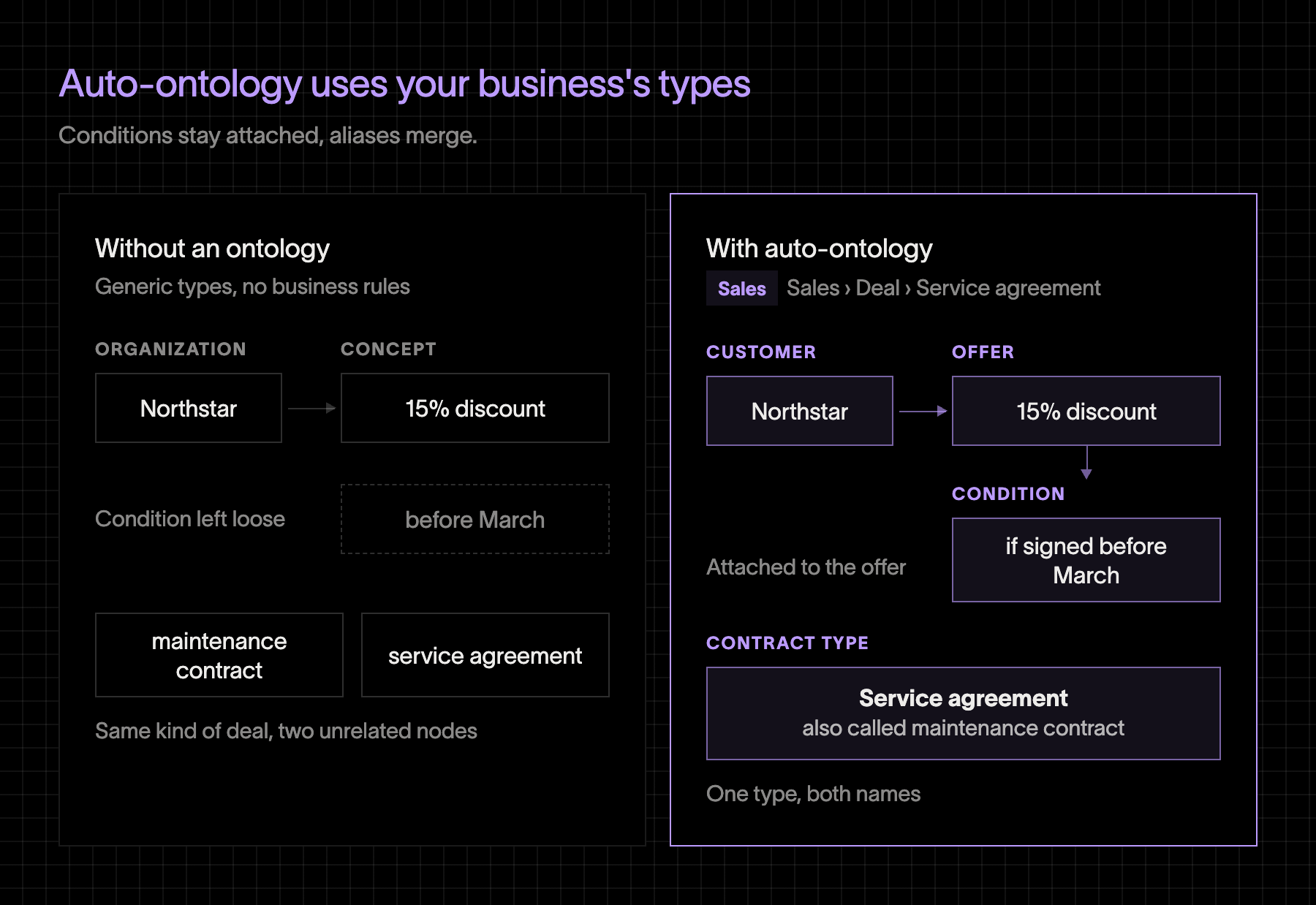
Available in cognee Cloud's Premium plan, auto-ontology identifies the entity types your business uses and organizes them into a hierarchy. For example, an SLA is a type of commitment, and a renewal is a type of deal. It then processes your data a second time, assigning each entity the most specific applicable type and adding descriptions rooted in the source material. When you ask a question, cognee uses these types to find relevant entities before retrieving the information needed to answer.
You can adjust the ontology in plain language. Tell the Ontology Editor to "merge Decision and DecisionRecord," and review the proposed changes before applying them.
Already have an ontology? Bring it in — cognee reads OWL, Turtle, JSON-LD and the other standard RDF formats, and builds on the ontology you've defined.
Cut extraction costs with small models
Another cognee user from the finance sector told us that memory was helping in his projects but eventually "you look at the bill and be like, it doesn't matter how useful this is. This isn't a cost that's worth it for me." He'd already switched to a cheaper model, but his bill was still too high. Another user we heard from burned through ~€10 in about 90 minutes just ingesting a 728 MB drive. So we fully understand people who opt for running extraction on their own GPU to keep their agents' memory affordable. But we also understand that not everyone has access to powerful GPUs.
Building memory means reading every chunk of every document and pulling out "Northstar", "15% discount" and "before March", again and again as documents change. That's pattern-matching, and it doesn't take a frontier model. So cognee now does it with GLiNER, a small open-weight model of about 194M parameters that runs on an ordinary CPU, while FastEmbed handles the embeddings. Leave the LLM API key unset and cognee will pick the local extractor automatically.
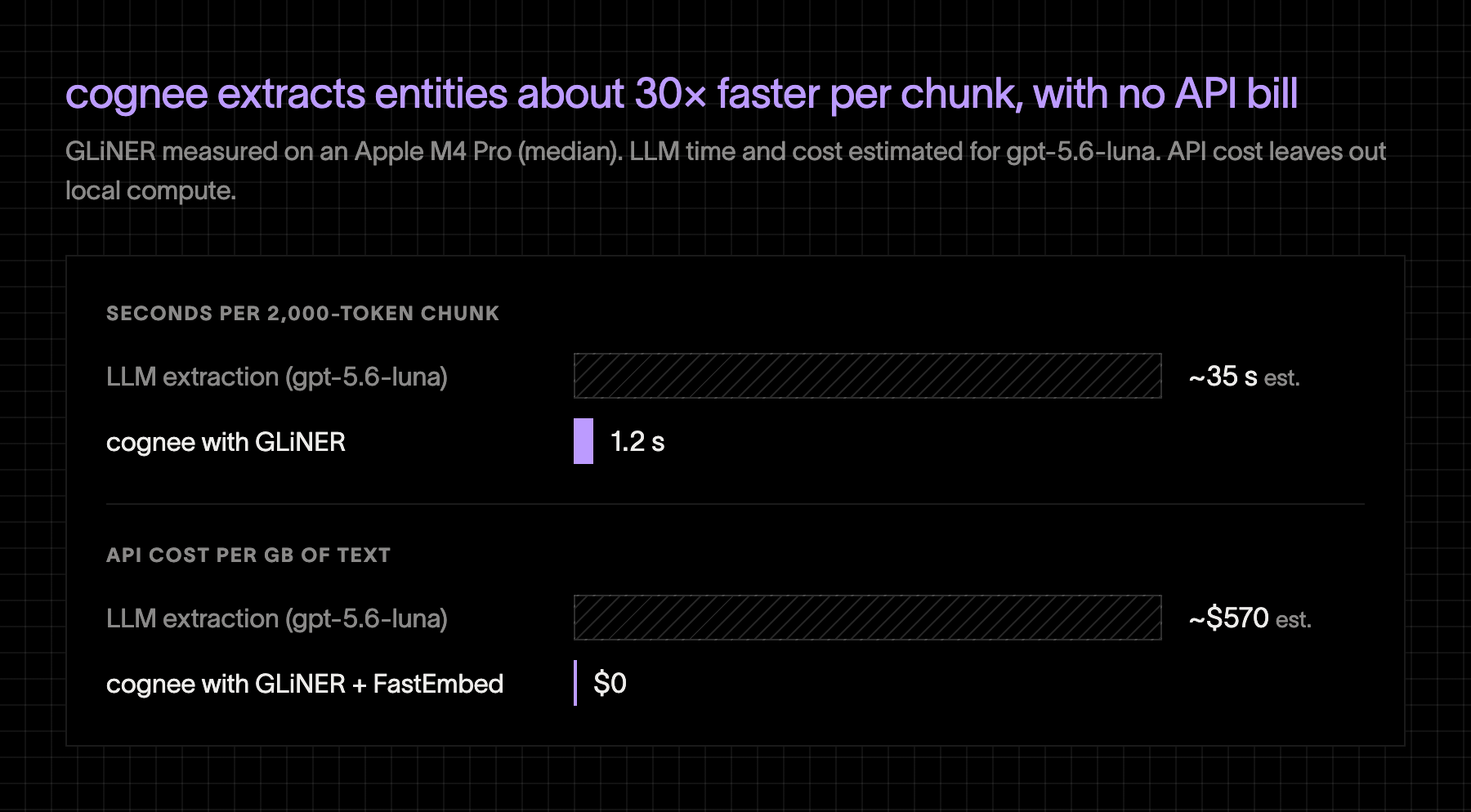
In our small-model extraction tests, a 2,000-token chunk took about 1.2 seconds on an Apple M4 Pro, against an estimated 35 seconds for gpt-5.6-luna, cognee's default LLM — around 30× faster, while also avoiding an estimated $570 of API charges per gigabyte of text.
And this is where the two launches meet: before extracting, cognee picks the entity and relation types to look for, from your ontology if you have one, or otherwise from a quick scan of each document.
Frontier models still handle the reasoning-heavy part: answering the question. The open-source extractor is a demo you can experiment with, while the production extractor, which offers higher accuracy and broader label coverage, is available through Enterprise.
Share memory across teams with rules you control
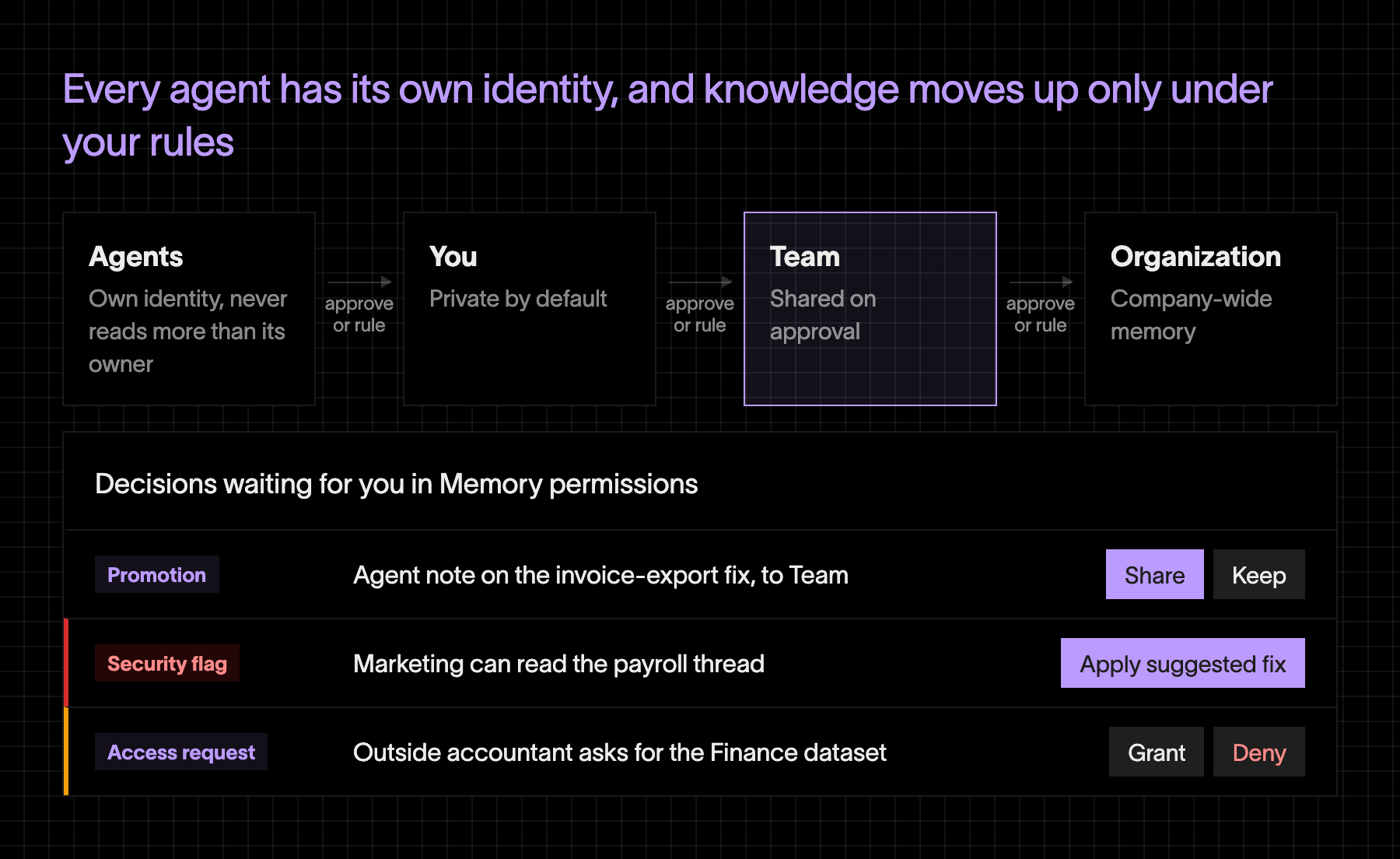
Memory promotion lets cognee share selected knowledge across agents, people, and departments, whether you're a large organization or a 10-person startup keeping founder and management materials private. Depending on your rules, sharing can happen automatically or require approval. Departments such as HR, engineering, and marketing can each maintain their own datasets, with reader, contributor, and admin roles controlling access. When one department needs information held by another, cognee copies the relevant knowledge into the receiving department's dataset without granting access to the original dataset.
You decide which knowledge can be shared across departments and which stays private. Engineering can share important technical decisions, for example, while HR keeps salaries and performance reviews restricted. cognee identifies knowledge that may be worth sharing, sends approval requests when needed, and flags questionable permissions, such as marketing having access to payroll data, along with a proposed fix.
Try it yourself
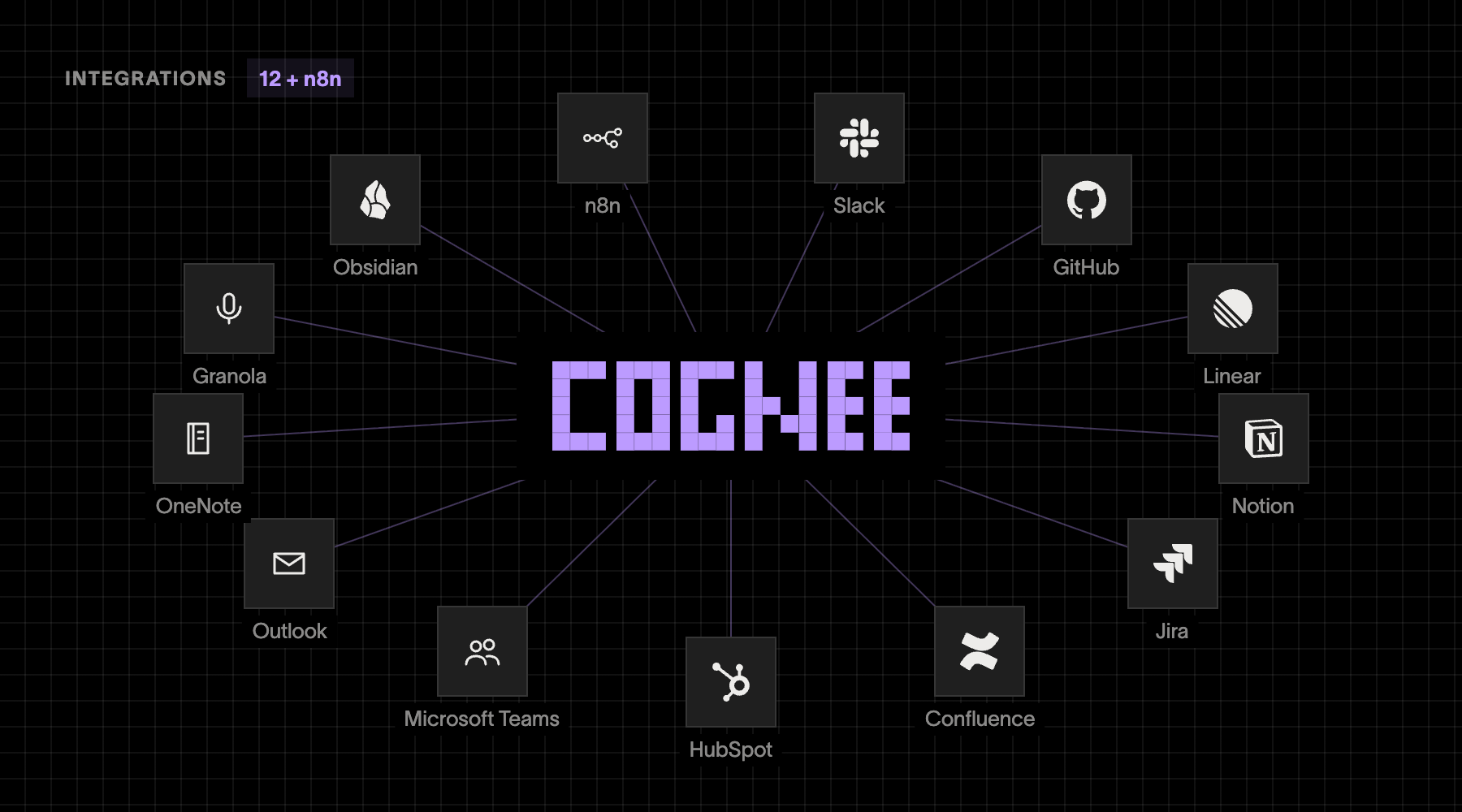
The best way to see all of this in action is with your own data. cognee Cloud connects to tools you already use, including Slack, GitHub, and Google Drive. More native integrations are on the way, but in the meantime, you can use our n8n integration to bring data from other sources into cognee through your existing workflows. Connect a source, let cognee ingest your data, then explore the graph it builds, level by level: domains, subdomains, entity types, and individual entities.
Get started with one of our 12+ integrations →
Prefer to run cognee locally? Be our guest, it's open source. Install cognee[gliner], leave your LLM API key unset (or set GRAPH_EXTRACTOR=gliner_demo), and follow our LLM-free setup guide.
For more, explore our documentation and check out our deep dive on small models.
Try the new cognee on your own data
Related reading


Cognee is the fastest way to start building reliable Al agent memory.