Open-Source Pinecone Alternatives: What Are You Trying to Replace?

TL;DR:
- Qdrant is the closest open-source substitute if you still want a dedicated vector database.
- Weaviate leans into hybrid semantic and keyword retrieval, while Milvus is better suited to large distributed vector workloads.
- pgvector is often the simpler choice when PostgreSQL is already central to the application; Chroma and LanceDB bring retrieval closer to the application itself.
- Don't migrate from Pinecone just because open source sounds cheaper. Justify taking on more of the retrieval infrastructure by choosing the architecture that gives you enough control, cost savings, or stack simplification.
Pinecone made vector search easier to adopt: send your embeddings, create an index, and let a managed service operate most of the infrastructure underneath it.
The search for alternatives usually starts once the bill gets harder to ignore, deployment rules tighten, or developers want more say over indexing and retrieval.
But sometimes Postgres or an existing search system already covers enough ground that taking on another managed database starts to feel redundant. And if Pinecone is already in production, is the operational benefit large enough to justify migrating the data and query behavior built around it?
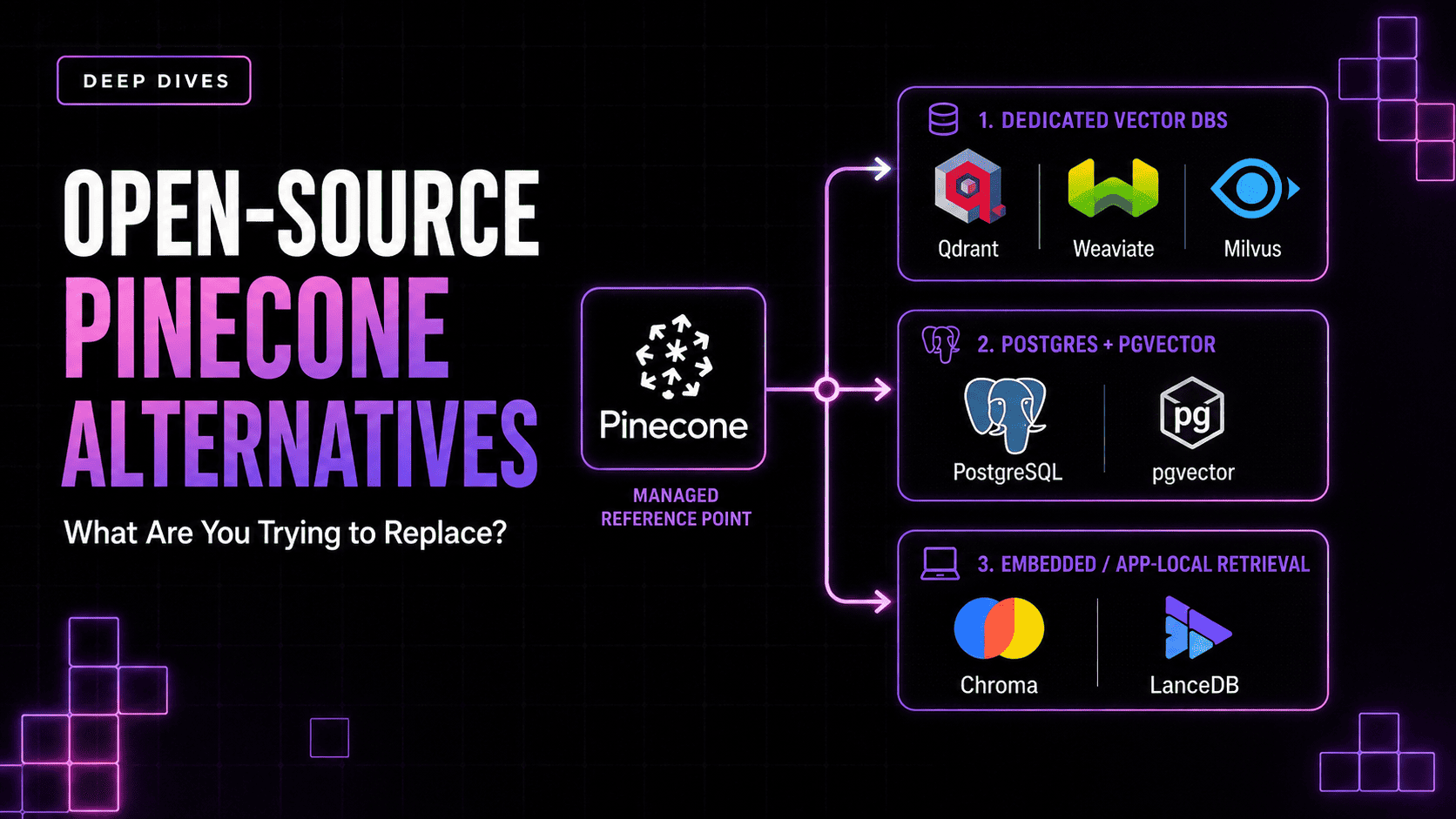
An open-source Pinecone alternative can mean several very different architectures:
- Qdrant, Weaviate, and Milvus are dedicated vector databases.
- pgvector adds vector search to PostgreSQL.
- Chroma spans local, single-node, and distributed retrieval, while LanceDB takes a more explicitly embedded approach.
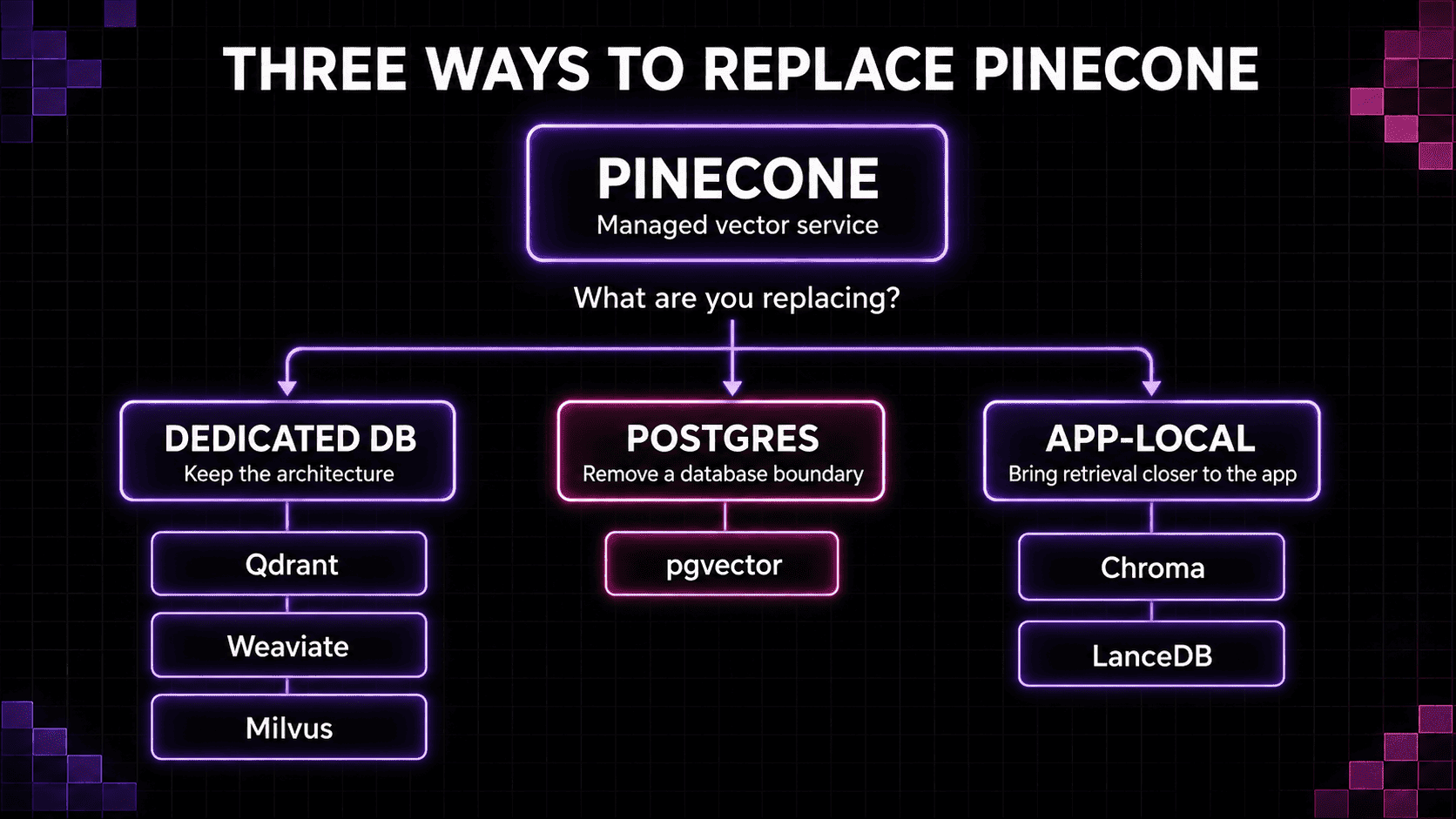
So the question really becomes: Which part of Pinecone are you trying to replace?
This guide compares the major open-source Pinecone alternatives by deployment model, retrieval features, operational burden, cost, scale, and the workloads each one is best suited to.
What Pinecone Is Designed to Solve
Before going all in on finding a Pinecone replacement, let's first clarify what exactly you'd be giving up.
Pinecone is a fully managed vector database built for production AI applications. Its serverless indexes separate storage from compute, leaving Pinecone to operate the infrastructure behind the API — enabling developers to use vector search without turning the process into an infrastructure project.
Pinecone has also grown well beyond basic nearest-neighbor search. It supports dense and sparse retrieval, hybrid search, metadata filtering, integrated embedding and reranking models, and namespaces for isolating data in multitenant applications. Its newer document-oriented capabilities bring full-text and BM25 retrieval (in public preview at the time of writing) into the same environment. An open-source alternative in 2026 therefore has to compete with a fairly complete retrieval stack, not simply provide somewhere to store embeddings.
If you're building RAG, semantic search, recommendations, or agent retrieval, very little database infrastructure has to be designed before the first query works, with no clusters to provision or ANN indexes to tune before getting started.
Pinecone also operates the service; you work through its API, deployment options, and data model. When that boundary suits the application, self-hosting can create a database project without solving a real problem.
Why Look for Open-Source Pinecone Alternatives
Qdrant, Weaviate, and Milvus all clear the basic vector-search bar. So, what do you actually gain by owning more of the retrieval stack, and is it enough to justify operating it yourself?
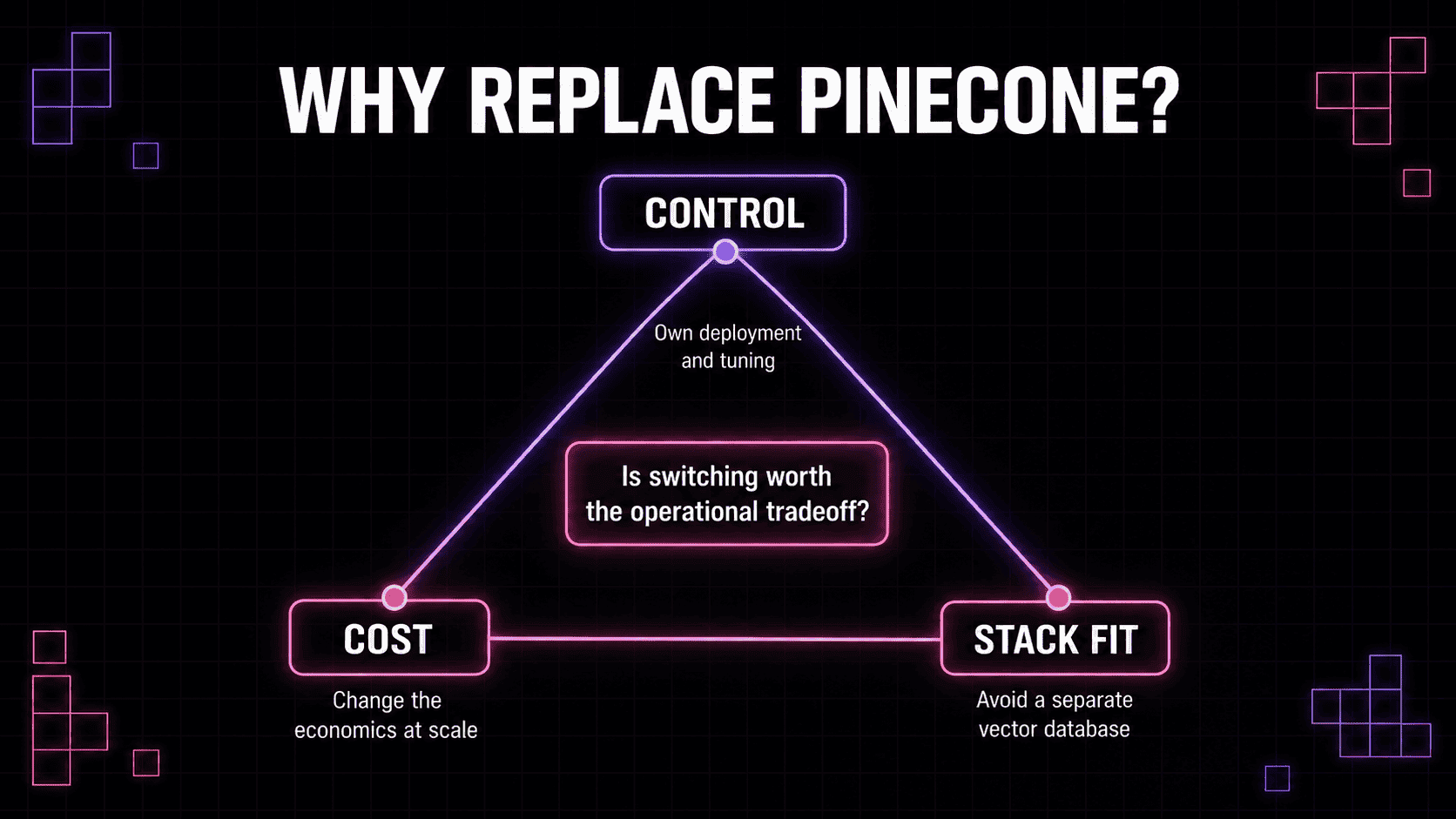
The reasons to switch tend to fall into one or more of these three buckets:
-
Cost compounds at scale
Pinecone Serverless uses consumption-based pricing across reads, writes, storage, and egress. At higher or steadier usage, retrieval becomes another cloud bill that deserves scrutiny — and self-hosting doesn't remove that cost so much as move it onto your own infrastructure and engineering time (more on that trade-off further down).
-
More control over the database and retrieval architecture
Data residency once created a much cleaner dividing line between Pinecone and self-hosted databases.
But Pinecone Bring Your Own Cloud (in public preview at the time of writing) has blurred that line by allowing the data plane to run inside a customer's AWS, GCP, or Azure account while Pinecone continues managing it.
Open-source systems still give developers control over how the database software is deployed, configured, and scaled, including indexing, hardware, and retrieval architecture, which can matter for on-prem deployments, stricter infrastructure policies, or products where retrieval itself needs active tuning.
This is part of what Pinecone charges for: many of those infrastructure decisions are made for you. An open-source move makes sense when taking them back gives you enough flexibility to justify the additional work.
-
Having a dedicated vector database becomes unnecessary
Sometimes, replacing Pinecone is less about finding another vector database and more about avoiding one altogether.
When PostgreSQL already stores the application data, pgvector can keep relational records and vector embeddings in the same system — extending familiar infrastructure may be simpler than adding another system to it.
What to Compare Before Choosing a Pinecone Alternative
The easiest mistake in a vector database comparison is lining up feature lists and declaring the product with the most checkmarks the winner. A better comparison starts with the workload.
Deployment model
How much infrastructure do you want to own?
Pinecone is managed. Qdrant, Weaviate, and Milvus can all be self-hosted as well as consumed through managed services, while Milvus also has a lighter local deployment through Milvus Lite.
The deployment choice decides who handles upgrades, replicas, scaling, security, backups, observability, and the inevitable 2 a.m. infrastructure problem — not just where the database runs.
Retrieval capabilities
Nearest-neighbor search alone doesn't tell you much about a candidate database anymore.
For production RAG, look at metadata filtering, sparse and dense retrieval, hybrid search, multiple vector representations, reranking, and whatever search logic the application needs around the embeddings themselves.
Qdrant supports hybrid dense and lexical retrieval alongside payload filtering. Weaviate combines vector search with BM25 keyword search and hybrid fusion, while Milvus supports multi-vector hybrid retrieval and reranking.
Performance and scale
"Fast" only means something once you attach a real workload to it — query latency, ingestion throughput, filtering patterns, index-build time, concurrency, replication, and recall requirements all affect the result.
Index choice can change the result as much as database choice. pgvector, for example, supports both HNSW and IVFFlat approximate indexes inside PostgreSQL.
Total cost
Compare total operating cost rather than the database price alone. Self-hosted systems add infrastructure and operator time to the calculation; Qdrant's documentation, for example, notes that self-hosted deployments leave replica management and shard movement to the operator as the cluster grows.
Data model and query fit
Some workloads depend heavily on relational joins and structured filters, while others need hybrid lexical search, several vector representations, multimodal data, or relationships between entities.
Compare each option against the queries your application actually runs, not just how it stores embeddings. A system that's superb at standalone vector retrieval may be awkward if every request also needs relational data, while a Postgres-centered architecture can become limiting once vector search grows into a large independent workload.
Production requirements
Finally, compare the things that rarely appear in a demo but are needed in any production environment:
- multitenancy
- authentication and authorization
- backups and recovery
- replication
- high availability
- observability
- data residency
- encryption
- SDK and framework support
- upgrade and migration paths
Taken together, these criteria lead to the bottom-line question:
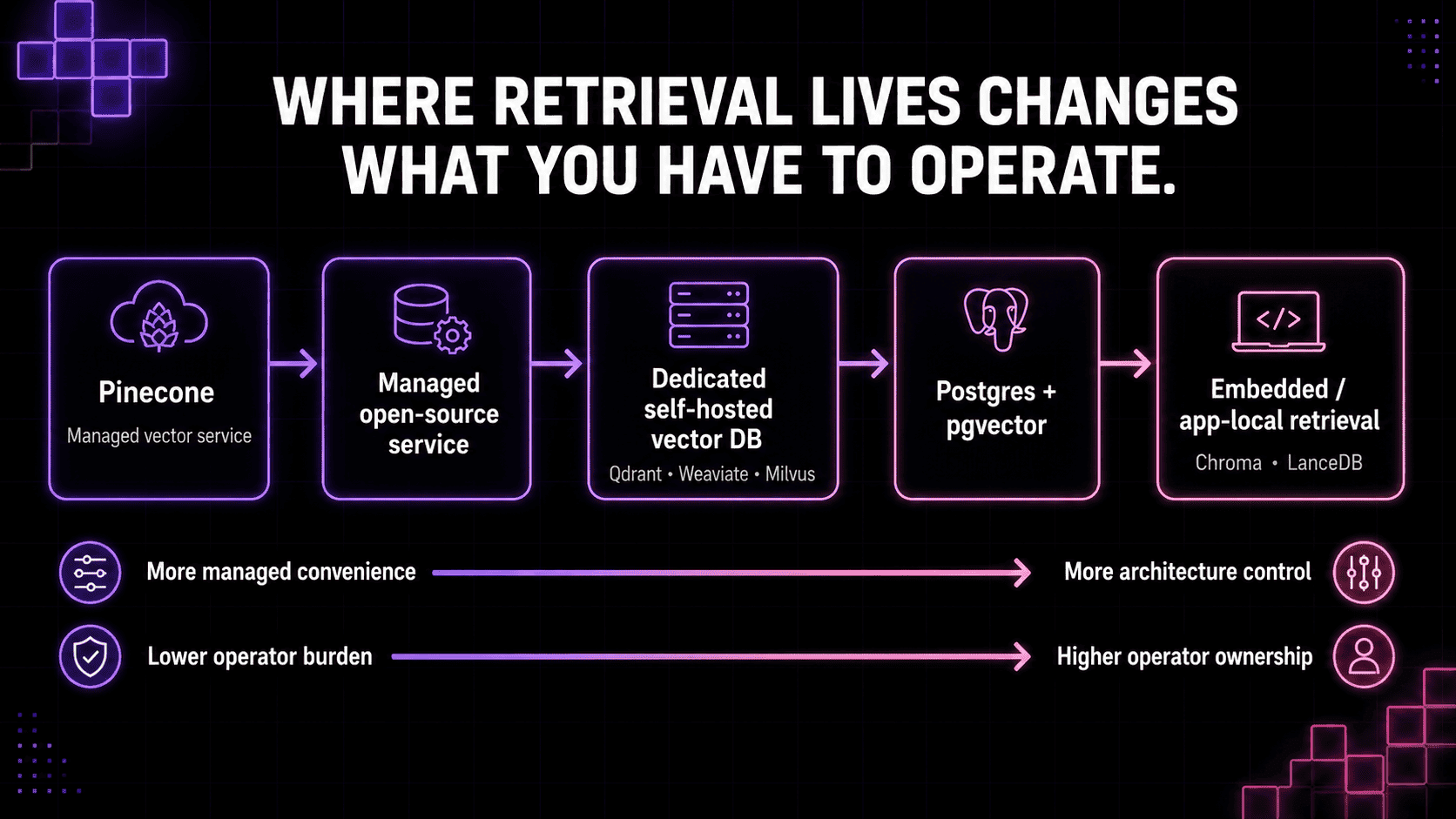
How much of Pinecone's managed convenience are you willing to trade for greater control over the retrieval layer?
A Glance at the Alternatives
These products overlap, but they aren't interchangeable. Some preserve Pinecone's basic dedicated vector service architecture, while others change the place of retrieval in the stack entirely.
| Option | What it is | Best fit | Main tradeoff |
|---|---|---|---|
| Qdrant | Purpose-built vector database with open-source, managed, hybrid, and private deployment options | A relatively direct Pinecone replacement with strong filtering and hybrid retrieval | Self-hosting puts more scaling and operational work on the operator |
| Weaviate | Open-source vector database with vector, BM25, and hybrid search, available self-hosted or through Weaviate Cloud | RAG applications where keyword and semantic retrieval need to work together | Wider retrieval surface means more architecture and configuration |
| Milvus | Distributed open-source vector database ranging from Milvus Lite to clustered production deployments | Large vector workloads where distributed scale is a first-order requirement | Full distributed deployments bring substantial infrastructure overhead |
| pgvector | PostgreSQL extension for exact and approximate vector similarity search | Applications already centered on Postgres that want vector retrieval without another database | Vector retrieval inherits PostgreSQL's operational characteristics |
| Chroma | Apache 2.0 retrieval database with local, single-node, and managed distributed options | Developer-friendly RAG and a low-friction route from prototype to hosted retrieval | Local and distributed deployments use different storage subsystems |
| LanceDB | Open-source embedded retrieval library built around the Lance multimodal format | Local, embedded, multimodal, or object-storage-oriented applications | The OSS architecture differs fundamentally from a remote vector service |
As the table makes clear, "best" doesn't mean much without an architecture in mind:
Do you want another vector database, vector search inside infrastructure you already run, or a lighter retrieval layer that runs closer to the application?
Now let's take a closer look at what these platforms actually offer.
Qdrant: The closest open-source Pinecone alternative
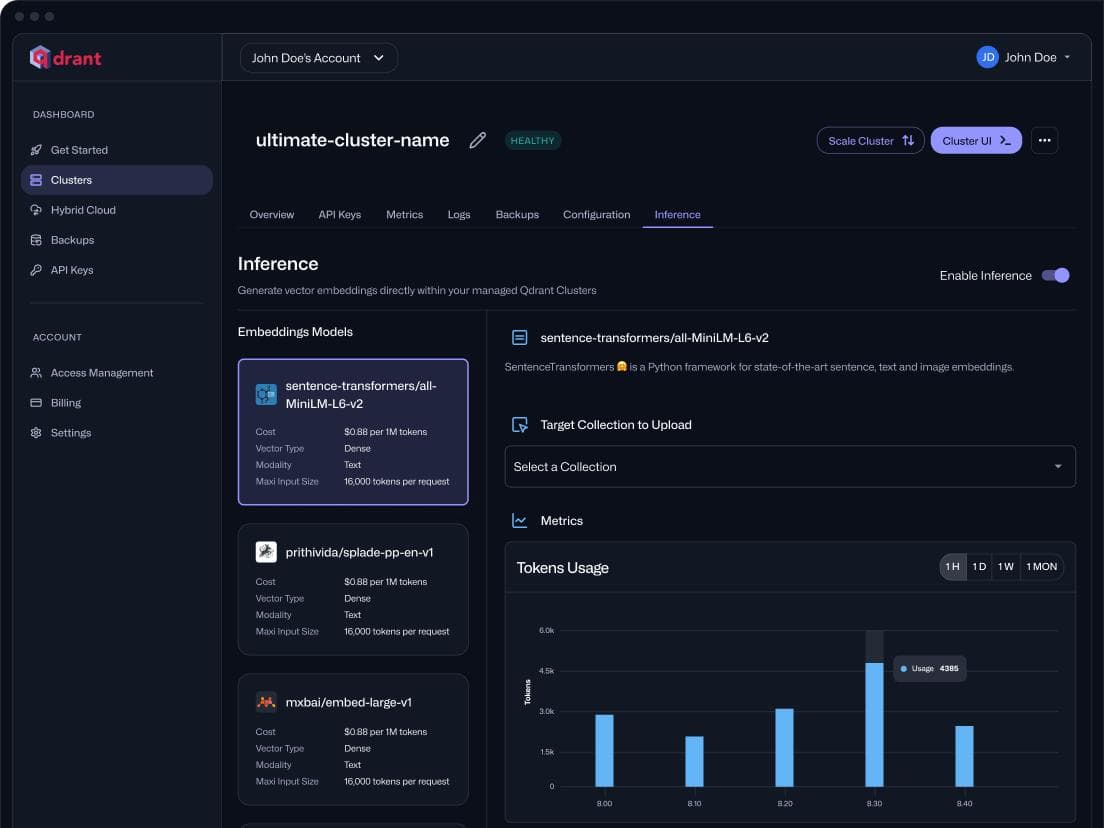
Qdrant is one of the most direct Pinecone replacements if you still want a dedicated vector database. It's open source and self-hostable, with Managed Cloud, Hybrid Cloud, and Private Cloud deployment options. Collections store dense or sparse vectors alongside payload metadata, with HNSW used for approximate nearest-neighbor search.
Its filtering model is particularly useful for RAG. Payload indexes can extend the HNSW graph so metadata constraints participate directly in vector search, and Qdrant also supports multiple named vectors, dense/sparse hybrid retrieval, multi-stage queries, and reranking.
Deployment ranges from fully managed to self-hosted. Hybrid Cloud keeps the database and user data inside your Kubernetes environment while using Qdrant's management layer. If self-hosting, replica management, shard movement, upgrades, and capacity planning become your responsibility.
Best for: A dedicated open-source vector database with strong filtering and hybrid retrieval.
Compared with Pinecone: Similar architecture, with more deployment control and more operational responsibility when self-hosted.
Weaviate: Hybrid search all the way
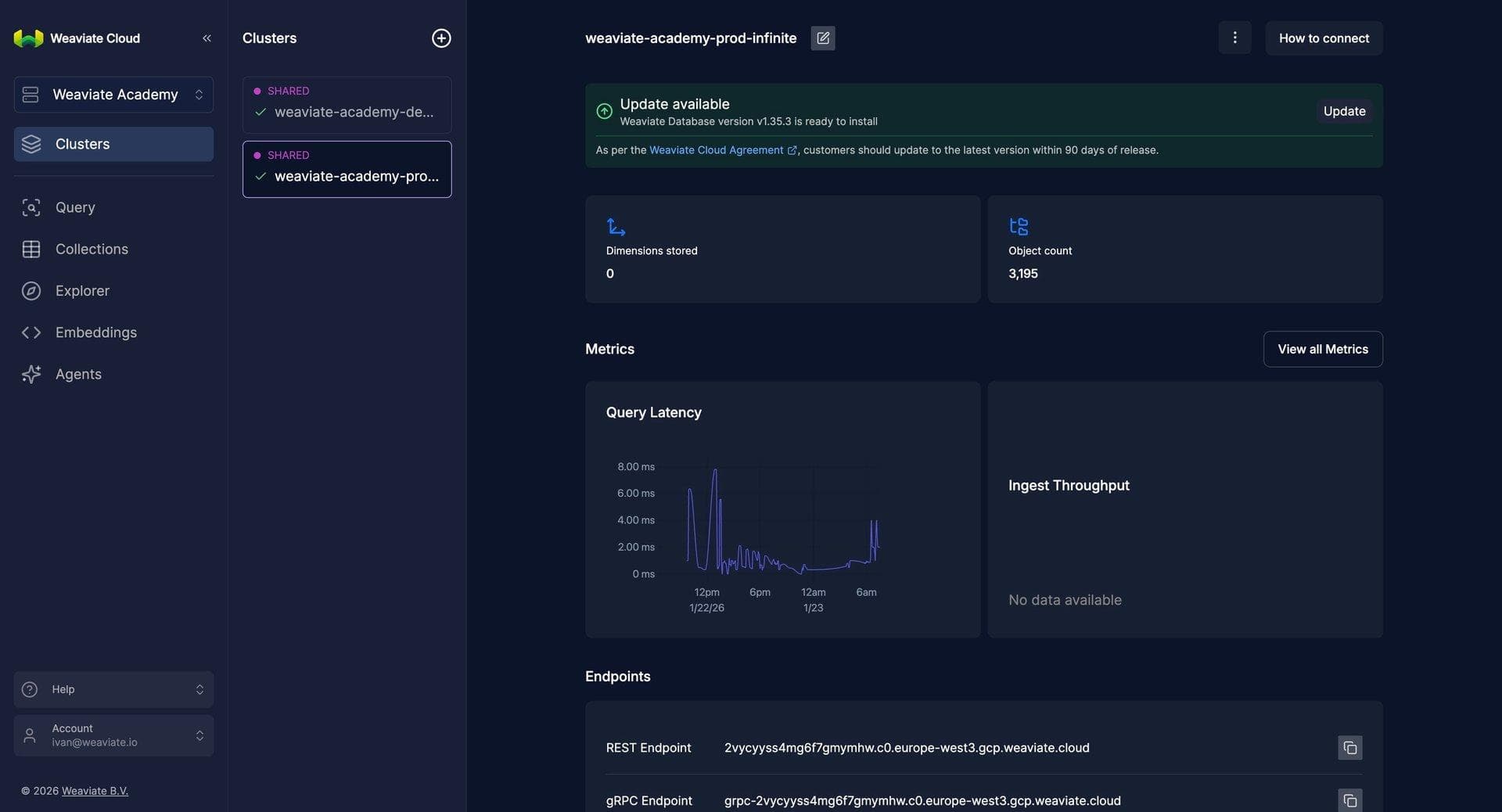
Weaviate is an open-source vector database combining semantic and lexical retrieval, available self-hosted or through Weaviate Cloud.
Its hybrid search combines vector and BM25 retrieval and lets developers control their relative weighting. Weaviate also supports metadata filtering, multiple vector spaces, reranking, and integrations with embedding and generative models.
For a simple vector-only pipeline, however, Weaviate may provide more functionality than necessary.
Best for: RAG and search applications combining vector retrieval with keyword search, filtering, and reranking.
Compared with Pinecone: More deployment choice and broad hybrid-search capabilities, with additional configuration and operational work when self-hosted.
Milvus: Vector search at serious scale
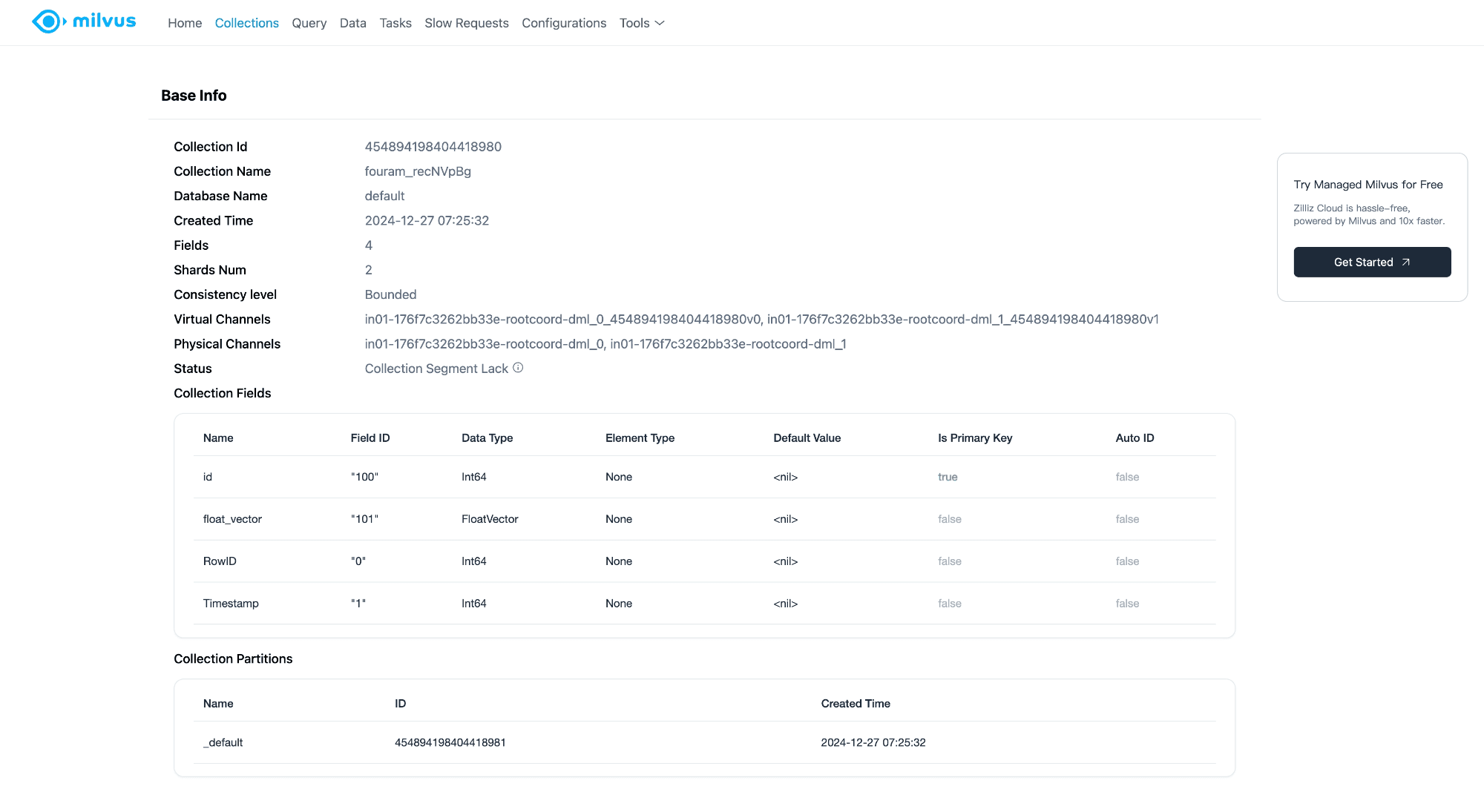
Milvus' deployment options range from Milvus Lite for local development to Milvus Standalone and Kubernetes-based Milvus Distributed, which is designed for datasets from 100 million into the tens of billions of vectors.
It supports dense and sparse vectors, metadata filtering, multi-vector hybrid search, and reranking methods including Reciprocal Rank Fusion and weighted scoring. BM25 full-text search is available in Standalone and Distributed deployments, but not currently in Milvus Lite.
Milvus Distributed separates components so they can scale independently and relies on infrastructure including a message queue/WAL, object storage, and metadata storage. That can be excessive for smaller RAG applications but useful when vector retrieval has become a substantial distributed workload.
Best for: Large or rapidly growing vector workloads that justify distributed infrastructure.
Compared with Pinecone: Greater control over scaling and deployment, but considerably more operational complexity when self-hosted.
pgvector: When you'd rather keep vector search in Postgres
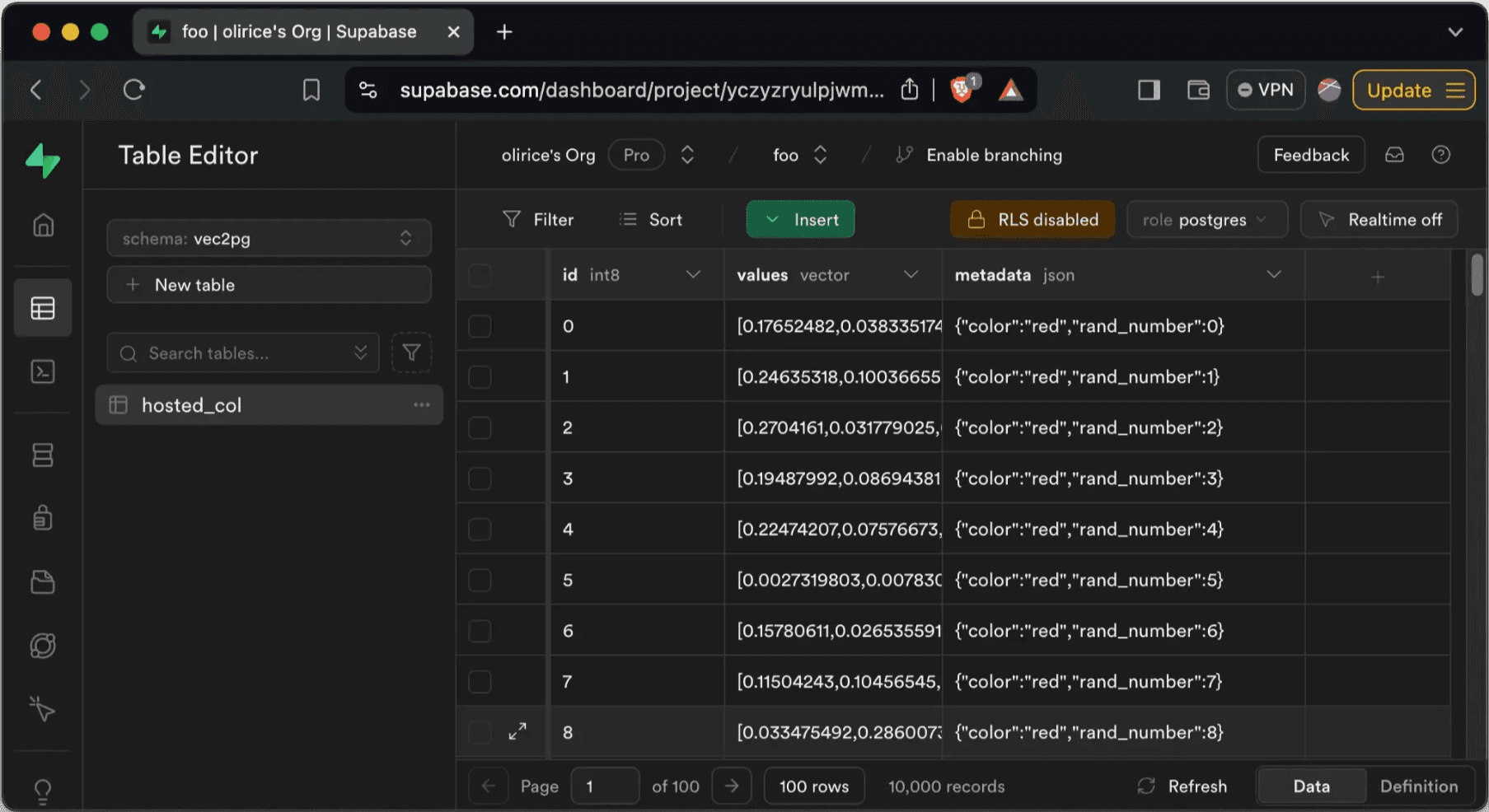
pgvector adds vector retrieval directly to PostgreSQL rather than introducing a separate database. It supports exact and approximate nearest-neighbor search, including HNSW and IVFFlat indexes, with cosine distance, inner product, Euclidean distance, and other similarity measures.
For applications already centered on Postgres, this keeps embeddings alongside relational data and makes them queryable with SQL — which can simplify synchronization while preserving the transactional and relational capabilities already used by the application.
The tradeoff is that pgvector remains PostgreSQL rather than a purpose-built distributed vector database. Index tuning, scaling, replication, query planning, and interactions between vector and conventional workloads stay within the Postgres environment.
Best for: Applications already using PostgreSQL that want vector search without another database.
Compared with Pinecone: Fewer infrastructure boundaries and tighter integration with relational data, but PostgreSQL performance and operations remain your responsibility.
Chroma: The whole gamut of retrieval
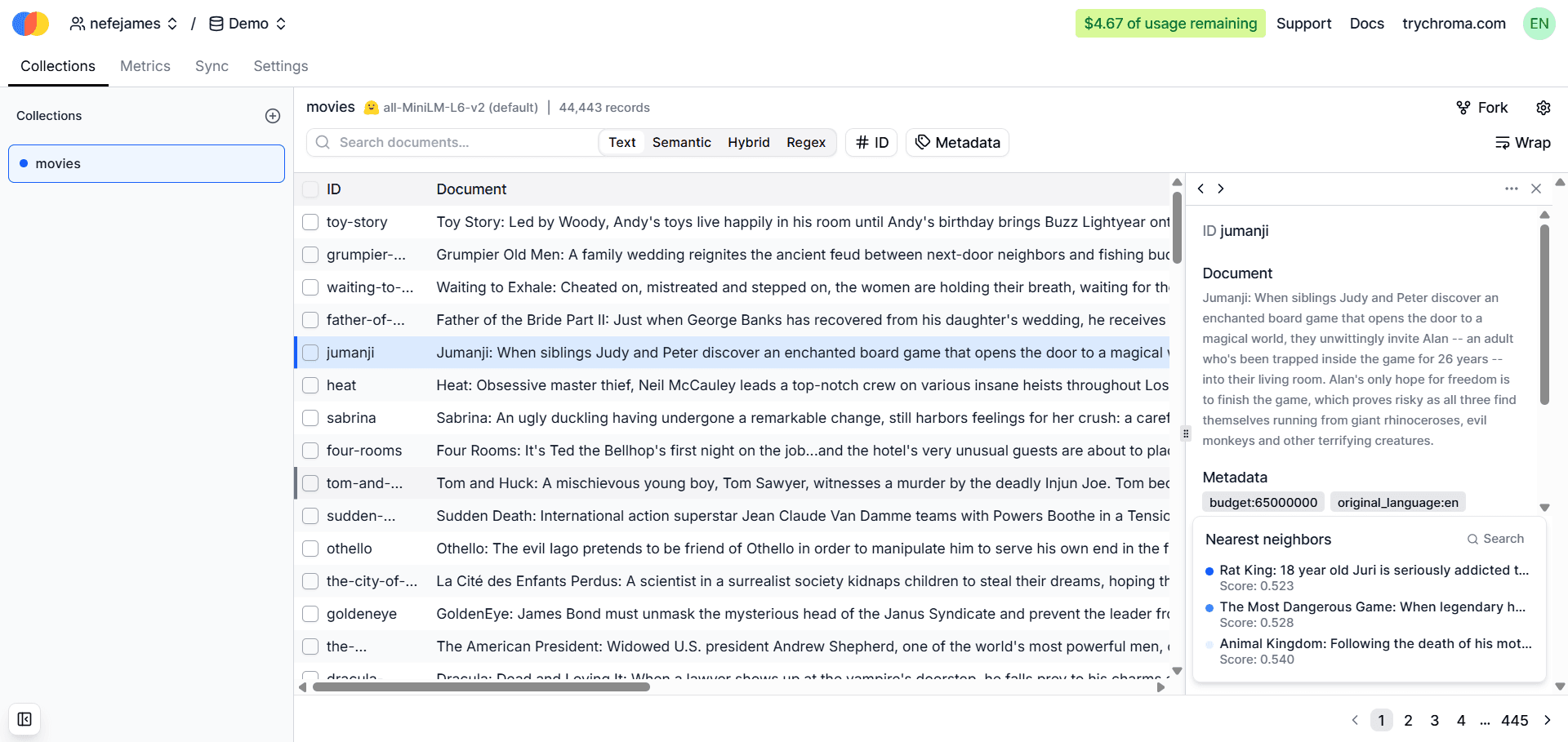
Chroma covers local, single-node, and distributed deployments behind a consistent API. It can run as an embedded library during development, as a standalone server, or through Chroma Cloud, which runs the open-source distributed architecture.
Collections store documents, embeddings, metadata, and IDs, with indexing for vector similarity, full-text search, and metadata filtering. Distributed Chroma separates its components into independently scalable services and uses object storage with SSD caching, making it suitable for larger production workloads.
Local and distributed Chroma currently use different storage subsystems, and some features and behaviors aren't yet identical across them. That makes the path from embedded development to distributed retrieval broader than Chroma's earlier prototype-focused reputation suggests, but deployment architecture still factors in when moving between the two.
Best for: Applications that want a straightforward path from local retrieval to single-node or managed distributed deployment.
Compared with Pinecone: More flexibility over where retrieval runs, including embedded and self-hosted options, but with greater architectural differences between deployment modes.
LanceDB: Embedded retrieval built around open storage
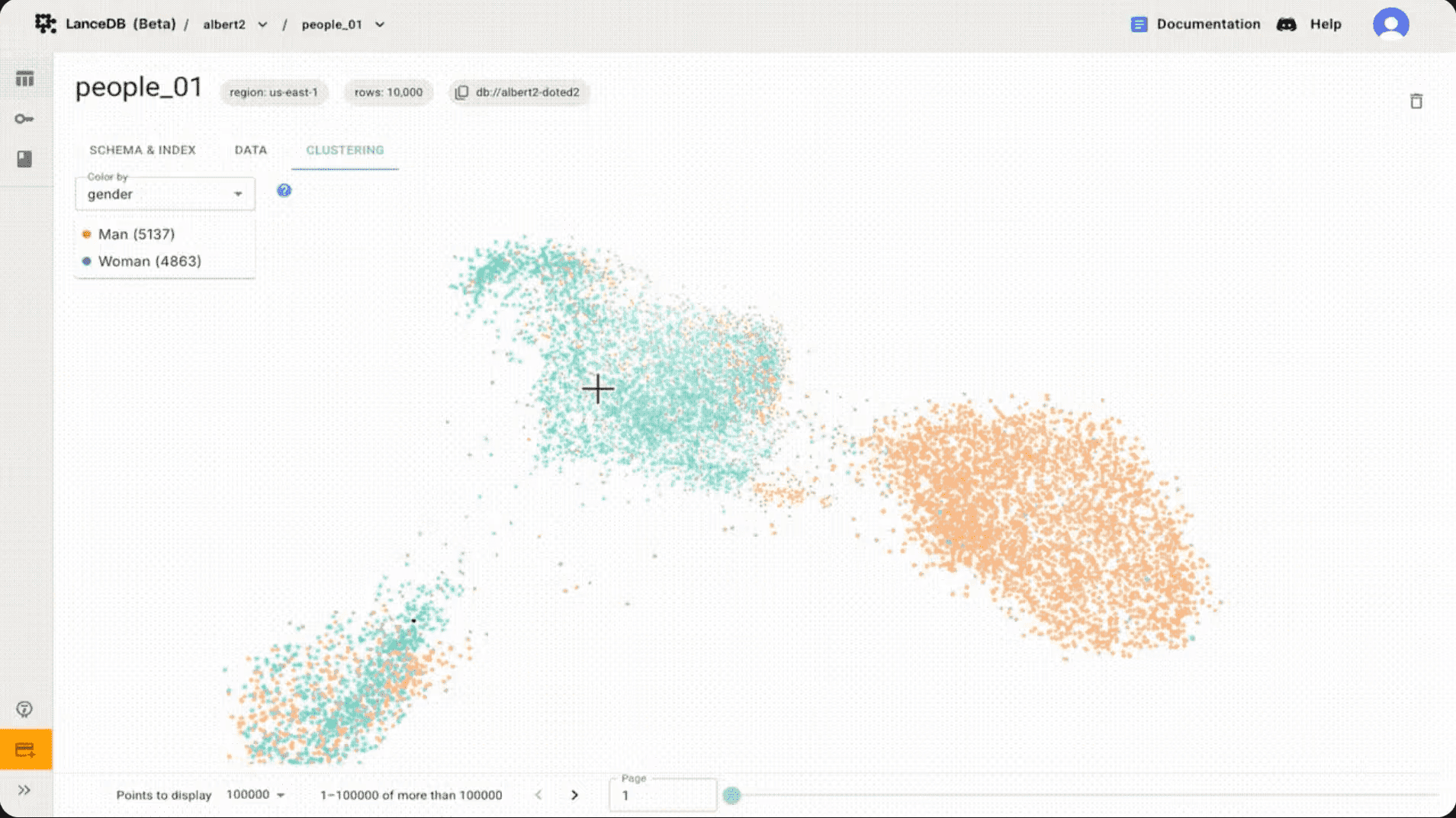
LanceDB's open-source version runs inside the application process rather than as a separate database service. It stores embeddings, metadata, and source data in Lance tables on local disk or object storage, using the open-source Lance multimodal data format.
It supports vector similarity search, metadata filtering, full-text search, hybrid retrieval, and reranking. The embedded model suits local AI, multimodal workloads, edge applications, and systems built heavily around object storage.
LanceDB Enterprise adds distributed production infrastructure, including distributed query execution and object-storage caching.
Best for: Embedded, local, multimodal, and object-storage-oriented applications.
Compared with Pinecone: Retrieval runs much closer to the application, but the open-source architecture is fundamentally different from a managed remote vector service.
Managed vs Self-Hosted: When Pinecone Is Still the Better Choice
Leaving Pinecone, choosing open source, and self-hosting sound like one decision but they're really three separate ones.
Pinecone's value goes beyond just running vector search well. Its managed architecture keeps much of the scaling, storage, maintenance, and index lifecycle behind the service boundary, and when operating retrieval infrastructure wouldn't create meaningful value for the application, paying for that abstraction can still make sense.
Stay managed when operations aren't the differentiator
Shipping production RAG or semantic search without taking on another database-operations workload usually favors managed retrieval.
But choosing an open-source database doesn't have to mean operating it yourself either. Qdrant Managed Cloud and Weaviate Cloud let you switch databases while leaving much of the operational burden with the provider.
Open source and self-hosting get treated as synonyms more often than they should, when really they solve different problems.
Self-host when control is a requirement
Self-hosting starts to make more sense once deployment topology, hardware, networking, security boundaries, or infrastructure policy need to stay under your control.
Pinecone BYOC shrinks the old data-residency divide by letting the data plane run inside your own cloud account. What full self-hosting still gets you is control over the database software itself: indexing, scaling strategy, upgrades, and how retrieval fits into the rest of the infrastructure.
Retrieval that needs active tuning, rather than a set-and-forget service behind an API, is where this actually makes a difference.
Don't self-host just to save the database bill
A cost comparison that only looks at the managed-service invoice is missing most of the picture: the compute, storage, monitoring, backups, security, upgrades, incident response, and engineering time needed to operate the replacement all count too.
Self-hosting can come out ahead for a predictable workload running on infrastructure you already operate. Bring in new monitoring, backup, security, scaling, and incident-response responsibilities to support it, though, and the savings can disappear fast.
As a reason to self-host, control holds up. But lower cost is only something that might follow from it, not something to assume going in.
Recap: Which Pinecone Alternative Fits Your Workload?
The decision gets much easier once you decide how you want to handle vector retrieval:
- Keep retrieval as a dedicated service. Qdrant is the closest fit when you want something structurally similar to Pinecone with stronger control over deployment. Weaviate has an edge when lexical and semantic retrieval need to work together extensively, while Milvus makes more sense when distributed vector scale is itself a major infrastructure requirement.
- Put retrieval inside Postgres. If PostgreSQL already carries the application's relational data, pgvector can add similarity search without creating another database boundary.
- Bring retrieval closer to the application. Chroma spans embedded, single-node, and distributed deployments, giving applications a path from local development to managed production retrieval. LanceDB takes the embedded model further, with retrieval running in-process and data stored through the Lance format on local or object storage.
Pinecone stays on the shortlist too, if changing where retrieval runs wouldn't actually solve or improve anything concrete.
The Best Pinecone Alternative Depends on What You're Replacing
Feature count doesn't decide the best replacement — removing a constraint you actually have does.
The real test is whether a different architecture improves control, cost, or stack fit enough to justify the migration and the operational model that comes with it. If Pinecone already meets the application's performance, deployment, and cost requirements, staying with it is a valid outcome.
Open source only helps if it gives you a retrieval architecture that fits the workload better.
FAQ
What's the difference between a vector store and a vector database?
There isn't a universally enforced boundary between the terms.
In practice, "vector store" is often used broadly for software that persists embeddings and retrieves them by similarity, while "vector database" usually implies more of the surrounding production machinery: indexing, filtering, replication, access controls, scaling, backups, and operational tooling.
The distinction is useful when comparing Pinecone with lighter options such as Chroma or LanceDB, which can solve retrieval without reproducing the full service model of a managed vector database.
Can you migrate from Pinecone without regenerating your embeddings?
Usually, yes. Changing vector databases doesn't require re-embedding your data as long as the replacement can store the existing vectors. Preserve the same dimensions and similarity metric if you want comparable retrieval behavior.
You can move existing embeddings from your own source store, export eligible Pinecone serverless backups to object storage, or retrieve vector values and metadata through the API. Re-embedding is only necessary if you also decide to change embedding models.
How difficult is it to migrate from Pinecone to an open-source alternative?
Migration difficulty depends less on moving the vectors than on reproducing the behavior around them, including metadata filters, namespaces, hybrid retrieval, reranking, authentication, and query logic.
A move to another dedicated vector database such as Qdrant or Weaviate can preserve more of the existing architecture, while pgvector or embedded systems like LanceDB usually require broader application and infrastructure changes.
What should you benchmark before switching vector databases?
Benchmark the replacement against your own workload, including retrieval quality, p50 and p95 latency, filtering performance, ingestion speed, concurrency, storage use, and total operating cost.
For RAG, also test the quality of the downstream answers. The best replacement is the one that performs well on your data and query patterns, not the one that wins a generic benchmark.