What Is RAG? Retrieval-Augmented Generation Explained

Retrieval-augmented generation — RAG — is a technique that gives a large language model access to external knowledge at query time. Instead of answering only from what it learned during training, the model first retrieves relevant documents from an outside data source, then uses that retrieved context to generate an answer.
The concept of RAG was introduced in a 2020 paper from Facebook AI Research, which described the pairing of a pretrained generative model with a retriever that fetched passages from Wikipedia. The idea has aged well: instead of trying to pack every fact into model weights, keep knowledge in an external store and retrieve it when needed.
So, the meaning of RAG is simple: retrieval brings in the evidence, generation turns it into a response.
The model itself can stay general-purpose while the retrieval layer gives it current, private, or domain-specific context. That's why RAG became an appealing choice for production systems that need their LLMs to answer from evolving information without having to retrain the model every time the data changes.
How RAG Works
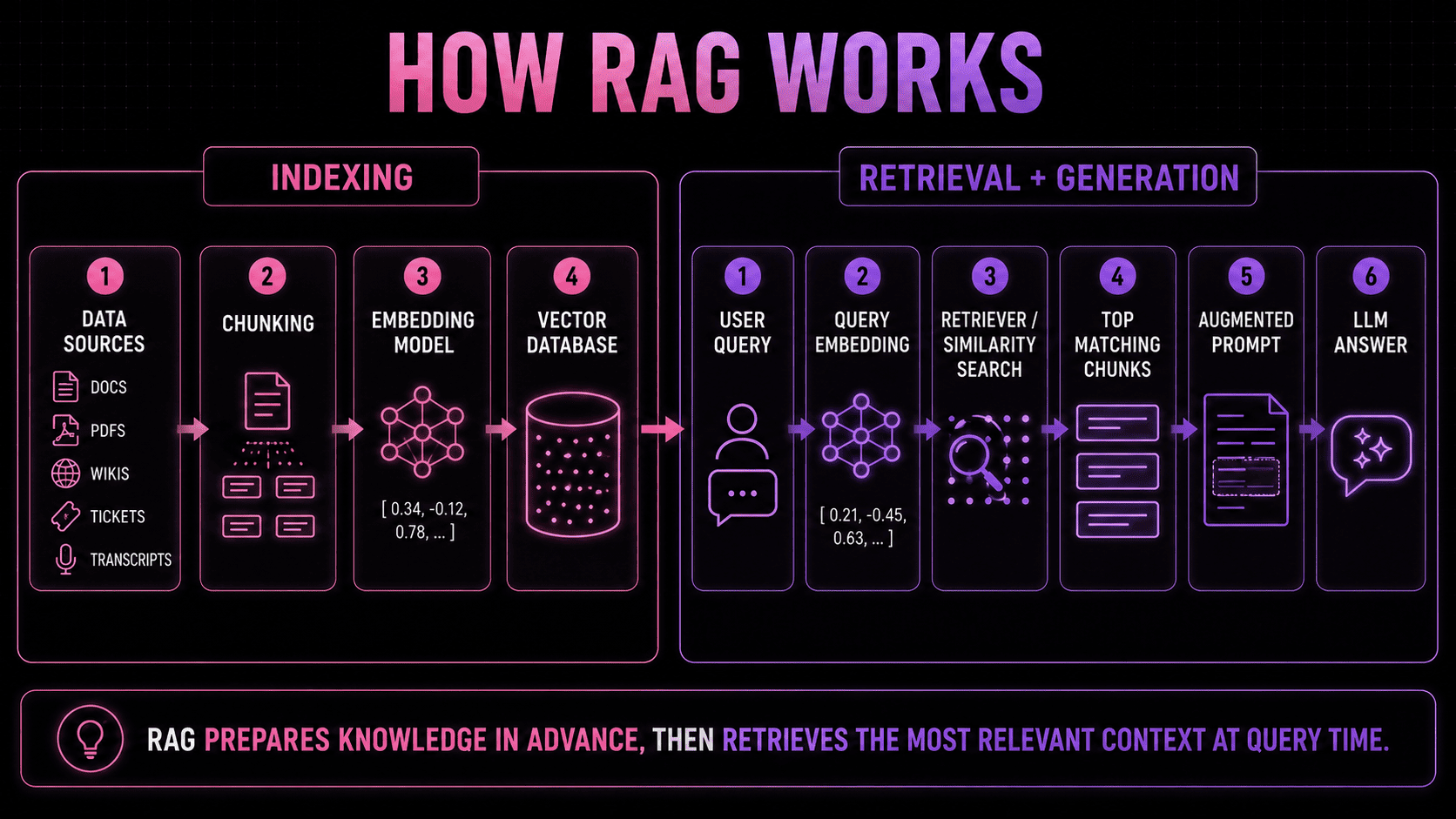
RAG runs in two phases: an indexing phase that prepares your data, and a retrieval-and-generation phase that runs at query time.
Indexing
Indexing is where the knowledge the model will later retrieve gets prepared. The process starts by collecting the data sources the system should be able to use — like help articles, PDFs, internal wikis, product documentation, transcripts, database records, support tickets, research papers, or any other relevant data that should inform the answers.
The system then chunks that text into smaller passages so that retrieval can return precise, relevant data rather than forcing the model to read entire files — we cover the impact of different chunking strategies on retrieval quality in our post on Advanced Chunking Techniques.
An embedding model then converts each chunk into a vector — a list of numbers that captures semantic meaning — and those vectors get stored in a vector database, which allows the system to search by meaning.
Retrieval and generation
When a user asks a question, the same embedding model converts the query into a vector, and the retriever searches the vector database for the closest matching chunks. This is information retrieval by semantic similarity: the system finds passages that are about the question even when they don't share its exact wording, which is what makes it more useful than traditional keyword search.
The retrieved chunks are added to the user's question to build an augmented prompt. The LLM then generates an answer from it, ideally citing or referencing the source material it used. The model supplies the language; retrieval supplies the evidence.
What RAG Solves for LLMs
A model can only answer from the information available to it at generation time. If the relevant fact wasn't in the training data, was changed after the training cutoff, or lives in a private system, the model has no reliable way to know it, so it may refuse, answer vaguely, or produce a fluent answer that sounds correct but isn't grounded in anything real — an LLM hallucination.
RAG directly addresses three of the most common failure modes:
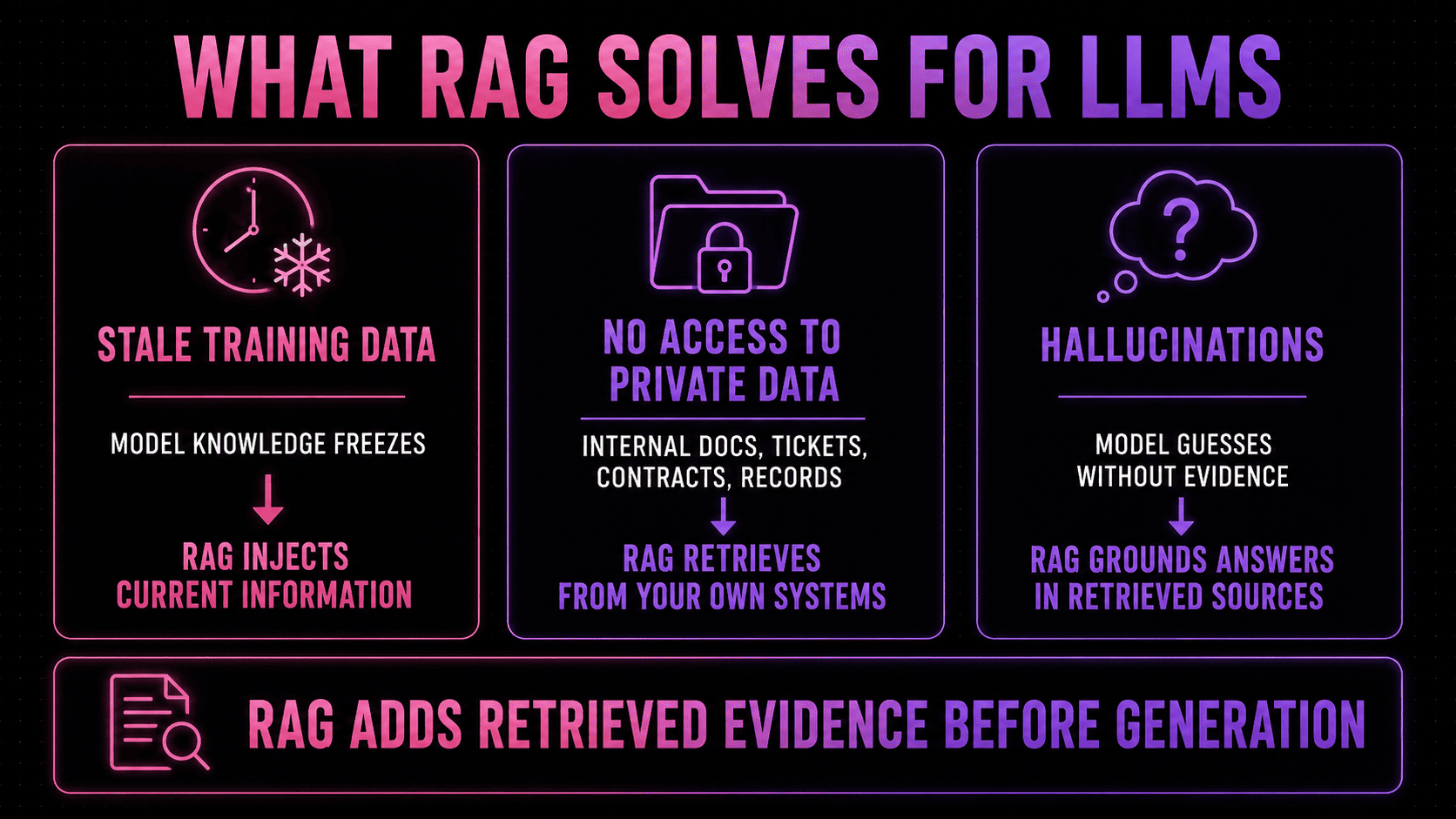
- Stale training data. A model's knowledge freezes at a point in time. RAG can inject current or near-real-time information at query time, so answers can reflect new policies, product changes, bug fixes, releases, or records that postdate the training cutoff.
- No access to private data. Contracts, tickets, internal docs, and customer records were never in the public training set. RAG lets the model answer from that external knowledge while the data stays in your own systems, without fine-tuning or retraining on sensitive material.
- Hallucinations. When an LLM doesn't have enough evidence, it may produce a plausible answer anyway. Grounding responses in retrieved documents makes the output easier to verify and reduces the chance the model drifts away from what the source actually says.
RAG is often compared with prompt engineering and fine-tuning, so the differences are worth being precise about:
| Approach | What it changes | Best for | Cost to update |
|---|---|---|---|
| Prompt engineering | The instruction or format given to the model | Behavior, tone, format, small fixed context | Low |
| Fine-tuning | The model weights through machine learning on examples | Style, narrow task behavior, repeated patterns | Higher, because updates require retraining |
| RAG | The information available at query time | Answering from large, changing, or private knowledge bases | Lower, because you update the data, not the model |
A useful rule of thumb: use fine-tuning to change how a model behaves; use RAG to change what it can reference.
Production Use Cases for RAG
RAG is useful whenever an answer needs to reflect a specific body of knowledge rather than the model's generic training. Here are some of the most common production applications:
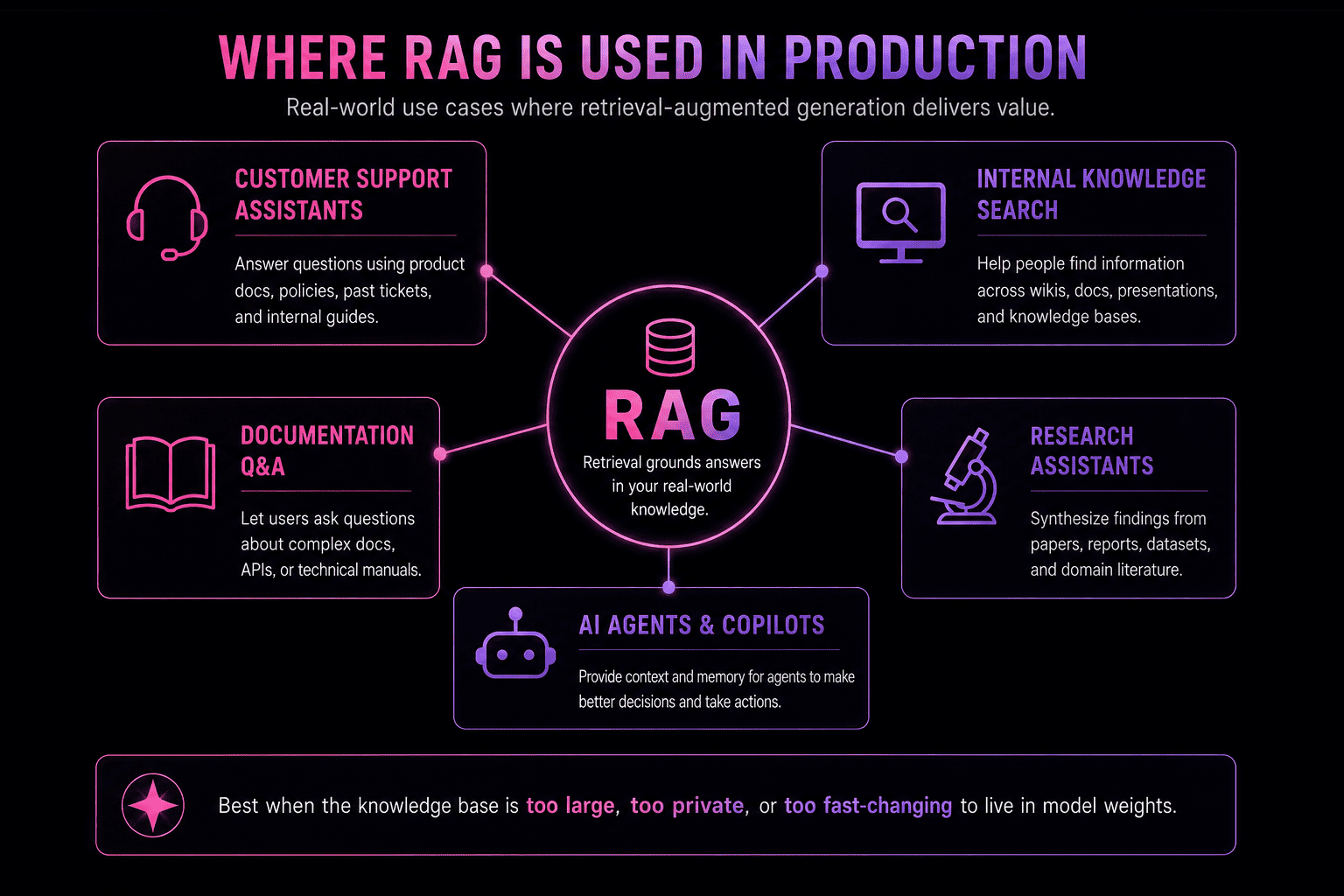
- Customer support assistants are among the most common deployments — pulling answers from help centers, product docs, and ticket histories rather than guessing from training data.
- Internal knowledge search is another: wikis, policy libraries, HR documents, engineering runbooks, and so on — knowledge that's too specific, too sensitive, or too frequently updated to live in a model's weights.
- Documentation Q&A for developer products — for technical queries that need a precise answer from the current docs, not a paraphrase of something similar.
- Research assistants that retrieve from papers, filings, or transcripts, including verticals like healthcare, legal, finance, and compliance where the answer has to be traceable to an approved source rather than inferred from general LLM knowledge.
- AI agents and copilots that operate across many steps need the system to be able to retrieve the right source, keep that source current, and decide whether the retrieved context actually answers the question before the model generates anything.
The common thread across all of these: the knowledge base is too large, too private, or too fast-changing to bake into the model itself.
RAG in an LLM: A Quick Example
Suppose a SaaS company builds a support bot and a customer asks: "Does the Pro plan include SSO, and when was that added?"
Without RAG, a generic LLM doesn't know what the Pro plan means for this specific company.
With RAG, however, the retriever searches the company's help articles, setup docs, and changelog, and returns the Pro plan feature list, the SSO setup guide, and a changelog entry from March 2026. Those chunks go into the augmented prompt alongside the question, and the model answers:
"Yes, SSO is included on the Pro plan. It was added in the March 2026 release."
That answer is current, specific to the company, and traceable to a real source.
The Limits of Chunk Retrieval
Standard RAG retrieves chunks ranked by semantic similarity. That approach starts to hit a ceiling when the answer requires connecting information across sources, tracking how something changed over time, or understanding that two mentions of the same entity are actually about the same thing.
For example: "Which customers hit the same bug we resolved last quarter, and what was the fix?"
A basic RAG system will retrieve chunks that mention the bug, the fix, and some customer tickets. What it won't return is the relationship between those things — which customers had the same issue, whether those bugs were actually identical or just similar, which fix applied to which case, and whether the records it found are still current. The model receives a pile of relevant-looking passages and has to stitch the answer together itself, which is where subtle errors start seeping in.
You could improve the embeddings, tune the chunking, or add reranking, but this is a structural problem — the issue isn't finding the right chunks, it's that chunks don't carry relationship information.
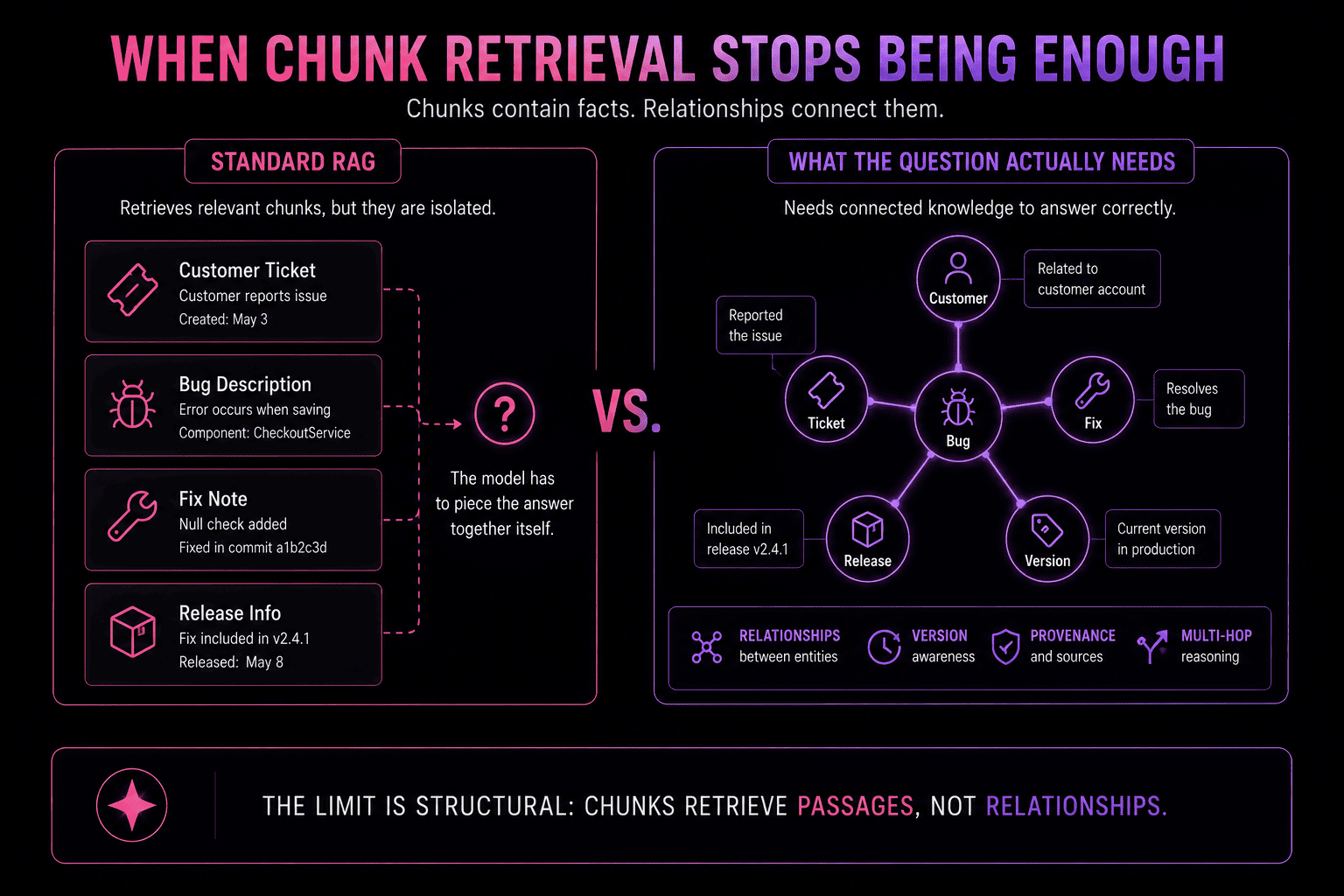
The specific failure modes of this architecture are predictable:
- Entity relationships get lost when chunks are retrieved independently
- Duplicate or conflicting facts surface without any reconciliation
- Older and newer versions of the same information appear equal
- Multi-hop questions — where the answer requires following a chain of connections — fall apart at each hop.
GraphRAG and structured memory make retrieval more meaningful by extracting entities and their relationships during data ingestion, then returning connected knowledge rather than disconnected passages.
RAG With cognee
RAG is undoubtedly an evolution of how LLM apps use external knowledge, but chunks just aren't the right unit for an answer that depends on relationships.
That's what we've designed cognee to help with: our open-source memory engine turns data sources into a queryable knowledge graph backed by both graph storage and vector search.
Instead of returning only the chunks closest to the query vector, cognee can connect entities across sources, reconcile duplicate facts, preserve provenance, and retrieve context that reflects how the knowledge fits together rather than just what's nearby in embedding space.
It runs the full pipeline (entity and relationship extraction, duplicate reconciliation, loading into a hybrid store) behind a small API:
The result is RAG that holds up on questions standard chunk retrieval struggles with — the kind that require knowing how facts connect, not just which paragraph mentions them.
FAQ
What is RAG in AI?
RAG stands for retrieval-augmented generation. A retrieval system finds relevant data from an external source, then a large language model uses that retrieved context to generate an answer. The model handles language; retrieval handles evidence.
What is retrieval-augmented generation used for?
Anywhere an AI system needs to answer from private, current, or domain-specific knowledge — customer support bots, internal search, documentation assistants, research tools, compliance workflows, and AI agents that need reliable context before they act.
What is the difference between RAG and fine-tuning?
Fine-tuning changes the model's weights by training it on examples. RAG leaves the model unchanged and supplies relevant data at query time. Fine-tuning is useful for behavior and style; RAG is generally the better choice for knowledge that's large, changing, or private.
Does RAG eliminate hallucinations?
No. RAG reduces hallucinations by grounding answers in retrieved documents, but retrieval can return the wrong source, miss the relevant passage entirely, or provide context the model misreads. That's why RAG systems still need evaluation, source checks, and hallucination detection alongside the grounding.
Is RAG just a vector database?
No — a vector database is one component of many RAG systems, not the system itself. RAG is the full architecture: preparing data sources, chunking content, embedding text, retrieving relevant documents, building an augmented prompt, and generating the answer. The vector database handles the search step; everything around it is also RAG.
What is the difference between RAG and GraphRAG?
Standard RAG retrieves text chunks by semantic similarity. GraphRAG adds entities and relationships extracted during ingestion, so retrieval can follow connections across sources rather than returning independent passages. The difference matters most for questions that require multi-hop reasoning, provenance tracking, or understanding how facts relate to each other rather than which paragraph mentions them.
When does RAG stop being enough?
When the answer depends on how facts connect rather than where they appear. If a question requires following a chain of relationships across documents, reconciling conflicting versions of the same fact, or tracking how something changed over time, standard chunk retrieval will struggle regardless of how well it's tuned. That's the ceiling GraphRAG and structured memory are built to raise.