LLM Hallucination Solution: How to Reduce Wrong AI Answers in Production

While it's not possible to switch off LLM hallucinations completely, it's feasible to reduce them enough that they stop being a production risk. Put simply, the most effective LLM hallucination solution is grounding, or making the model answer from retrieved, verifiable knowledge instead of relying on what it learned during training.
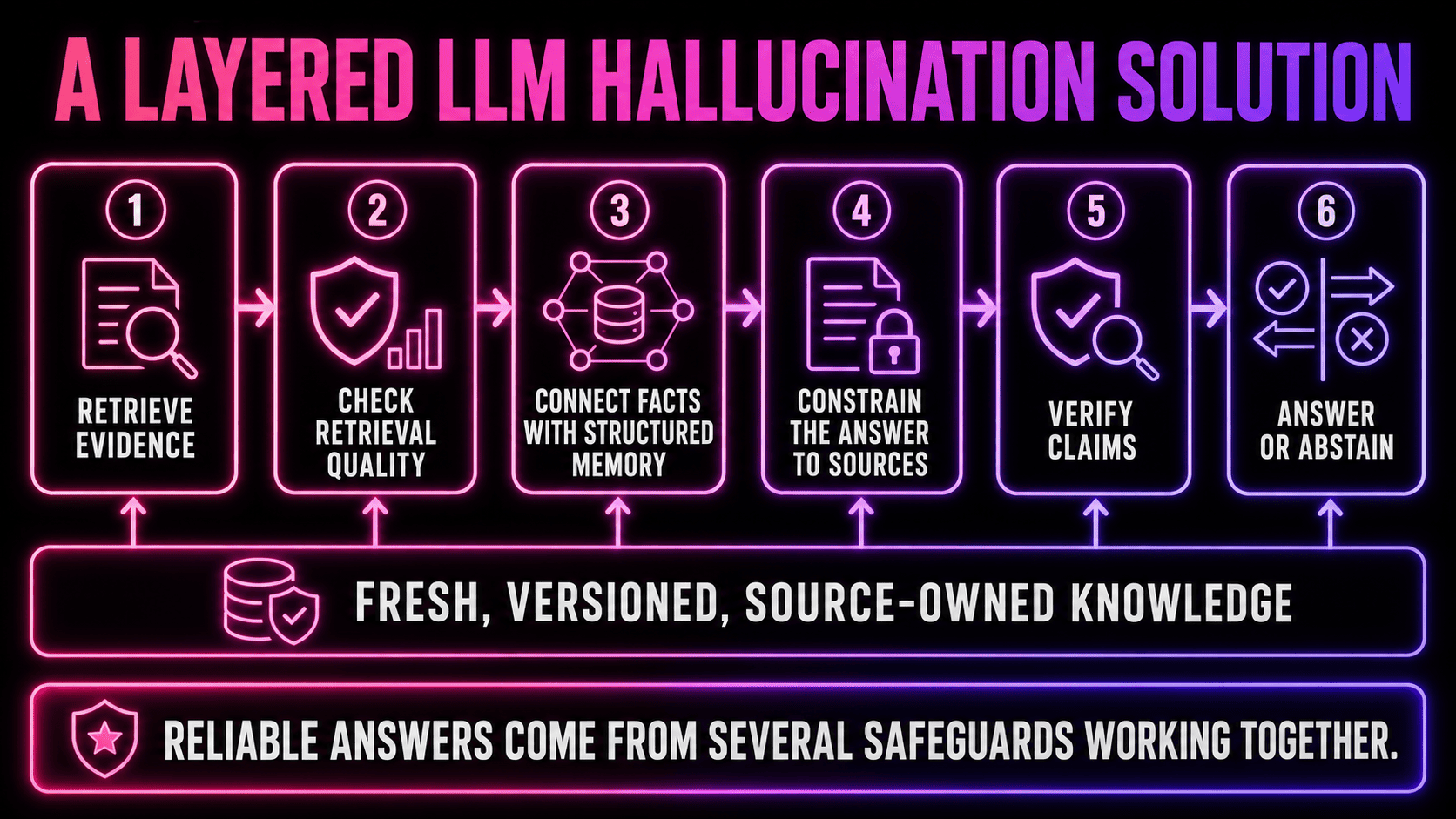
That's just the starting point, though. Even strong machine learning models need a system built around them: better retrieval, cleaner source data, structured memory, guardrails, abstention, monitoring, and evaluation, working together rather than any single one carrying the load.
Unsupported answers need to be made less likely before generation, then risky LLM outputs that do manage to slip through need to be caught before they reach a user or trigger an action.
To brush up on the basics, head to our guide on LLM hallucinations and their detection. Here's the other half: what actually reduces hallucinations in LLM systems, how the fixes layer on top of each other, and where structured AI memory fits in.
Why LLMs Hallucinate in the First Place
LLMs generate likely continuations of text, which works out great when the model has enough context and the task is straightforward, but turns into a guess fest when the answer depends on private data, recent facts, domain-specific documents, long-term context, or relationships the model can't infer from the prompt alone.
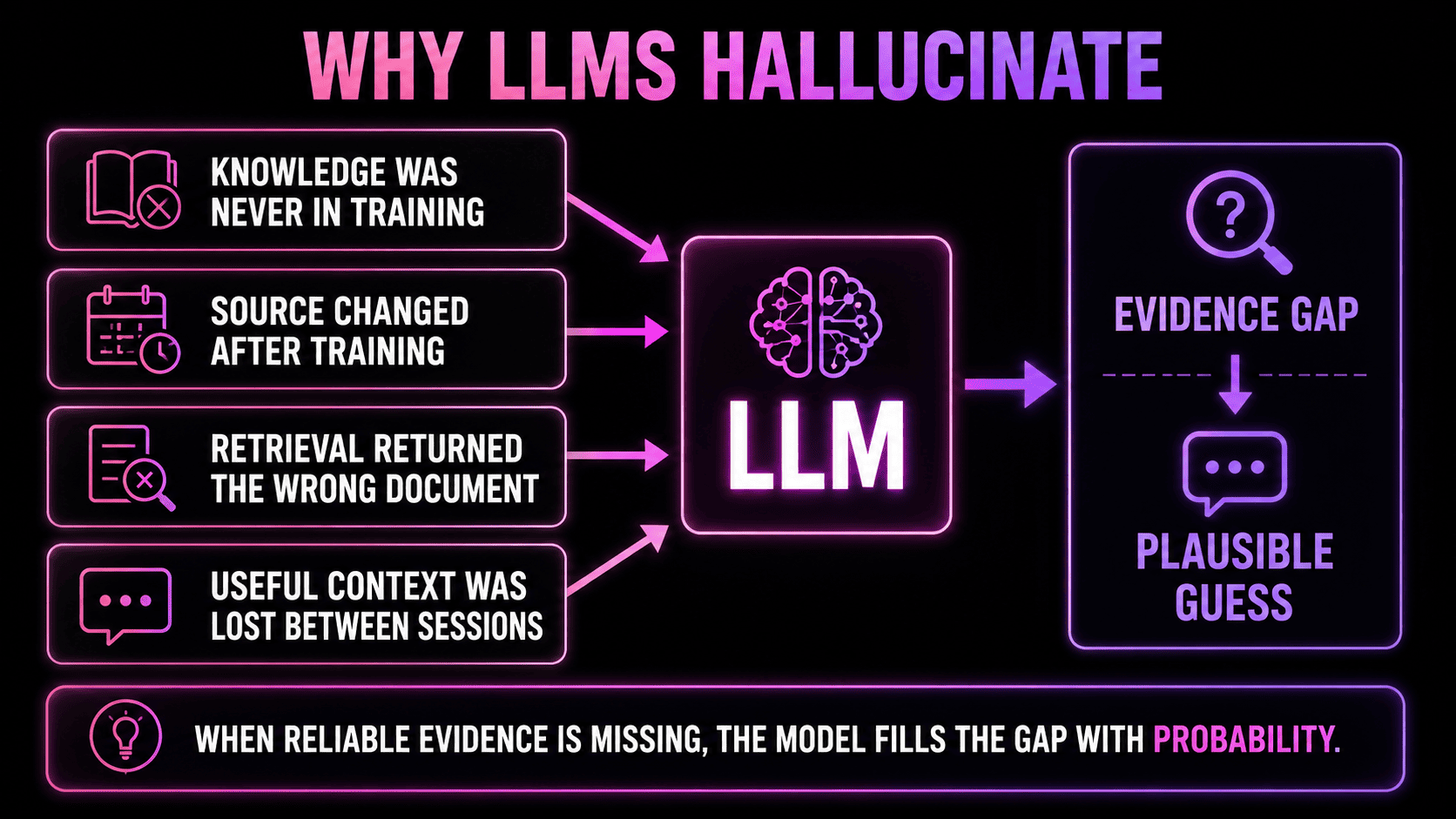
Most hallucinations trace back to the same root: the model is being asked to answer the question without enough reliable evidence. The relevant fact may never have been in the training data, the source may have changed since the model was trained, retrieval may have brought back the wrong document, or the prompt may have left too much room for the model to fill in gaps on its own.
In long-running agent workflows, it can also happen because useful context never became persistent memory, so once the current context window runs out, the system starts assuming.
Solid prompting helps, but the deeper fix is context engineering: retrieved sources, structured facts, provenance, and a way to verify what the model produces against something real.
How to Fix LLM Hallucinations
The best way to reduce hallucinations is to stop treating the model as the ultimate source of truth — the evidence behind the answer needs to be inspectable.
Ground answers in retrieved data
The highest-impact starting point is RAG and graph-aware retrieval: retrieve relevant documents for the question, put them into the prompt, and have the model answer from those sources rather than from memory.
When the model has the right source in context, it has something concrete to work from. When the retrieved context doesn't answer the question, the system should say that instead of forcing a fluent guess.
A grounding prompt that actually works tells the model to answer only from the provided sources, asks it to cite or reference what it used, and gives it explicit permission to say the context is missing or insufficient. Grounding doesn't make hallucinations impossible, but it makes the answer easier to verify and gives downstream detection something concrete to check against.
Improve retrieval quality
RAG only helps when retrieval brings back the right facts. Weak retrieval produces answers that look grounded but rest on the wrong context entirely, which is arguably worse than no grounding, since the answer now looks more trustworthy than it is.
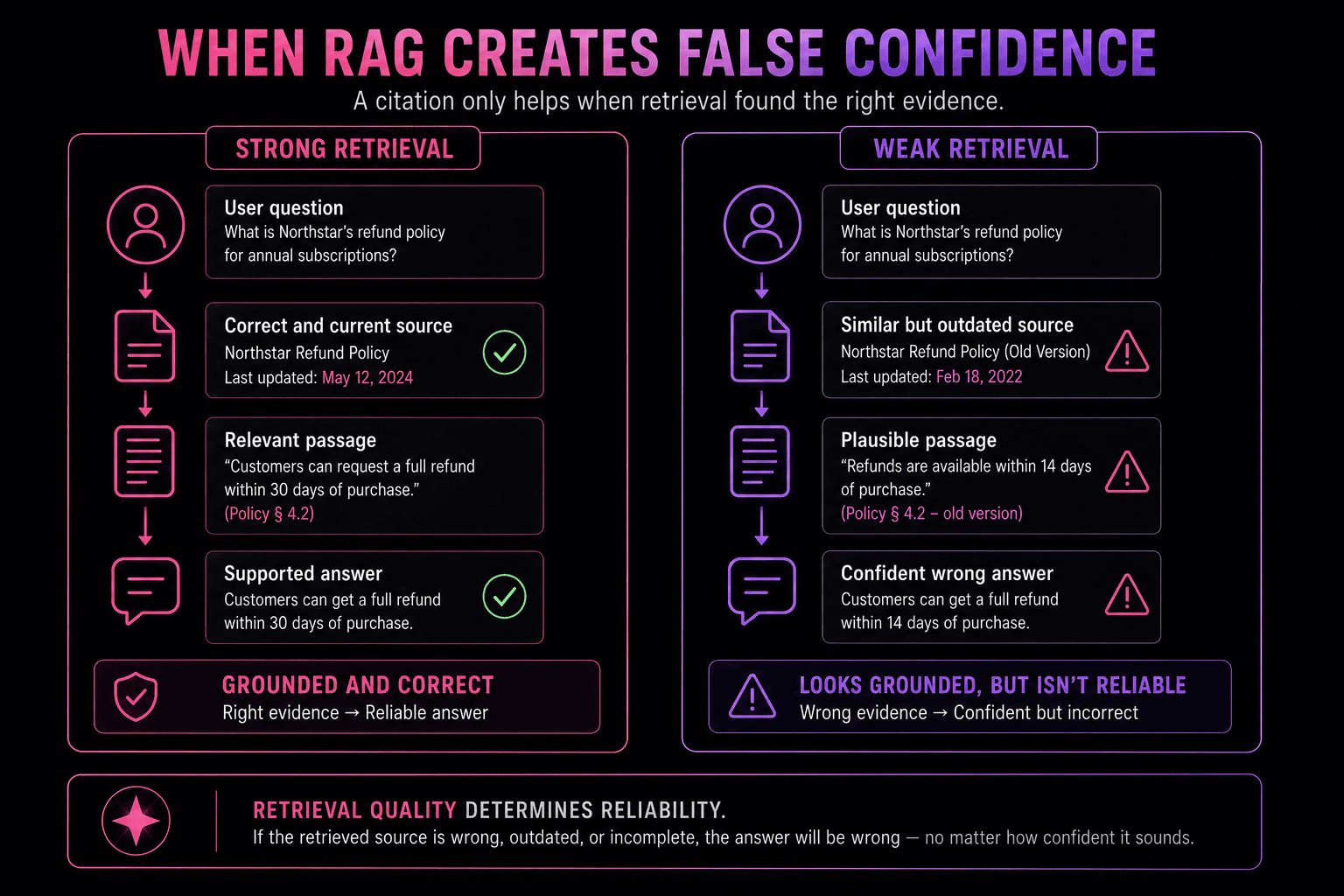
Chunking, embeddings, metadata, filters, reranking, and vector database choice all affect this. A good retrieval system brings back passages that are relevant, current, and appropriate for the question, while avoiding the trap of flooding the model with loosely related text that makes the answer harder to control.
If the system retrieves nothing useful, the safest response is an abstention. If it retrieves contradictory sources, the answer should reflect that uncertainty rather than smoothing over the conflict.
Our guide to choosing the best vector database for search, RAG, and AI memory goes deeper into database selection and retrieval architecture.
Use structured memory
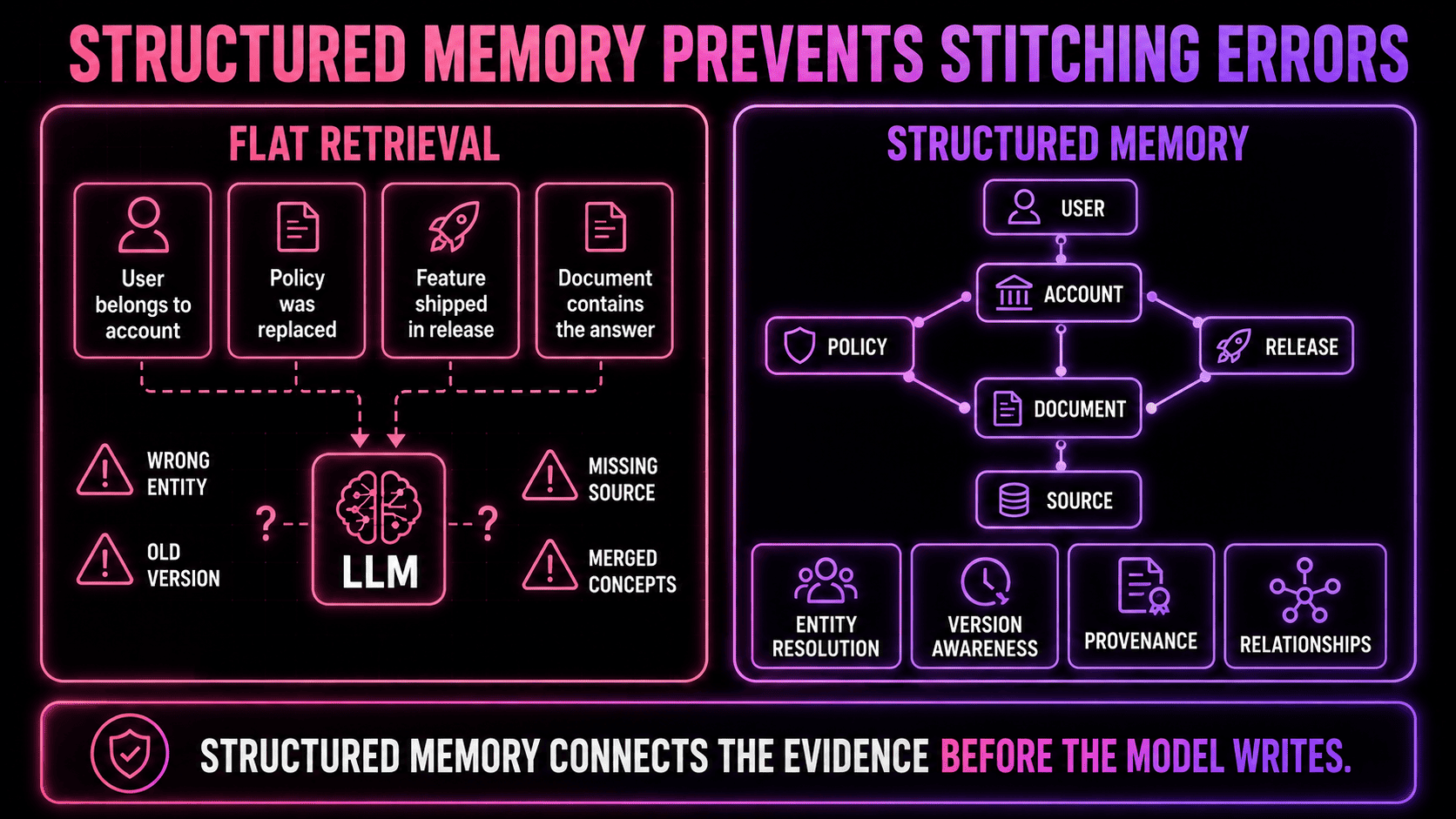
Flat chunk retrieval works well when the answer can be found in one clear passage but not when it depends on relationships — like, which user belongs to which account, which policy replaced an older one, which feature shipped in which release, which document is the current source of truth.
Structured memory (a knowledge graph, for example) stores entities, relationships, source links, and metadata in a form the system can retrieve precisely, rather than approximately. It connects the relevant facts before the model ever writes the response, and ontologies keep entities consistent, reduce duplication, and make extracted facts easier to validate.
Most wrong answers are actually the result of small stitching errors, not some wild fantasies. The model connects the wrong entity, pulls from an outdated source, or merges two similar concepts into one answer that sounds confident and is quietly off. That's what structured memory is built to catch.
Tighten the prompt around sources and abstention
Proper prompting can't fix missing knowledge, but it can reduce avoidable errors. The prompt should specify to the model to: answer only from the provided context, not add unsupported facts, cite the relevant source when possible, and say when the evidence is missing.
For logic and calculation tasks, asking the model to work through its reasoning carefully can reduce careless mistakes, though the final result still needs checking for optimal accuracy.
Normalizing abstention is very important — "I don't have enough information to answer that" is safer than always trying to be helpful.
Add verification before the answer reaches a user
A verification layer is there to inspect whether:
- the cited source actually exists
- each claim is supported by the retrieved context
- structured output matches its schema
- answer conflicts with a trusted knowledge base.
In higher-risk workflows, unsupported answers should be routed to review instead of shown directly.
So, grounding lowers the rate of bad answers reaching this stage and detection catches the ones that still get through — yin and yang of hallucination reduction.
Keep the knowledge fresh
If product docs, policies, tickets, pricing, or internal records change, retrieval has to reflect that quickly. Stale sources are dangerous exactly because the model isn't inventing anything but answering correctly from evidence fed to it, that has since became outdated.
Fresh ingestion, versioning, timestamps, and clear source ownership are what prevent AI knowledge base failures from creeping in.
Fixing Hallucinations Is an Ongoing Process
Prompts change, models get swapped, data drifts, and users ask the same question in different ways — what worked at launch can become a problem a user encounters before anyone else catches it. That's why hallucination prevention can't be a one-time setup but must be a feedback loop instead. Here's how to build it out:
- Start with an eval set: known questions, expected source behavior, and examples of the failure modes relevant to your use case. Use it to measure faithfulness and factual accuracy whenever the model, prompt, retrieval settings, chunking strategy, or memory pipeline changes.
- Monitor production behavior. Track unsupported answers, user corrections, failed groundedness checks, retrieval misses, and low-confidence outputs. These tell you whether the system is actually improving or just moving the hallucination problem somewhere quieter.
- Feed corrections back into retrieval and memory. A static index can only return what it already stores, which means the same failure repeats indefinitely unless something changes upstream. Long-term memory for AI lets the system preserve corrections, update relationships, and improve future retrieval instead of answering the same question wrong every time it comes up.
Better Evidence, Not a Better Guess
Every fix covered in this guide is really solving the same problem from a different angle: at some point in the pipeline, the model had to answer without enough reliable evidence, and something allowed that to happen. Better retrieval, structured memory, tighter prompts, and verification layers all exist because the model's starting position was too weak.
The most durable solution isn't constraining the model more aggressively on the way out, but giving it better material to work from on the way in. Knowledge that's structured rather than scattered, traceable rather than anonymous, and connected rather than siloed — so retrieval returns the right fact and the system can actually explain why it did.
That's what we built cognee to solve. cognee turns files of many formats into persistent AI memory: entities and their relationships get organized into a knowledge graph, embedded as vectors, and tied to their sources, so the model isn't stitching an answer together from whatever chunk happened to score highest in cosine similarity.
As a result, the retrieval becomes more precise, with traceable context, and the small errors that cause most production hallucinations have a much harder time slipping through.
FAQ
What is the best LLM hallucination solution for production systems?
Grounding is the highest-leverage starting point — retrieve relevant, verifiable facts and make the model answer from those sources rather than from memory. In practice, grounding works best when retrieval quality is strong, the knowledge is structured, and there's a verification layer catching what still slips through. No single fix handles the whole problem; the most reliable production setups layer several of these together.
Can LLM hallucinations be eliminated completely?
No. Large language models generate text from learned patterns, so some rate of hallucination is unavoidable in open-ended settings. The realistic goal is reducing that rate enough for the use case — grounding the answer, verifying LLM outputs before they reach users, and routing weak or unsupported answers away from automated actions.
Does RAG stop hallucinations?
It reduces them significantly, but retrieval quality determines how much. If RAG brings back the wrong context, stale context, or contradictory sources, the model can still produce an unsupported answer that looks grounded. RAG is most effective when paired with structured knowledge, strong filtering, and a groundedness check on the way out.
What is the difference between fixing and preventing hallucinations?
Fixing usually means addressing a specific failure path — grounding, prompting, verification, or abstention on a particular question type. Prevention is the ongoing system around those fixes: eval sets that run continuously, monitoring that surfaces new failure modes, and fresh knowledge that keeps retrieval from drifting. Both are necessary because a fix that works today can quietly stop working when prompts, models, or source material change.
How do you know whether your hallucination fix is actually working?
Build a labeled evaluation set and run it on a consistent schedule, not just at launch. Track whether answers are supported by their sources, whether retrieval is returning the right evidence, and whether unsupported LLM outputs are being caught before users act on them. A system that sounds better isn't the same as one that measures better — fluent wrong answers pass informal checks every time.
When should abstention be preferred over a generated answer?
Whenever the retrieved context doesn't actually answer the question. A model that always tries to be helpful will fill that gap with something plausible, which is exactly how confident wrong answers get generated. Building abstention into the prompt — giving the model explicit permission to say the evidence isn't there — is one of the simplest and most underused parts of hallucination prevention.