What Is GraphRAG? Retrieval-Augmented Generation with Knowledge Graphs Explained

Retrieval-augmented generation made LLMs much more useful in production because it gave them the ability to answer from external sources rather than just their training corpus. But standard RAG retrieves semantically similar parts of a text, which isn't enough in cases where the answer depends on how several pieces of information scattered across different documents connect.
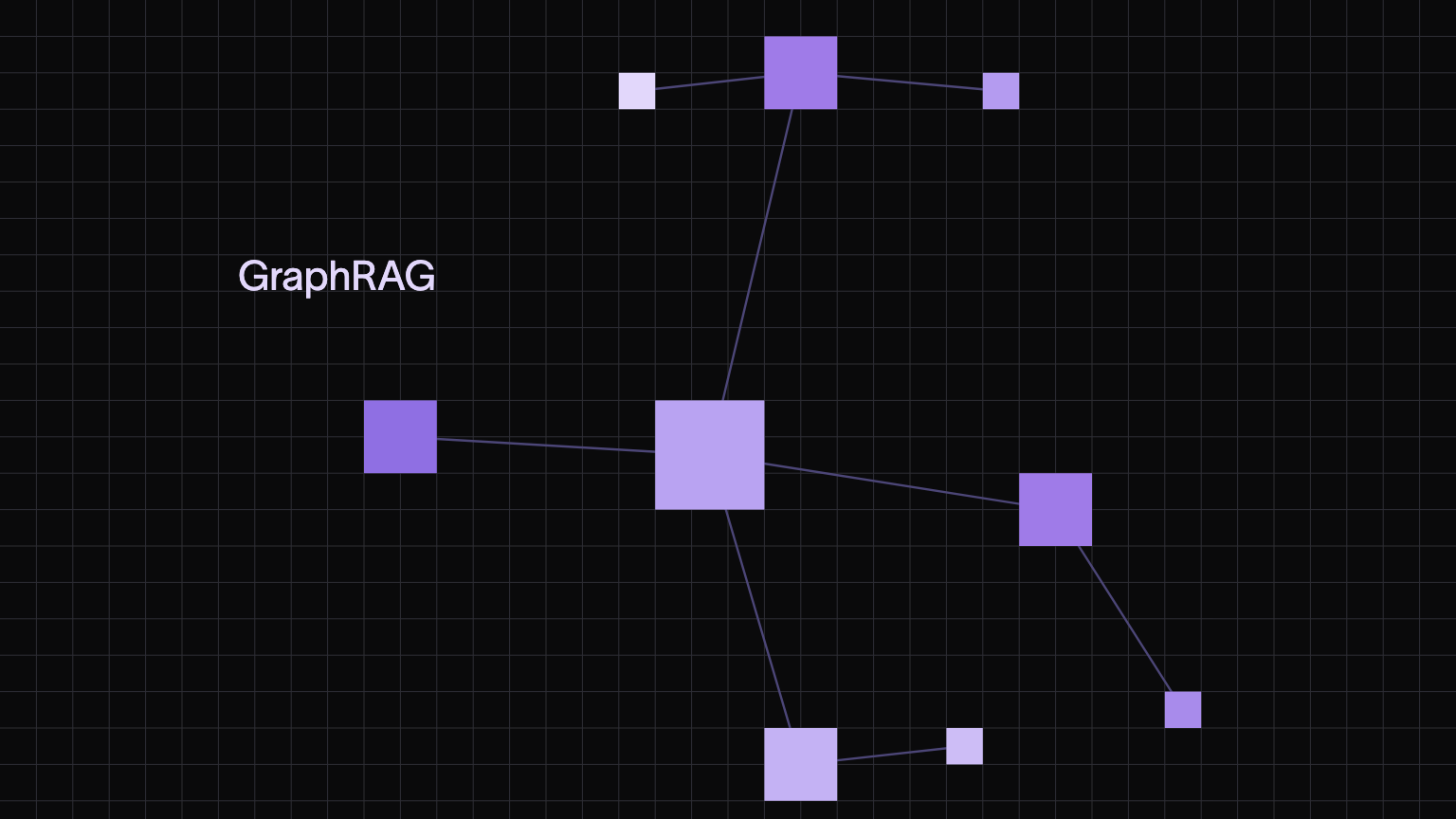
GraphRAG is one way to extend that retrieval architecture. It adds a knowledge graph to the RAG pipeline, so the system can follow the connections across the knowledge base rather than retrieving isolated passages.
In a nutshell: standard RAG retrieves text chunks, GraphRAG retrieves connected knowledge.
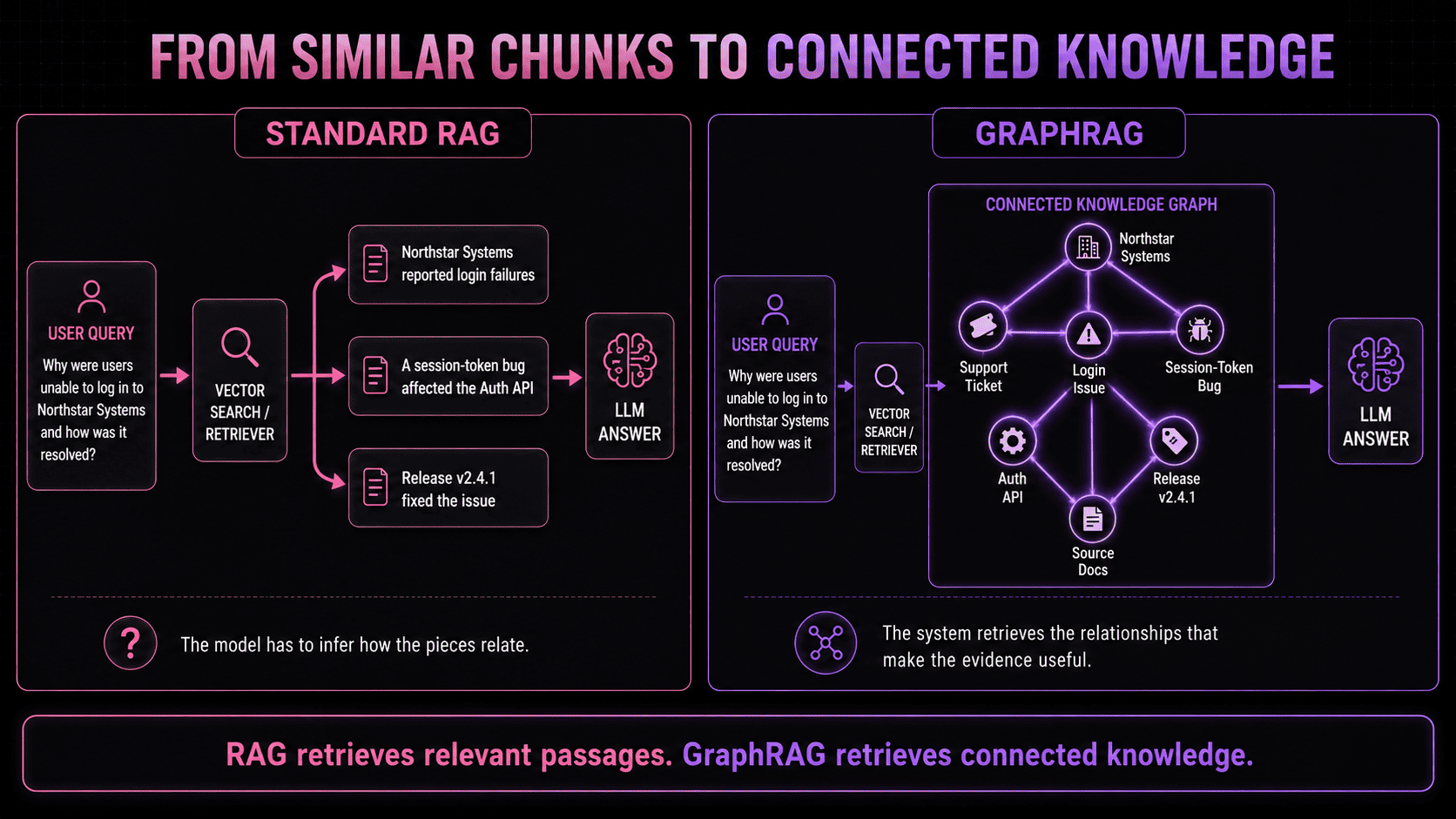
This article focuses on the graph layer: what GraphRAG is, how GraphRAG works, where local and global search fit in, and why graph-based retrieval becomes useful once chunk similarity stops cutting it.
When Chunk Retrieval Runs Out of Road
In a standard RAG system, ingested documents are chunked, embedded as vectors, and then retrieved by semantic similarity at query time. For questions that can be answered by a single clear passage, this approach is simple, fast, and effective.
But more complex queries start making the limitations of this approach apparent, and they don't have anything to do with embedding quality or chunking strategy. To illustrate simply, an entity appearing in five different documents is five separate retrievals, not one connected record — and no amount of reranking will change that.
When a question requires knowing which policy replaced another, which customers share the same bug, or what changed between two versions of the same document, a chunk retriever can fetch passages that look relevant without understanding how any of them connect. The model ends up assembling the answer from fragments, which results in:
- Entity relationships getting lost
- Duplicate or conflicting facts unreconciled
- Older and newer versions of the same information weighted the same
- Multi-hop questions falling apart because each step depends on the previous retrieval being both correct and interpretable.
GraphRAG was proposed to address this and Microsoft Research's paper laid out the rationale convincingly in 2024: relationships between facts are at least as important as the facts themselves.
During ingestion, the graph layer extracts entities — people, products, customers, documents, tickets, decisions, features, policies, events — and maps how they connect: who owns what, which document replaced another, which issue affected which customer, which feature shipped in which release. Retrieval can then follow those connections rather than treating every passage as if in a vacuum.
The LLM still writes the answer, but with GraphRAG it gets to reason over structure rather than raw text fragments.
The GraphRAG Pipeline in Detail
GraphRAG and RAG share the basic principle of retrieving relevant context before generation, but they differ in what gets retrieved and how it's organized before the model sees it.
Here are the distinctions in the main stages of the pipeline:
1) Ingestion and extraction
The system starts with the same kinds of sources — documentation, PDFs, tickets, transcripts, wikis, product records, research papers, customer notes, etc.
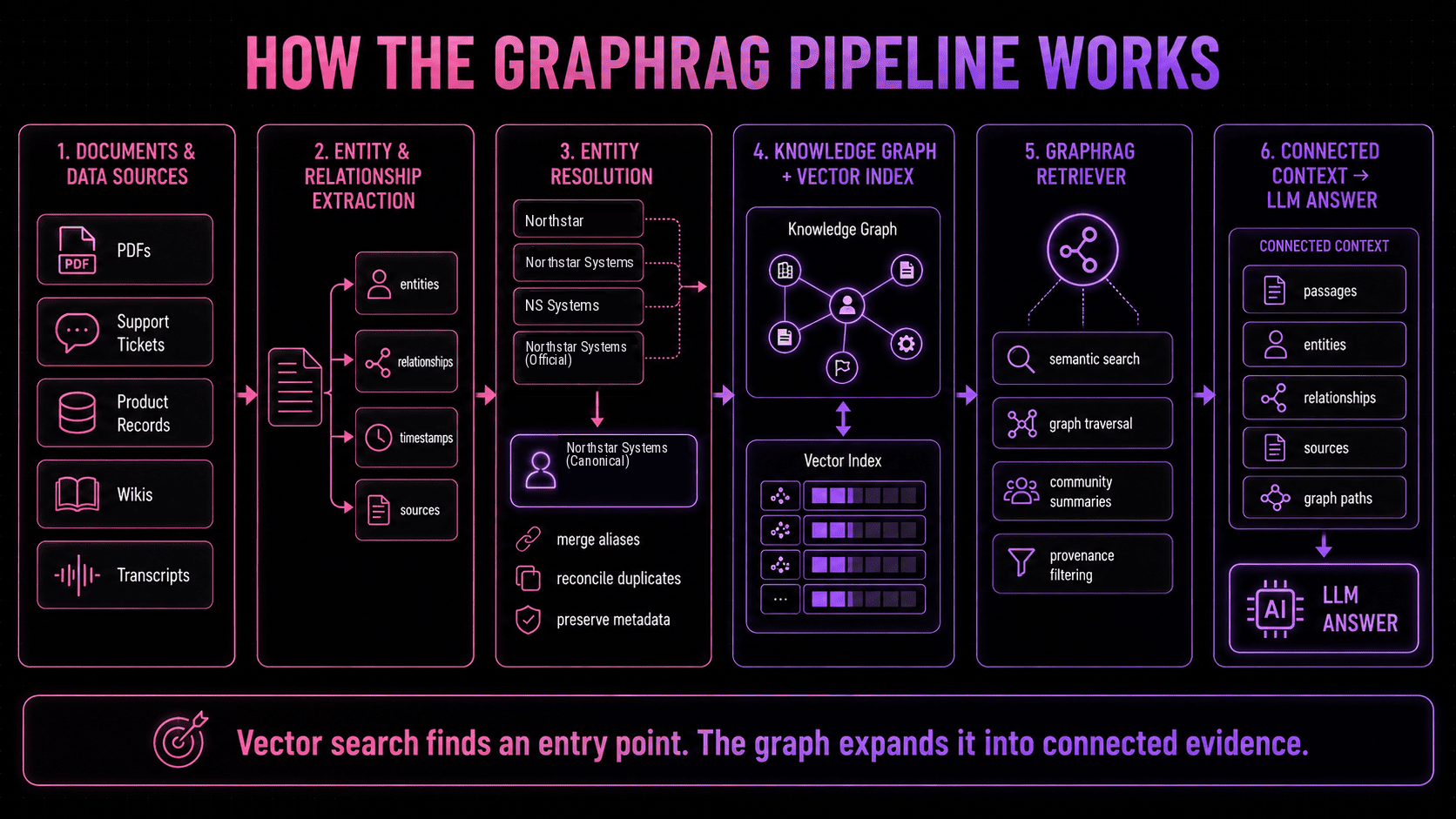
During ingestion, a GraphRAG pipeline performs an entity extraction step, identifying the meaningful data points in the source material: people, companies, customers, products, features, tickets, policies, projects, documents, events, dates, claims, decisions. These become the nodes of the graph.
Then, a relationship extraction step identifies how those entities connect — a ticket affects a customer, a policy replaces an older policy, a feature ships in a release, a document supports a claim, a bug gets fixed by a specific patch. Those connections become the edges.
Real data is messy, so a deduplication and entity resolution step tries to reconcile the same entity appearing under different names across different sources. Metadata, timestamps, source ownership, and provenance help the system decide which facts are current, which are outdated, and where each claim came from.
2) Indexing
The extracted entities and relationships go into a graph store or graph index. Text, entities, or summaries also get embedded and stored in a vector database, so the system can still use semantic search when that's the best entry point into a question.
The two structures work together: vector search finds semantically related material when the query is open-ended or conceptual, and graph traversal follows relationships when the question is specific.
The retriever decides how to combine the signals: it might use vector search to find the closest entities or passages, then expand through the graph; or start from a known entity and follow relationships outward; or retrieve summaries of graph communities when the question is broad.
The architecture as a whole looks like this:
Documents and data sources → entity and relationship extraction → knowledge graph + vector index → retriever → connected context → LLM answer
3) Retrieval and generation
At query time, the retriever assembles connected context with all the relevant chunks, entities, relationships, source references, and graph paths that explain why the information belongs together. Then, the LLM generates the answer from that structured input.
The model still interprets the question and writes the response, but with context arranged to reflect how the knowledge actually fits together rather than assembled from chunks that scored highest in cosine similarity like in baseline RAG systems.
Here's the comparison of the two approaches:
| Dimension | Baseline RAG | GraphRAG |
|---|---|---|
| Main retrieval unit | Text chunks | Entities, relationships, passages, graph neighborhoods, and summaries |
| Best for | Questions answered by one or a few clear passages | Questions that depend on connected facts across sources |
| Retrieval signal | Semantic similarity, keyword filters, metadata, reranking | Semantic similarity plus graph traversal, entity relationships, provenance, and community structure |
| Relationships | Usually implicit | Explicitly represented in the graph |
| Provenance | Often limited to chunk or document citation | Can preserve source links at the entity, claim, relationship, or document level |
| Duplicate facts | Retrieved as repeated chunks | Can be reconciled through entity resolution and source metadata |
| Time awareness | Usually handled through metadata filters | Can model versions, timestamps, events, and source relationships more directly |
| Multi-hop questions | Fragile when each step depends on another retrieved passage | Stronger when the graph already connects the relevant entities |
| Main trade-off | Simpler to build and cheaper to run | More ingestion and maintenance complexity |
This is all to say that GraphRAG isn't automatically better for every question. For a simple definition lookup from a clean documentation page, baseline RAG may be faster and just as accurate, and the graph structure doesn't add much when the answer can already be found in one clear source.
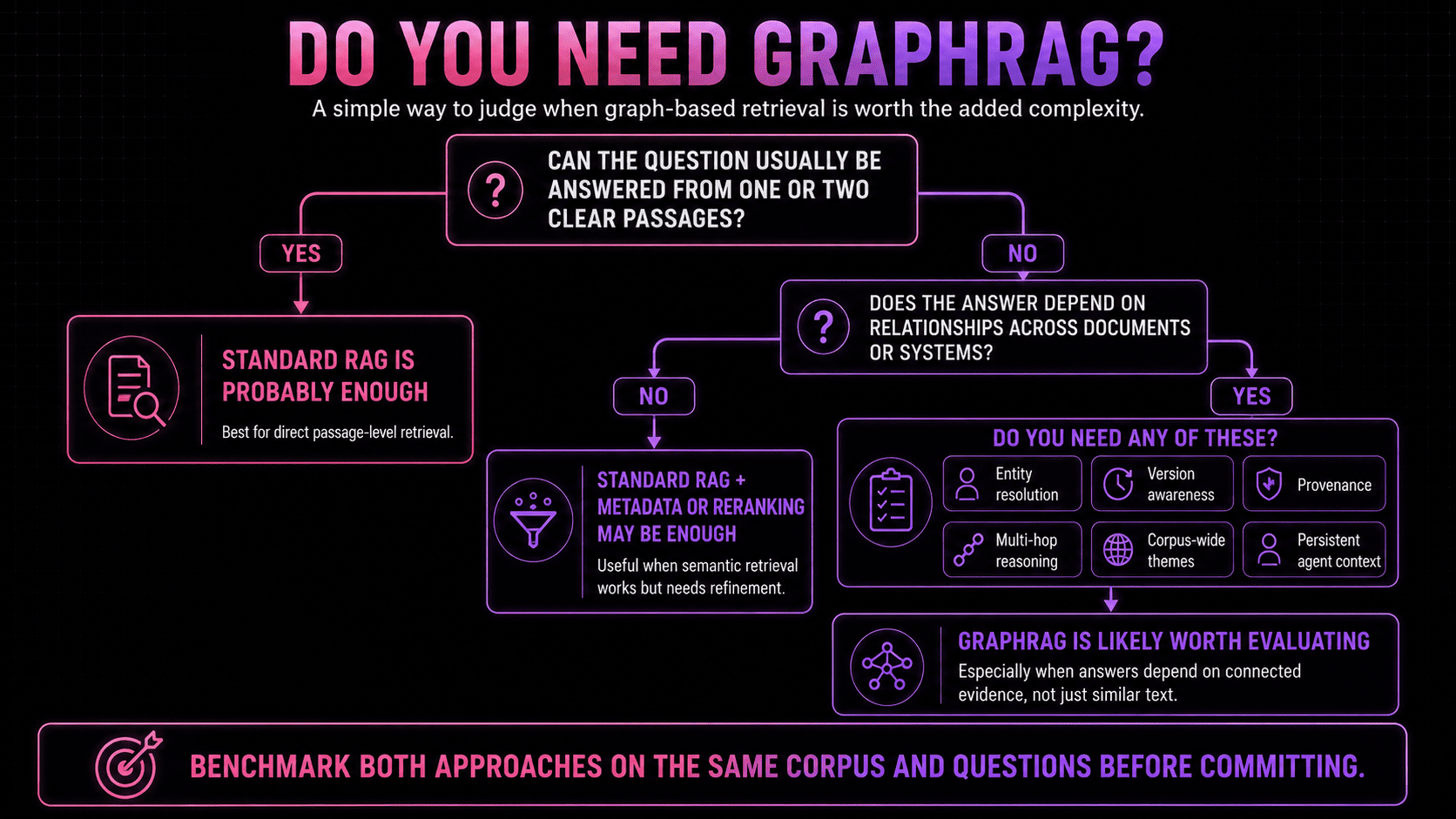
The advantage is apparent when the system needs to connect facts, though: in these cases, GraphRAG reduces how much connective work the LLM has to do on its own. It also makes the retrieval path inspectable, making it much more valuable for LLM hallucination detection.
GraphRAG Local vs Global Search
GraphRAG retrieval gives the system two ways to retrieve the right shape of context, and which one fits depends on the nature of the query.
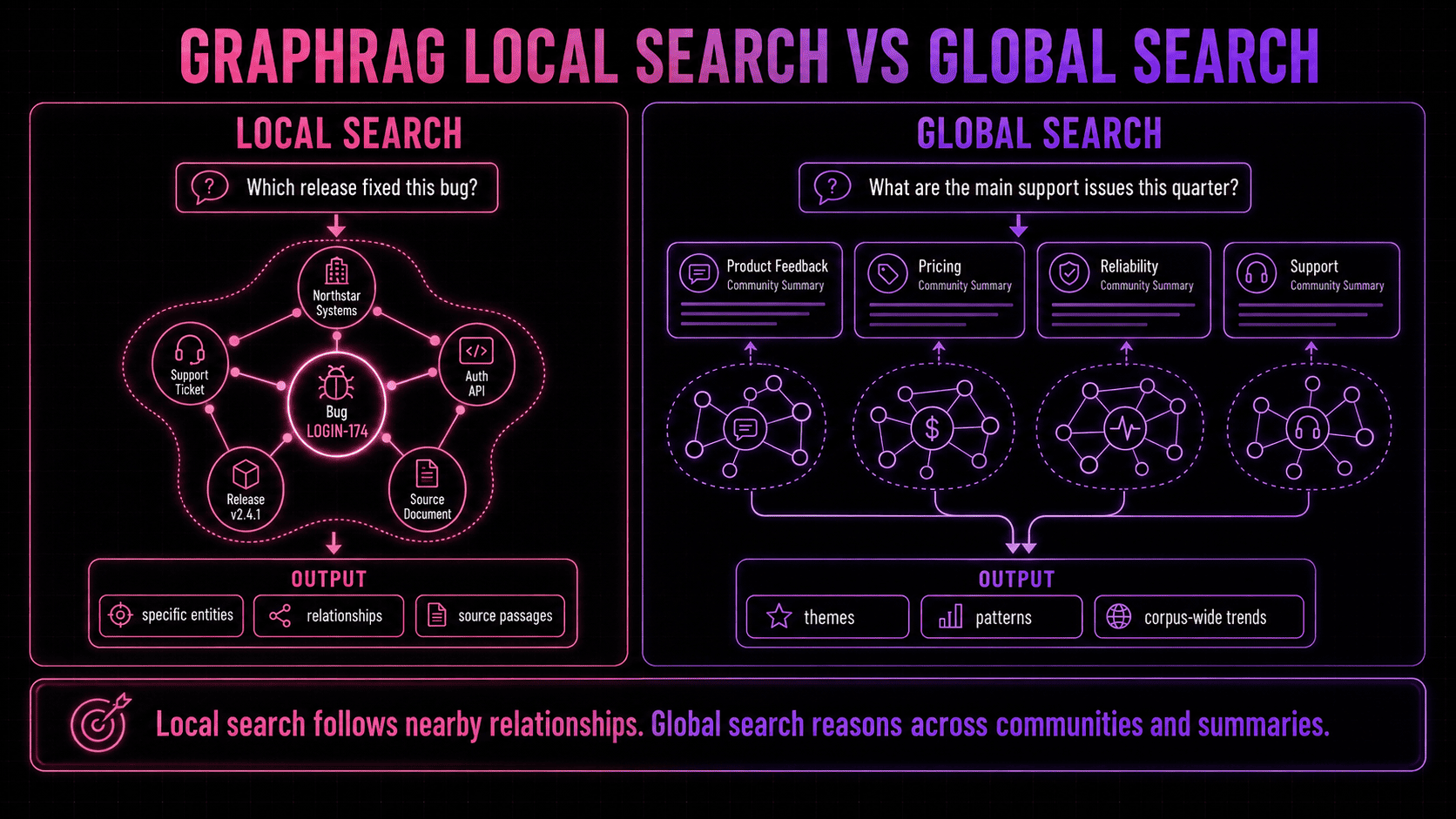
GraphRAG local search starts from a specific entity or small set of entities, then expands through nearby relationships in the graph. It's triggered for questions with a concrete starting point where the answer can be found in the surrounding neighborhood of the entity. These are questions like:
- "Which tickets are related to this customer?"
- "Which release fixed this bug?"
- "Which customers were affected by the same issue?"
- "Which documents support this claim?"
GraphRAG global search looks at broader structures like clusters, communities, themes, or summaries of related groups of entities. It's for questions that touch patterns sprawling across the whole data corpus.
In Microsoft-style GraphRAG systems, global search often works through community-level summaries, where related entities are grouped and summarized before the answer is generated. Instead of reading every document at query time, global search retrieves these summaries and reasons over them, which makes it tractable for broad questions like:
- "What are the main support issues across this quarter?"
- "Which product themes appear most often in customer feedback?"
- "What are the major risks mentioned across these reports?"
- "How has the pricing strategy changed over time?"
A system might use global search to understand the theme of a question, then local search to retrieve the specific sources that support the final answer. Or start locally, then widen if the first entity neighborhood doesn't contain enough evidence.
Common GraphRAG Use Cases
GraphRAG is most useful in workflows where the answer depends on relationships across sources:
- In customer support, GraphRAG can connect customer accounts, product documentation, support history, known issues, and source records, so answers reflect the wider context behind each request rather than a single retrieved passage.
- In internal knowledge search, it links policies, owners, decisions, projects, and related records, which helps when relevant context is spread across several systems.
- In research and analysis, the graph can map papers, authors, methods, datasets, claims, and findings, revealing which results support, contradict, or extend each other.
- In compliance, audit, and provenance-heavy workflows, GraphRAG ties claims back to sources, timestamps, owners, and related records, giving the system a clearer trail from answer to evidence.
- For agent memory, it gives structure to tasks, decisions, user preferences, sources, and outcomes, so agents can retrieve long-term context as relationships rather than flat notes.
How to Know If GraphRAG Is Actually Helping
GraphRAG should be evaluated against the question that motivated its emergence in the first place: does the graph help the system retrieve better evidence and produce better answers than baseline RAG on the questions that matter for your use case?
The most useful benchmark is a head-to-head comparison — baseline RAG versus GraphRAG on the same corpus and the same questions.
Here are some useful signals to track beyond final answer quality:
- Retrieval relevance — did the system retrieve the sources that actually answer the question, or just the most similar ones?
- Entity and relationship coverage — did it find the important connections, not just the right chunks?
- Faithfulness — is the final answer supported by the retrieved context, or did the model add something the sources don't back up?
- Multi-hop accuracy — can it answer questions that require following a chain of facts without losing the thread?
- Provenance quality — can it show which sources support the answer and why they were retrieved?
- Latency and cost — does the accuracy improvement justify the extra indexing, retrieval, and maintenance overhead?
A GraphRAG system can retrieve more context and still fail if the graph is noisy, if entity resolution merges things that should stay separate, or if retrieval expands too far from the original question. It's worth running a knowledge graph memory benchmark rather than assuming graph-backed retrieval will automatically outperform chunk retrieval.
Relationship-Aware Retrieval With cognee
Most retrieval failures in production aren't search failures — the system found something relevant, it just didn't know how the pieces connected. When the answer depends on entities, sources, timestamps, and relationships across documents, a list of similar passages isn't enough. The retrieval layer has to carry that structure before the model writes anything.
We built cognee as an open-source memory engine that addresses problem. cognee turns documents and data sources into graph-backed AI memory — extracting entities and relationships, organizing them into a knowledge graph, embedding them for vector search, and keeping every retrieved fact tied to where it came from.
That gives the model connected, source-aware knowledge that already reflects how the facts relate to each other. Vector search provides the semantic reach, the graph provides the structure, and provenance makes the retrieval path something you can actually inspect when an answer needs to be checked.
GraphRAG doesn't make every answer correct — no retrieval architecture does. What it does is give the system better evidence to work from, which makes answers more reliable, more traceable, and easier to verify. That's the bit cognee is designed for.
FAQ
When should you use GraphRAG instead of standard RAG?
When the answer depends on how facts connect rather than where they appear. If questions typically sound like "find the section that says X," standard RAG is usually enough. If they sound like "which entities are related to this one," "what changed between these two versions," or "which source is current," a graph layer earns its complexity.
Does GraphRAG require a knowledge graph database?
Not necessarily, but it does require graph structure somewhere in the retrieval system. Some implementations use a dedicated graph database; others store relationships in Postgres or a hybrid retrieval layer. What matters is that entities and relationships are represented explicitly enough for retrieval to follow connections rather than relying only on vector similarity.
Does GraphRAG still use embeddings?
Yes, in most practical implementations. Vector search and graph traversal work together rather than replacing each other — vector search finds a useful entry point, graph traversal expands from that point through entities, relationships, and provenance. Choosing between them as if they're alternatives usually produces a weaker system than combining both.
What kind of data works best with GraphRAG?
Data that contains meaningful entities and relationships: support tickets, product documentation, changelogs, customer records, research papers, legal documents, policy libraries, meeting notes, project records. The more the answer depends on who, what, when, where, and how things connect, the more useful the graph becomes. For small, clean document sets where most questions can be answered from one paragraph, standard RAG is probably enough.
What makes a GraphRAG system hard to build?
The hard part isn't storing the graph — it's making it accurate enough to trust. Entity extraction can miss important objects. Entity resolution can merge things that should stay separate. Relationship extraction can produce noisy or vague edges. If the ingestion pipeline is weak, the graph gives retrieval more structure without giving it better evidence, which can make answers worse rather than better. Good GraphRAG needs ingestion, extraction, validation, retrieval, and evaluation working together.
Can GraphRAG reduce hallucinations?
It can reduce some hallucination risks caused by missing relationships, weak provenance, duplicate facts, outdated sources, or multi-hop retrieval errors, which covers a significant portion of production failures in knowledge-intensive systems. But it's not a complete LLM hallucination solution — detection and groundedness checks are still needed since the model can still misread context or overstate a claim even with good retrieval.
Is GraphRAG the same as agent memory?
They overlap but aren't the same thing. GraphRAG is a retrieval architecture — a way of organizing and querying knowledge. Agent memory is the broader system that lets an agent retain useful context across sessions, tasks, users, and decisions, including update rules, forgetting, feedback, and permissions. A graph-based memory system will often use GraphRAG-style retrieval as its recall mechanism, but memory requires more than retrieval: it needs to know what to keep, what to update, and what to let go. For agents specifically, the graph is useful because memory is rarely just a flat list of notes — it's a web of decisions, sources, preferences, tasks, and outcomes that needs structure to be useful later.