What Is an AI Knowledge Graph? Entities, Relationships, and Use Cases Explained

A knowledge graph in AI is a structured network of entities, relationships, and source-linked facts that helps AI systems understand how information connects rather than just register and store what it contains.
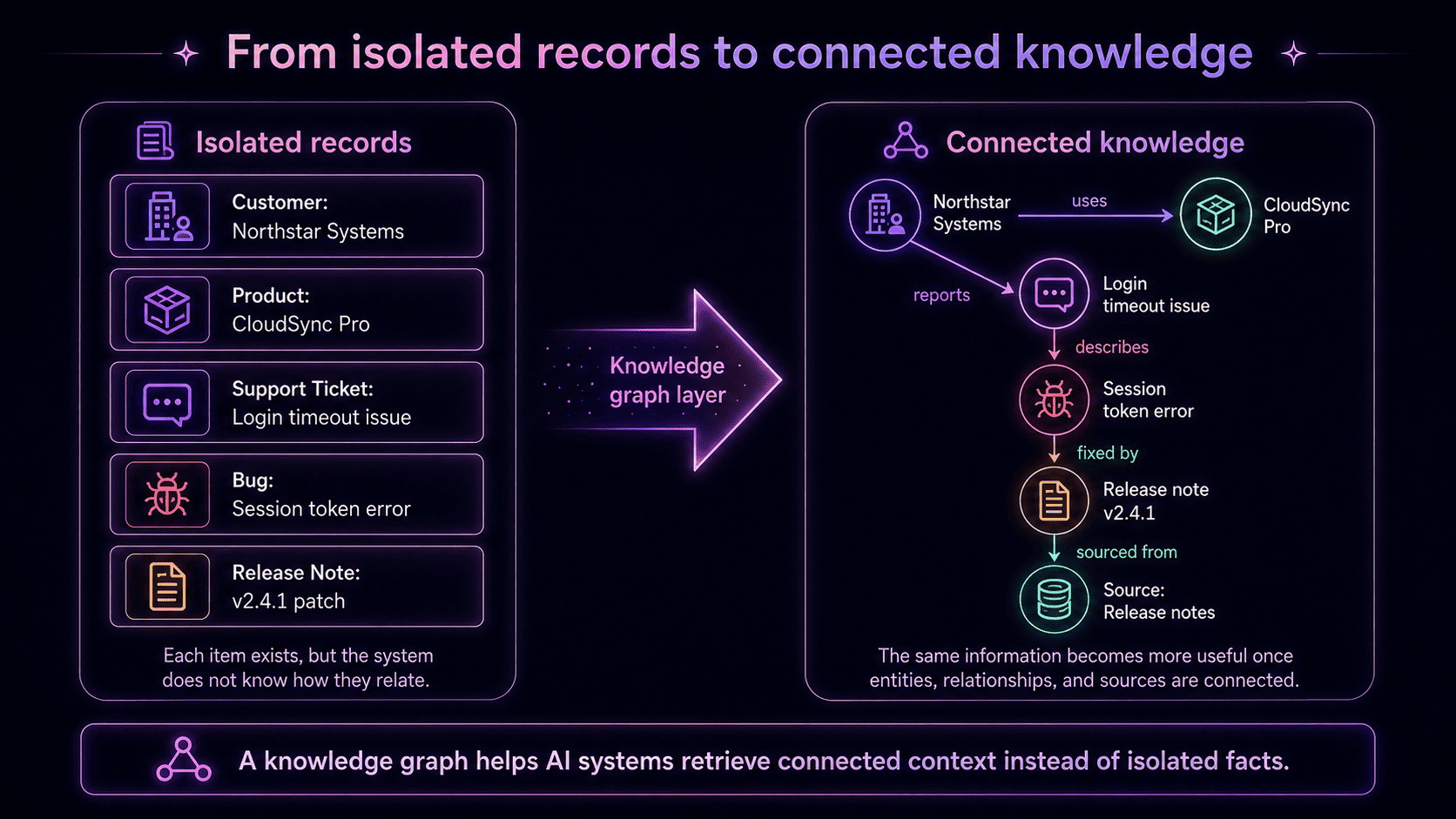
A conventional database can record that a customer, a product, a support ticket, and a release document all exist. An AI knowledge graph, on the other hand, represents which customer owns which product, which ticket describes a known issue, which later release fixed it, and which release note is the source behind that claim.
Most AI tasks depend on interconnected context, and a search system needs to know which entity a query actually refers to. A question-answering system has to connect information across sources, a generative AI application needs evidence it can trace back to something real, and an agent needs memory that preserves the relationships between users, tasks, decisions, and outcomes.
A knowledge graph gives those systems a semantic layer over their data — it captures what that information represents, how the pieces relate, and where each fact came from.
This guide covers how AI knowledge graphs work, what their main components are, how they get built from structured and unstructured data, and why they've become central to search, generative AI grounding, GraphRAG, and agent memory.
What Is a Knowledge Graph in AI?
An AI knowledge graph is a network of entities (nodes) and the relationships (edges) between them.
- Entities can be people, companies, products, documents, policies, events, concepts, research papers, customer accounts, or any other object that matters within a domain.
- Relationships describe how those entities connect: a person works for a company, a research paper uses a particular dataset, a product issue affects several customers and gets resolved by a specific release.
Together, entities and relationships form a semantic network that both machines and people can query.
What makes an AI knowledge graph more useful than a simple network diagram is the structure layered around those connections. Entities have types and properties, and relationships carry direction and meaning.
Individual facts can carry timestamps, confidence scores, and ownership information, and an ontology defines which entities and relationships are actually valid within the domain — context that gives machine learning and generative AI systems something static records never could.
Semantic search might retrieve several passages that mention the same product issue, but a flat retrieval system has no way to know they're related. The knowledge graph can show that those passages refer to one shared bug, that the bug affected three customer accounts, that a particular patch resolved it, and that a newer release note supersedes an older workaround — shifting the system's perspective from "these pieces of text look similar" to "these pieces of information describe the same connected situation."
Knowledge graphs can be purposefully integrated into:
- search systems that need to interpret entities and relationships
- question answering that depends on facts spread across several sources
- recommendation systems that model users, items, attributes, and behavior
- generative AI systems that need grounded, source-aware context
- AI agents that need persistent memory across tasks and sessions
The Core Components of an AI Knowledge Graph
These are the layers an AI knowledge graph is built from:
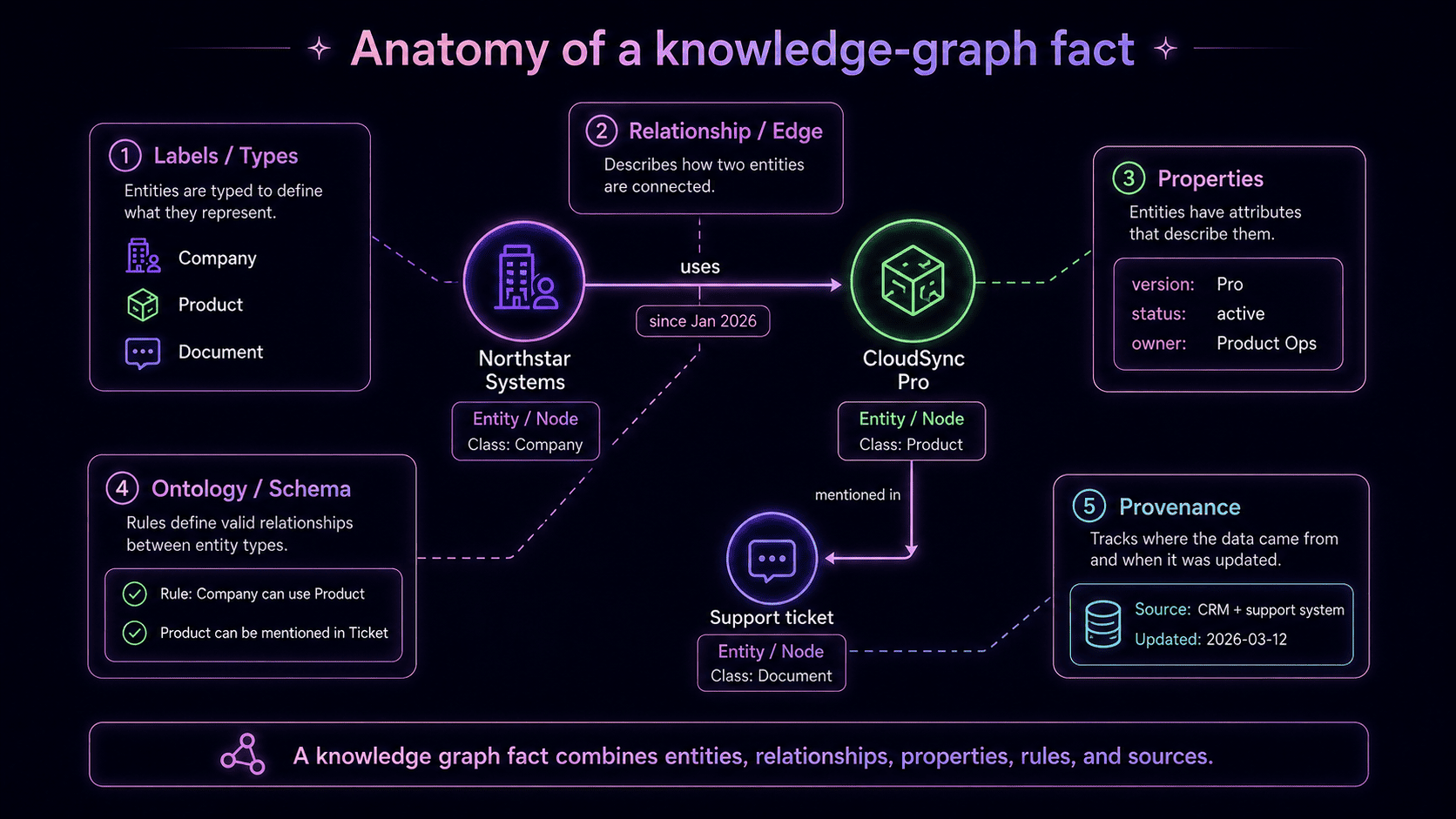
| Component | What it represents | Example |
|---|---|---|
| Node or entity | A person, place, object, concept, document, or event | Customer, product, policy, research paper |
| Edge or relationship | A typed connection between two entities | owns, replaces, supports, affected_by |
| Label or class | The category an entity or relationship belongs to | Person, Company, Product, Document |
| Property | An attribute attached to a node or edge | Status, date, title, confidence score |
| Ontology or schema | The rules defining valid concepts and relationships | A Person may work_at a Company |
| Provenance | Where a fact came from and when it was recorded | Source document, author, timestamp |
| Embedding | A vector representation used for semantic similarity | An embedded document, entity, or claim |
Nodes and entities
In a customer-support graph, nodes might include customers, products, tickets, bugs, releases, and help articles. In a research graph, they might include papers, authors, methods, datasets, experiments, and findings.
Entity extraction identifies those objects in the source data so the graph can represent them consistently.
Edges and relationships
Edges explain how the nodes connect. A ticket might report a bug, that bug affects a product, a release resolves it, and a document supports the claim that ties it all together.
These relationships are what give the graph its value, letting an AI system follow a path across several pieces of information instead of retrieving each one separately.
Labels, types, and properties
Labels classify entities and relationships, while properties add descriptive detail.
A node might be labeled Product and include properties such as its name, current version, status, and owner. A relationship might be labeled replaces and include the date it became valid.
This helps the system distinguish between things that look similar in text but play different roles.
Ontologies and schemas
An ontology defines the concepts, categories, and relationships that are meaningful within a domain. It can specify that a Person can work_at a Company, that a Policy can replace another Policy, or that a ResearchPaper can use a Dataset.
Ontologies give domain knowledge a consistent structure, and they help validate extracted facts, reduce ambiguity, and keep the graph from turning into a mess of nodes and edges.
Provenance and timestamps
Provenance records where a fact came from; timestamps record when it was true, created, updated, or superseded.
Generative AI depends on both. A model might retrieve a fact that used to be true but no longer is, or run into two sources that disagree — provenance and timestamps let the retrieval layer figure out which source to trust. They also make the result easier to check: instead of presenting a claim in a vacuum, the system can point to the document, record, or event that backs it up.
Vector embeddings
Embedding data in a vector database helps the system find semantically related entities, documents, or claims even when the wording differs, and the graph adds explicit relationships and domain structure around whatever comes back.
Using vector embeddings alongside graph structure equips the system with both the breadth of semantic search and the precision of graph traversal. Vector search finds what's similar and the knowledge graph shows how it connects.
How an AI Knowledge Graph Is Created
An AI knowledge graph usually starts with data that was never designed to fit together.
Some of it is structured, like CRM records, product tables, support tickets, transaction logs, and database exports. Much of it is unstructured — PDFs, emails, meeting notes, research papers, policy documents, knowledge base articles — and needs processing before it's useful.
The job of the pipeline is to turn that mixture into a consistent, reliable, trustworthy network of entities, relationships, and source-linked facts.
Here's how:
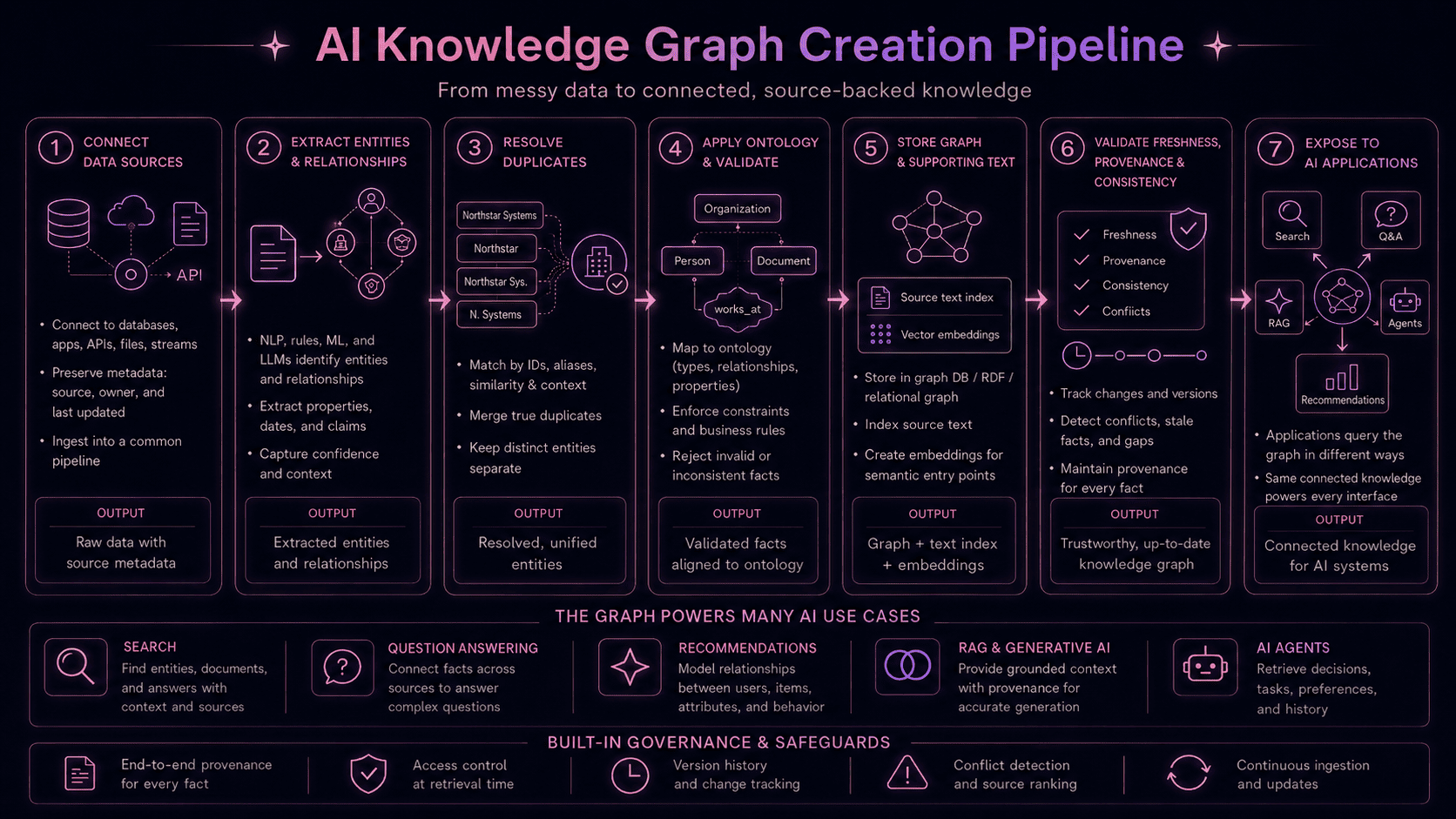
1. Connecting the data sources
The first step is data integration. The system connects to whatever enterprise data should feed the graph — databases, document stores, cloud drives, APIs, event streams, internal applications — and maps each source into a common ingestion pipeline.
The aim at this stage isn't to force sources into a rigid schema but to preserve enough metadata to know what each record is, where it came from, who owns it, and when it was last updated.
2. Extracting entities and relationships
Structured sources often already contain explicit entities and relationships. Unstructured text usually doesn't — natural language processing, rules, machine learning algorithms, and LLM-based extraction can identify the important objects in the text and the relationships between them.
Extraction quality has a major effect on graph quality, since every error here becomes a graph error — a missing entity breaks useful connections, a vague relationship adds noise, and a wrongly extracted date can make an outdated fact look current again.
3. Resolving duplicate entities
The same real-world entity often appears under several names — entity resolution decides whether those mentions refer to the same object. This can involve exact identifiers, aliases, metadata, similarity models, surrounding context, and domain-specific rules, with the goal being to merge true duplicates without collapsing different entities that only look similar.
Entity resolution is one of the most consequential aspects of a reliable AI knowledge graph — split one entity into several nodes and retrieval becomes fragmented; merge unrelated entities and the system starts connecting facts that should've stayed separate.
4. Applying domain knowledge through an ontology
An ontology defines the entity types, relationship types, properties, and constraints that matter within the domain. A healthcare graph, financial graph, and product-support graph may all contain people and documents, but the valid relationships between those entities will differ.
Applying an ontology helps the system normalize extracted facts and reject combinations that don't make sense, and it makes the graph easier to query since the same concepts are represented consistently across sources.
5. Storing the graph and supporting text
Once the entities and relationships are validated, they can be stored in a graph database, an RDF (Resource Description Framework) store, a relational system with graph support, or another graph index.
The source text is often stored or indexed alongside the graph, so the system can retrieve the original passage behind an entity, relationship, or claim.
Many implementations also create vector embeddings for documents, entities, summaries, or individual claims, giving the system a semantic entry point into the graph when a user's wording doesn't match the stored terminology exactly.
6. Validating freshness, provenance, and consistency
A knowledge graph has to change as its sources change. New records need ingesting, old facts need superseding, conflicting claims need flagging or ranking by authority, and the ontology itself may need to evolve as the domain changes.
Validation checks help identify missing relationships, duplicated nodes, unsupported claims, stale sources, and broken provenance links. Skipping this layer makes the graph less trustworthy while still being technically queryable.
7. Exposing the graph to AI applications
The finished graph can support search engines, question-answering systems, recommendation tools, analytics, RAG pipelines, and AI agents.
Different applications query it differently — a search system ranks entities and documents, a recommendation engine follows user-item relationships, and an agent retrieves the decisions, tasks, and preferences relevant to whatever it's about to do next. The graph provides the same connected knowledge underneath each of those interfaces.
What Knowledge Graphs Give AI Systems
A knowledge graph gives an AI system a model of how information relates, changing what search, question answering, and reasoning can actually do with the data. These are some of the benefits systems can reap from incorporating graph technology:
- Better contextual understanding. A graph connects mentions of the same entity across different files, distinguishes current information from outdated versions, and links related records, so the system can have a rich interpretation of the context.
- More precise search. Beyond keyword and semantic matching, graph paths let a search engine recognize what a query actually refers to and rank results by how directly they connect to it.
- Multi-hop question answering. Many answers require connecting several records in sequence — customer to account, account to product, product to issue. A graph represents that chain explicitly and can expose the retrieval path behind an answer.
- Relationship-aware reasoning. Because relationships are represented explicitly, the system can follow paths across several records and surface connections that no single document states on its own.
- Explainability. Retrieval paths become inspectable. When the system recommends, flags, or answers something, the graph shows which relationships and sources led there.
- Recommendations and discovery. Modeling relationships between users, items, and behavior directly supports recommendations, and the same structure helps surface non-obvious connections in research, product development, and fraud analysis.
Knowledge Graphs and Generative AI
Large language models generate answers from patterns learned during training and whatever context they receive at query time. A knowledge graph gives that context structure.
Instead of passing the model a loose assortment of documents, the retrieval layer can provide entities, relationships, source records, timestamps, and the connections derived from the data. The model still writes the response, but it works from evidence that's already been organized around the question.
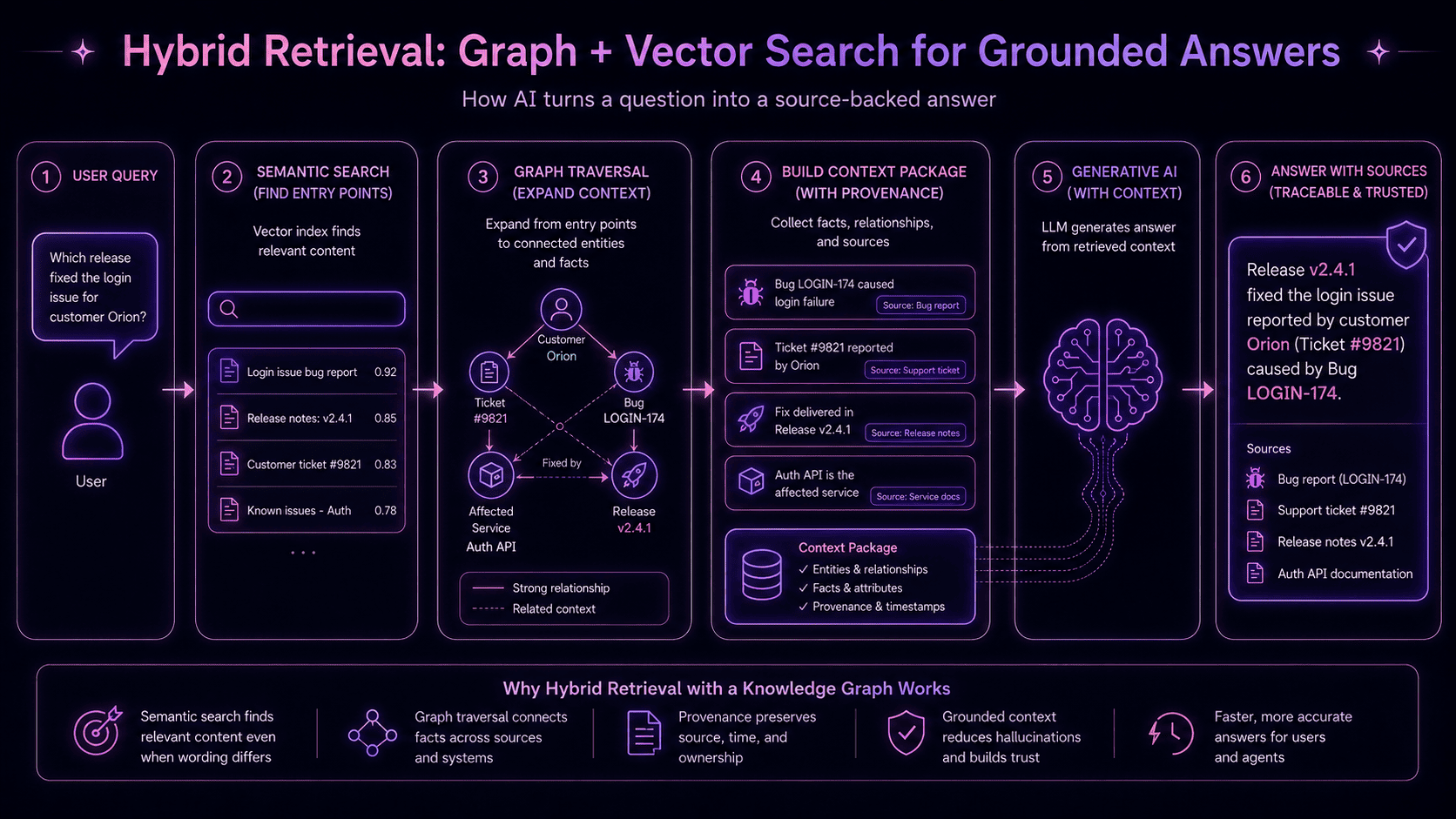
Retrieval-augmented generation is the clearest example. Standard RAG retrieves passages by semantic similarity alone; adding a knowledge graph enables the system to pull the facts surrounding an entity, not just the chunks that happen to resemble the query.
GraphRAG extends this further by combining graph traversal with vector search. Semantic retrieval can find a useful entry point, and the graph then expands the search to related entities, documents, events, and claims.
Grounding LLM outputs (Reducing hallucinations)
For generative AI, a knowledge graph can provide grounded facts that a retrieval or validation layer can compare with the model's claims. Provenance shows where the fact came from, and timestamps or version history help distinguish current from outdated information.
It's not a complete LLM hallucination solution, but it gives hallucination detection better evidence to work with — unsupported claims are much easier to flag when the expected facts and sources are already laid out explicitly.
External memory for AI agents
Knowledge graphs can also provide persistent context that lives outside the model's context window.
If an agent stores records of which user made a request, which decision followed, what source informed it, and how the outcome changed the next task as isolated messages, retrieval becomes unscalable as that history grows. Stored as entities and relationships, however, it becomes long term AI memory the agent can query later.
The model handles language and reasoning, while the knowledge graph holds onto the domain knowledge, evidence, and history that need to stick around between interactions.
AI Knowledge Graph Use Cases
Knowledge graphs appear across more and more AI systems as the queries demonstrate that the relationships between facts are as valuable as the facts themselves:
- Search engines use entity-oriented knowledge to tell apart people, places, organizations, products, and concepts that share similar names. Google's Knowledge Graph — the entity graph powering the summary panel that appears next to search results for a person, company, or landmark — is likely the most visible example.
- Question-answering systems and virtual assistants use knowledge graphs to retrieve facts from several sources and follow the relationships between them when an answer depends on more than one record or requires picking the right version of a fact.
- Recommendation systems model relationships among users, products, categories, attributes, and behavior, suggesting relevant options through shared characteristics and interaction patterns.
- Fraud and risk systems trace connections among accounts, devices, payments, identities, and events. Suspicious activity often only becomes visible once several independently observed ordinary records get patternized into a connected network.
- Research and discovery tools rely on graphs to connect papers, authors, methods, datasets, citations, and findings, which researchers can use to find related work, trace how a result was produced, or spot findings that support or contradict one another.
- Enterprise search and internal assistants unify policies, documents, owners, projects, decisions, and source systems into a graph from which the application can retrieve the current record along with the context that explains how it relates to the question.
- AI agents use graph-backed memory to preserve relationships among users, tasks, tools, preferences, decisions, and outcomes, giving the agent persistent context it can reuse across sessions instead of having to reconstruct the same history from transcripts every time.
Knowledge Graph vs Graph Database, Vector Database, and Knowledge Base
An AI knowledge graph is sometimes conflated with graph databases, vector databases, and knowledge bases, but all these terms describe different layers of a system.
A knowledge graph is a semantic representation of entities, relationships, properties, and source-linked facts. It describes what the information means and how the pieces connect.
A graph database is technology for storing and querying graph-shaped data. It can host a knowledge graph, but not every graph database contains the ontology, provenance, and semantic structure that would make the data a knowledge graph.
A vector database stores data embeddings and retrieves items by similarity — useful whenever the system needs to find text, images, or records with related meaning, even if the wording is completely different.
A knowledge base is a managed body of information designed for reuse — documents, policies, FAQs, structured records, workflows, or machine-readable data — and a knowledge graph can serve as part of its underlying structure. An AI knowledge base uses retrieval to make information available to models and agents, often adding embeddings or a graph layer to improve how that information is found and connected.
| System | Main purpose | What it represents well | Common limitation |
|---|---|---|---|
| Knowledge graph | Organize knowledge as entities, relationships, semantics, and provenance | Connected facts, domain context, multi-hop paths, source trails | Requires modeling, extraction, and ongoing quality control |
| Graph database | Store and query graph-shaped data | Traversals, network structure, highly connected records | Does not provide domain meaning or governance by itself |
| Vector database | Retrieve semantically similar items | Fuzzy meaning, unstructured content, nearest-neighbor search | Relationships are usually implicit rather than modeled directly |
| Relational database | Store structured operational data | Transactions, constraints, tabular records, mature SQL workflows | Connected queries can become harder to manage as relationships grow |
| Knowledge base | Make information available for search, support, or reuse | Curated documents, policies, records, and organizational knowledge | Quality depends on how content is structured, maintained, and retrieved |
These systems often work together. A relational database might remain the source of truth for transactions, a vector index makes documents searchable by meaning, a graph layer connects the relevant entities and preserves how they relate, and a knowledge base exposes all of it through search, an assistant, or an agent.
The choice usually isn't "graph or vector" or "knowledge graph or database" — many production AI systems combine them. Vector search gives retrieval semantic breadth, the knowledge graph adds explicit relationships and provenance on top of it, and the source database keeps the underlying operational records consistent. The application layer decides which of those signals matters most for a given query.
How to Plan and Govern an AI Knowledge Graph
Building an AI knowledge graph starts with the questions the system needs to answer — a narrow, well-defined graph that supports real queries is more useful than a large graph built without a clear retrieval or reasoning goal. Here's how to do it:
1. Start with the intended questions
Define the decisions, searches, recommendations, or agent actions the graph should support. For example, a support assistant might need customers, products, tickets, bugs, releases, and documentation, while a research system needs papers, authors, methods, datasets, findings, and citations.
Once the graph is running, you can evaluate whether it actually retrieves the entities, relationships, and sources needed to answer them.
2. Select and map the source data
Inventory the structured and unstructured sources that contain the relevant domain knowledge.
For each source, record:
- what kind of information it contains
- who owns it
- how often it changes
- which identifiers can support entity resolution
- what permissions apply
- whether it should be treated as authoritative
3. Build a minimum viable ontology
The first ontology doesn't need to model the entire organization.
Start with the entity types, relationships, and properties the initial queries actually need, then expand as retrieval patterns in practice reveal missing concepts or distinctions.
A smaller ontology is easier to validate, and it shrinks the risk of vague relationship types that add complexity without actually improving search or reasoning.
4. Invest in entity resolution
Entity resolution deserves separate attention because errors here spread through the whole graph.
The pipeline should combine stable identifiers, aliases, metadata, context, and domain rules to determine when two mentions refer to the same real-world entity.
Automatic matching should also expose its own uncertainty — low-confidence merges are usually safer to flag for review than to accept silently, especially once the graph starts feeding decisions or agent actions.
5. Preserve provenance and version history
Useful provenance includes the document, record, author, system, extraction time, and source location, and version information should show whether a fact is current, superseded, disputed, or only valid during a particular window.
The value of provenance and versioning becomes clear when two sources disagree, or when a previously correct fact changes without anyone updating the graph.
6. Apply access control during retrieval
A knowledge graph may connect information from several systems with different permission models. Those permissions need to carry into the graph and get enforced at retrieval time — an agent shouldn't gain access to a restricted fact just because it's connected to an entity it's allowed to see.
Access control can operate at the level of documents, nodes, relationships, properties, tenants, or graph subspaces depending on the application.
7. Monitor graph quality
To keep the graph useful, quality checks should look for:
- duplicate or fragmented entities
- unsupported relationships
- missing provenance
- stale facts
- conflicting sources
- orphaned nodes
- changes in ontology coverage
- retrieval paths that repeatedly lead to weak answers
Usage data can also unearth repeated failures on important queries, which tend to point to something like a missing entity type, a weak relationship, an ingestion gap, or an ontology that doesn't align with how people actually ask questions.
8. Evaluate the applications built on top
Graph quality should ultimately be measured through the systems using it. Search needs measuring retrieval relevance and source coverage; question answering needs tracking faithfulness and multi-hop accuracy; generative AI needs a check on whether claims are actually backed by the retrieved evidence; and agents need evaluation of whether memory updates, corrections, and later recall behave the way they're supposed to.
Evaluating and maintaining the graph keeps it useful as the sources, domain, and AI applications change.
Knowledge Graphs and AI Memory With cognee
With cognee, the knowledge graph is already part of the memory layer.
Add documents and data sources, and cognee extracts entities and relationships from them, organizes them through an ontology, creates vector representations, and preserves provenance — no need to assemble a separate extraction pipeline, graph layer, vector index, and retrieval system before your agents can work with connected knowledge.
That combination gives AI applications several ways to reach the same information. Vector search can find relevant material even when the wording differs, the graph preserves how the underlying entities and facts relate, and provenance makes the resulting context easier to inspect and verify.
For agents, this turns accumulated information into persistent memory they can return to across sessions. Instead of searching through an ever-growing collection of notes or repeatedly reconstructing context from transcripts, they can retrieve the facts, relationships, decisions, and sources relevant to the task in front of them.
FAQ
Answers to the most common questions from this guide.
What is the difference between a knowledge graph and an ontology?
An ontology defines the concepts, categories, relationships, and rules valid within a domain. A knowledge graph contains the actual entities and facts organized according to that structure. The ontology might define that a Person can work_at a Company; the knowledge graph records that a specific person works at a specific company.
Can a knowledge graph be built from unstructured text?
Yes. Natural language processing and LLM-based extraction can identify entities, relationships, dates, and claims in documents, emails, transcripts, and other unstructured sources. The extracted information still needs validation, entity resolution, provenance, and an ontology to keep the resulting graph consistent.
Do knowledge graphs train AI models?
Knowledge graphs can contribute to model training, but they're more commonly used as an external knowledge layer. An AI application queries the graph at runtime and places the relevant facts into the model's context, which lets the underlying knowledge change without retraining the model every time a document, policy, or record is updated.
When is a vector database enough without a knowledge graph?
A vector database is often enough when most questions can be answered by retrieving one or a few semantically similar passages; a knowledge graph earns its keep once answers depend on relationships across sources, entity resolution, provenance, version history, or multi-hop reasoning.
Can knowledge graphs reduce AI hallucinations?
They can, by giving the model structured, source-aware context that makes unsupported claims easier to flag — see the grounding section above for how that works in practice. They don't guarantee correct answers on their own; retrieval quality, source freshness, and prompt design still matter.
What tools are commonly used to build an AI knowledge graph?
Building one usually means combining a graph database or graph-capable storage layer, an entity and relationship extraction pipeline (often LLM-based), a vector index for semantic retrieval, and an ontology to keep extracted facts consistent. Open-source memory engines like cognee bundle several of these pieces together instead of making you assemble each one separately.
Are knowledge graphs only useful for large organizations?
No. A smaller application may benefit from a knowledge graph whenever its important information is highly connected. The deciding factor is usually the shape of the questions — if the system needs to understand how people, documents, products, events, or decisions relate, graph structure can be useful even when the overall dataset is modest.